

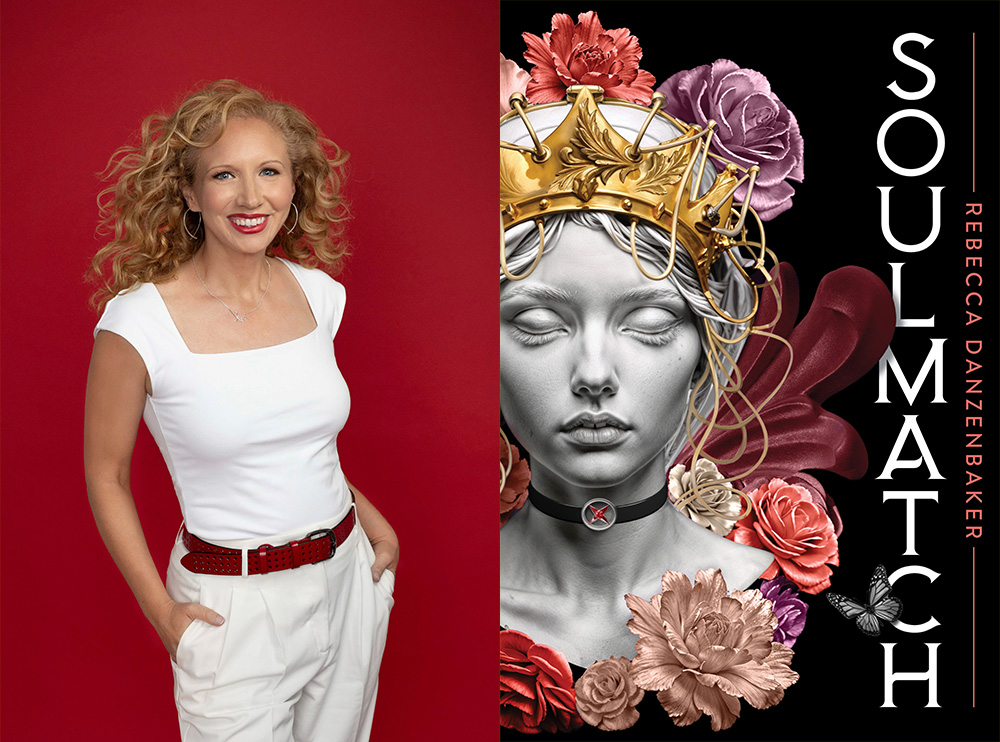
Guest post written by Soulmatch author Rebecca Danzenbaker
Rebecca Danzenbaker believes in trusting your gut and chasing your dreams. That probably explains her massive career jumps—from teaching elementary school music, to managing a team of twenty-five at Congressional Quarterly, to running an award-winning photography business, to writing young adult novels. When she’s not editing words or photos, she’s either reading, hiking, sending memes to friends, volunteering, planning incredibly detailed travel itineraries, being a goofball on social media, or cheering on her husband and two children as they chase their own dreams. Soulmatch is her debut novel, the culmination of five years of blood, sweat, and tears. She did it!
About Soulmatch (out 29 July): In a world where past lives determine your future, a sharp-witted girl confronts a major twist of destiny, embroiling her in a high-stakes game of danger, corruption, and heartbreak in this young adult speculative romance perfect for fans of Scythe and Matched.
We could be on the cusp of learning who we were in our past lives. As far-fetched as that may sound, the theory is actually rooted in scientific research dating back to the nineteenth century, and the basis of my debut novel, Soulmatch.
In 2010, I was driving past a cemetery and randomly wondered if my former self was buried there. Maybe I was a boy in my last life. Maybe we shared the same talents. Maybe someday we’ll have the technology to find out who we were. How would that knowledge change who we are?
Seemed like a fun premise for a novel. But in 2010, I had no clue how to even begin crafting a novel. I also worked full-time, had two toddlers, and was building a portrait photography business. As much as I loved the concept, “writing the novel someday” became part of my far-off retirement plans, something I would do when I finally had the time.
But I couldn’t shake the idea, so over the following decade, I occasionally brainstormed how proof of reincarnation would transform our world. I made notes on everything from the potential effects on religions and nationalism to how we handled loss. If we knew we would be reborn, we’d no longer pass our inheritances to our kids, but to our next lives. We’d need new infrastructure to ensure money went into the right hands. What else would we want to share with our next lives? What would we want to hide?
When the COVID shutdown happened, I not only found myself with the time to begin my writing journey but also a desperate need for a diversion from our new, uncertain reality. So I took an online writing workshop, sketched out a rough outline, and began researching.
My favorite dystopian novels are ones that feel eerily possible, even inevitable. As we’ve experienced many times in our own lifetimes, a shift in political power, a natural disaster, or the evolution of technology can usher in new eras humanity must adapt to. To root Soulmatch in real-world scientific research and methodology, I turned to Google.

The wealth of history I found sent chills down my spine. Since the mid-eighteen hundreds, scientists have studied the electromagnetic energy humans emit and attempted to photograph them. In 1896, Dr. Hippolyte Baraduc, first published The Human Soul: Its Movements, Its Lights, and the Iconography of the Fluidic Invisible, in which he shares photographs of human emotions and the soul. His image of a hand using Yakov Narkevich-Iodko’s method of electromagnetic stimulation, is exactly how I described human souls in Soulmatch.
In the 1930s and 40s, inventor Semyon Kirlian created a methodology for photographing plant and human auras. The process he used for his Kirlian photography inspired how eighteen-year-olds in Soulmatch learn about their past lives. In fact, his work, combined with improved camera resolution, is credited in the novel as the origin of soul identification, so much so that the fictional government institute is named after him. Welcome to the Semyon Kirlian Institute, everyone! Or as the cool kids call it—SKI.

The next challenge was to make the process of “kirling”—the matching of souls from a former life to a current one—so advantageous that everyone would want to do it. If your soul can be born into any body, anywhere on Earth, we’d need worldwide buy-in for accuracy, a global kirling mandate.
First and foremost, kirling isn’t painful, you only feel slight discomfort from the buzzing electrical diodes. Next, only adults would be kirled. As we’ld learn over the first few decades of kirling, children can’t handle the weight of their past lives’ mistakes. Even adults grapple with such life-changing information, so the government begins offering counseling at SKI to prevent suicides. Sure, a small percentage of the population carries criminal records and may have to complete unfulfilled prison sentences, but the vast majority leave SKI with their inheritances, university scholarships, and/or job offers. The lucky few even learn they have soulmates—two souls with a 99% or greater match in their electrical patterns.
Combine this world-building with a “magic system” in which we interact with the same network of souls in each lifetime, and you have the structural frame around which Soulmatch was built. I fleshed out the story with characters who share our own hopes and dreams, but who face challenges we could only daydream about (which I did for ten years).
We don’t yet have scientific proof of reincarnation, but we’ve seen how science fiction can inspire real-world technological advances—iPhones and Apple watches are just two examples that come to mind. So if scientists can photograph souls, and if we develop the capacity to catalogue those images and match them from generation to generation, proof could be just around the corner. Are we ready?While dystopian, Soulmatch isn’t set in a post-apocalyptic world rife with destruction. It’s a peaceful, idyllic future with underlying currents of corruption, soon unearthed by its savvy heroine and her supportive cast of characters. Fans of fantasy, scifi, and romance will be equally delighted. Writing Soulmatch was the perfect escape from the dystopian world I was living in at the time. I hope reading it is your perfect escape now.