


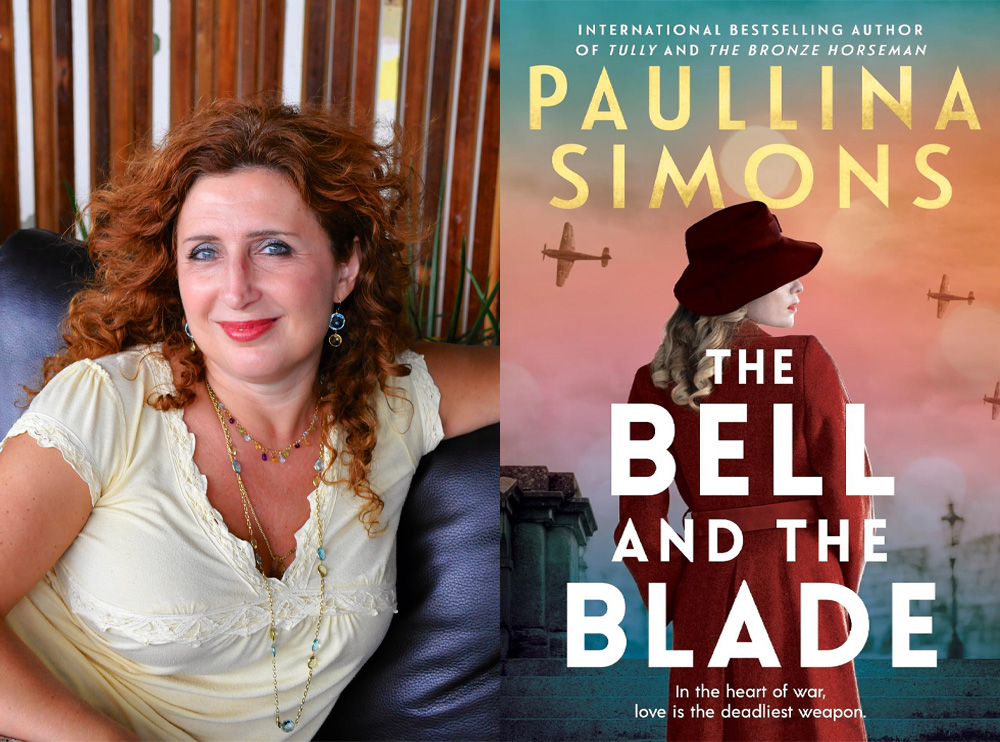
We chat with author Paullina Simons about The Bell and the Blade, which is a sweeping WWII love story that shines a spotlight on the fierce, too often overlooked women who fought from the shadows.
The novel shines a light on the women behind the front lines in WWII. What drew you to explore this particular perspective, and how did that shape the story you wanted to tell?
I’ve always been drawn to stories of ordinary women thrust into extraordinary circumstances—women who didn’t set out to be heroic, but who, by necessity, rose up to do the impossible. In The Bell and the Blade, I wanted to explore what that looked like in wartime Belgium from multiple angles: the soldiers, the enemy, and the women caught between them. I wanted to show not just the fear and danger of life under occupation—but also the stubborn insistence of the young on being young. These were real women, full of longing and defiance, who still wanted joy, still wanted love, even as the world burned around them.
You’ve said this book features “the most formidable villain in your oeuvre.” Can you talk about how you conceived this character and what makes him different from antagonists you’ve written before?
Erich Von Rheinhardt is not only one of my most formidable villains—he’s the first to whom I gave a full internal point of view. For the first time in my sixteen novels, readers aren’t just watching the antagonist act; they’re living inside his mind. They see his calculations, his doubts, his agonies, and his fanatical thirst for order in a collapsing world. That intimacy raised the tension for me dramatically, because we knew how close he was getting to our heroes—and how ruthless he would be when he found what he was looking for.
What makes Rheinhardt different is that he isn’t a cartoon villain or a Nazi cutout. No one is the villain of their own story, and that’s what I wanted to explore—how a man like this justifies to himself the terrible things he does.
Instead of letting my characters face a faceless evil, I gave them an implacable, intelligent adversary. It made the stakes more personal—and the story more terrifying.
Research plays a big role in the novel. Can you walk us through one particularly surprising or memorable discovery from your archival work or resistance histories that found its way into the story?
Research often takes me down roads I never expect—and in The Bell and the Blade, there were three that caught me by surprise.
One led me to equatorial Africa. I uncovered the long European presence there, and their relentless pursuit of minerals buried deep in the earth. Without that historical obsession, this story wouldn’t exist—and the world we live in might look very different. There’s a whole other story buried along that mythical trail, about what we unearth when we dig too deep.
The second path took me into my protagonist’s past—because to understand Fletcher Gray in the present, I had to follow him home. That journey led to the bayous of Louisiana, to a haunted family history, a Shakespearean fall from grace, a story of tragedy, escape, and survival. The Bell and the Blade is a title born from that past. And though the novel is built on forward motion, the ghost of what came before shapes everything.
But what stunned me the most was the research into how the war’s most catastrophic weapons were actually made. The methods were mind-boggling: corrosive gases so volatile and toxic they could melt flesh on contact—and often did. And yet, humans persevered. Not to cure disease. Not to extend life. But to build weapons meant to end it. To me that was the most astonishing discovery of all.
The book blends action, espionage, and passionate relationships. How did you strike the balance between historical thriller and romance, and was there a moment where one element risked overpowering the other?
I don’t set out to balance romance and action—they rise together. For me, the story is always about people first. What they fear, whom they love, what they want, and what they’re willing to give up to get it. The espionage, the stakes, the ticking clock, those are just crucibles that reveal the truth of my heroes’ hearts.
There were moments of course when the suspense threatened to take over. But I never worried. I knew love would find its place. It always does. Especially in war, where time is the one thing young people don’t have, and yet everything else is heightened—every glance, every embrace, every goodbye.
With so many emotionally rich character arcs, which one stayed with you most after you finished writing the book—and why?
It’s impossible for me to choose just one. Louise, Charlie, and Fletcher, the three reluctant heroes, will stay with me forever. Flawed, frightened, and deeply human. None of them wanted the burdens they were forced to carry. Fletcher was reeling from unbearable loss and didn’t believe he was worthy of the mission. Charlie, after witnessing unspeakable violence, only wanted to run.
And Louise—Louise is the thread that binds every heart in the story.
I carry them all with me. I always will.
Writing epic historical fiction often involves juggling large casts, timelines and settings. What was the most challenging structural or logistical hurdle you faced in writing this novel, and how did you overcome it?
The biggest challenge in writing The Bell and the Blade was pacing. At times I felt like I was on a runaway train—momentum was everything. But too much speed makes it hard to slow down, and without slowing down, it’s hard to fall in love. Love needs space and breath. It needs a moment to forget the danger pressing in.
Yes, the world might end tomorrow, but tonight we’re going to share a smoke, tell a joke, laugh, be young, and feel something real. That was the tightrope I walked. The action had to roar forward, but the heart of the story had to be still. Without both, I couldn’t have finished writing—and I hope readers won’t want to stop reading.
You’ve created iconic female protagonists in many of your previous books. In this novel, how did you approach telling the story of these women, who resist, survive, fight and retain their identities during a time and a war when power was so often denied them?
To tell the story of these women, I had to see them fully: cinematically, emotionally, and above all—truthfully. I imagined them as real girls: pretty, curious, passionate, frightened. What would it feel like to face danger with no safety net, no power, and no promise of cavalry to come?
Each woman in the book is a flawed, funny, brave, afraid human being. And yet, they never stop being women. That was essential to me. I wanted to show their strength, but also their vulnerability, their joy, their longing, their beauty. I wanted to show how they resisted, survived, and fought back, without losing the heart of what it meant to be women in that world.
Louise, in particular, reminded me that courage doesn’t always look like a gun in the hand or a battle cry from the barricades. Sometimes, it’s the quiet refusal to betray your own soul.
For many readers, the romance is a key draw—but you’ve embedded it in a broader story about betrayal, conscience, and survival. How did you ensure the love story remained authentic without diminishing the brutal moral stakes of war?
I don’t see romance as separate from the brutal moral stakes of war. Love in wartime, becomes more urgent—not less. It’s not sentimental, it’s not a side quest. It’s survival. The intimacy of the heart and the body is what tethers you to life, to joy, to a future you can barely imagine.
That’s why the love is essential. It isn’t a break from the darkness—I wrote the love to illuminate the darkness. It’s the light by which everything else in the story is seen.
Looking at your own growth as an author, how do you feel this novel extends or challenges your previous body of work, and were there any risks you chose to take that surprised you?
The Bell and Blade is one of the most ambitious novels I’ve ever attempted. It had to fuse everything I love to write about—romance, war, family, history, conscience—and throw it all into a cauldron compressed by time and stakes. It demanded a large diverse cast full of clashing desires and conflicting personalities. It required humor, action, heartbreak, and humanity. It had to feel real. It had to make me weep. And it had to make me want to turn the page as I wrote.

In most of my novels, tension comes from emotional stakes: from choices and their consequences. But this one required a different kind of propulsion. It was a pressure cooker. The pacing had to be tight and relentless. It was a challenge—and a thrill.
One of the biggest creative leaps for me was writing from the soul of a villain. Hugo may have written from Javert’s point of view, but I never had—until now. That risk was both exhilarating and deeply challenging.
In the end, what surprised me most was how powerfully this story became mine. A Band of Brothers with unforgettable women at its center. A war novel that dared to make me laugh, fall in love, and break my heart.
The Bell and the Blade features a large ensemble—snipers, partisans, demolition men, trackers, Congolese officers, even a little boy. Was there one character you particularly loved writing scenes for, who surprised you as the story evolved?
I loved writing them all. I didn’t want to let them go. I longed for more of Ngomo and Zeus. More scenes between Louise and Saul Grunfell. More Belvedere, more Briggs. More of Louise and Rafael, and more of Charlie and Fletcher—two reluctant heroes who were so lucky to find each other. It hurt to finish the book because I didn’t want to leave their world.
I especially loved writing the scenes between Erich Von Rheinhardt and his lowly but loyal assistant, Franz Hübner. Those two made me laugh even as they terrified me. Their relationship—laced with friction and a twisted kind of affection—surprised me again and again.
And in the end, it made their fate all the more haunting.
Finally, if a reader takes away just one thing from The Bell and the Blade, what would you hope that is—beyond the thrill and the love story—that resonates long after they turn the last page?
I hope they remember that sometimes, the one who seems softest—the least likely to survive the war—is the one who carries the world on her back. That the one most easily overlooked or underestimated may end up taking the path no one else dares to walk.
If readers take away just one thing, I hope it’s this: you are capable of more than you know. When the moment comes, you might be the one who changes everything.
Just remember—Joan of Arc was fifteen when she turned the tide of a hundred-year war and brought the English army to its knees.
Sometimes you are Joan of Arc.