


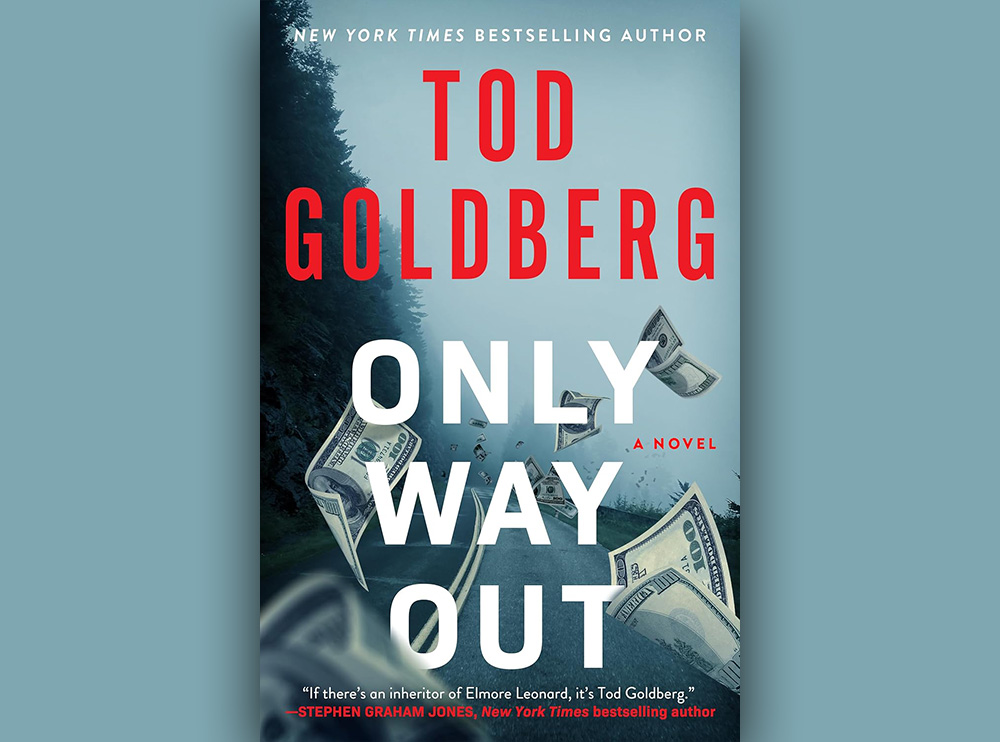
A luckless thief’s wrong turn becomes a crooked cop’s fortune in a wild ride of a thriller by a New York Times bestselling author.
Intrigued? Well read on to discover the synopsis and an excerpt from Tod Goldberg’s Only Way Out, which releases on December 1st 2025.
Failed lawyer Robert Green has such a good plan: Crack three hundred safe-deposit boxes and sail off to South America with his brilliant, morally flexible sister, Penny. If it weren’t for the damned freezing rain.
In the dying resort town of Granite Shores, cop Jack Biddle is self-appointed king―mostly of bad decisions. Between his family’s crumbling legacy, a wife who just joined the city council, and life-threatening gambling debts, Jack’s looking for a way out. Then he spots a van spinning off a mountain road into the valley below. In the wreckage, Jack finds a very dead Robert, millions in heisted loot…and opportunity.
All Jack has to do is clean up the mess, disappear Robert’s body, make off with the fortune, and not get caught. One hitch is Penny. Another is Mitch Diamond, a wild card ex-con who knows more about the missing fortune than he lets on. Jack, Penny, and Mitch each have an endgame. But there’s only one way out, and they’re crashing headlong toward it.
CHAPTER ONE
Fifteen Years Ago
Granite Shores, Oregon
The Day After Thanksgiving—Black Friday
The problem with being a crooked cop? When shit inevitably goes sideways, you’re on your own.
This truth came to Officer Jack Biddle way too late. But what to do? Wasn’t like he could go state’s evidence. If he tried to cut a deal, he’d end up doing less time, but he’d still be doing time, and cops don’t do well up in gen pop. Not even in some medium-security spot like Shutter River down in Bend. He’d be somebody’s chew toy in about fifteen minutes.
He couldn’t go to his friends. Only a few knew he possessed such a . . . fungible . . . moral center, and none knew the extent of his mendacity. Most of his true friends couldn’t even define mendacity. His wife was way out. She just got elected to the city council. Rest of her family were dentists, save for her cousin Tommy, who was a DA up in Corvallis.
Was there something he could put into the water supply? Didn’t Putin have some kind of chemical that could erase people’s memories? Some old Soviet-era shit? Had he read that somewhere? He’d look into that.
Jack fired up a joint, took a big drag, tried to find a better solution. He’d parked his cruiser-rigged Tahoe near the top of Patterson Summit on the east side of Yeach Mountain, then backed up into a dense overgrowth of towering evergreens that obscured him from sight. Jack had to be careful, though, because if he backed up too far, he’d be ass over teakettle into Patterson Gulch, and that would be that. He’d be lucky if anyone ever found him. The gulch was named for the Patterson family, who disappeared into it in 1848 during a snowstorm; miners ended up finding one living family member seven months later—Yeach Patterson, an eleven-year-old boy, who later gave his name to the mountain—starving, stark raving, and with tales of eating the family dogs and then, eventually, the family to survive.
Seven months was a long-ass time. Could Jack survive that long? Maybe. He’d need more weed. More beer. More shotgun shells. Absolutely would need to figure out a Wi-Fi situation. A better coat, for sure. Tonight was the start of the bad weather. Freezing rain. Forty-mile-per-hour wind gusts that swirled across the grade.
Jack’s granddaddy claimed the Pattersons were distant cousins, but Jack had never seen any proof, not that he gave a shit, since he’d never tell anyone that he came from some creepy-ass stock, though if Jack had his way, there’d be a Yeach Patterson Festival every summer.
Amp up the crazy. Get the tourists to flood into town. More tourists meant more traffic tickets. More traffic tickets meant more drug seizures. More seizures meant more people spending the night in County. More people in County meant a larger county jail, which meant a construction boom, which meant more housing, which meant more cars, which meant even more traffic tickets. Turn Granite Shores into something more than a dying resort town—turn it into a real destination! Get a little film festival. Close the streets around the boardwalk and let people walk around with beer. Maybe eventually they’d legalize weed, and that would mean more bakeries and deep-fried food places.
People had to get to know Granite Shores for more than its shitty nickname. The city was shaped like a capital L with the boardwalk and its rickety old amusement park rides, the farmers market, the marina, Granite Shores Bay, and the main businesses running north and south along Beach Boulevard. Most of the original neighborhoods, littered with Craftsman houses and clapboard bungalows, were situated to the east, in the foothills of Yeach Mountain, near the old quarry. The new developments, the nice part of town, where the Canadians and retirees bought houses and condos, where there was talk of maybe a new mall and a miniature golf joint, maybe a surf park if the locals didn’t mind the Japanese funding—that was all located along the short leg, beside the village of Granite Park, which was what the world would look like if Pottery Barn was a recognized religion.
None of that mattered when you looked at the place on a map—the topography made it strongly resemble a giant L carved into an old man’s forehead. So of course, kids started calling it Losertown as soon as they were able to get a look at it. Then the internet came along, and that was that. You lived in Granite Shores, you lived in Losertown. There were mugs and T-shirts sold on the boardwalk.
It was, in Jack’s opinion, a fucking disgrace. He was a goddamn winner.
Jack’s personal cell phone rang.
Bobby C.
Danny Vining’s collections guy.
Shit.
Ignore.
Any idea of starting a festival was out the door if Bobby C. found him, that much was for sure.
Not that Bobby C. would have any notion where to even begin looking for him, since the only person who knew about this spot was Jack’s father, Owen, who showed it to him in the first place, and he wasn’t telling anyone anything anymore. Not without a Ouija board. Back in the day, Owen told Jack that if he ever went missing to come up here and bring a cadaver dog.
The cell rang again.
Bobby C. again.
Ignore.
Usually you couldn’t get two bars up here, so the storm had to be messing with the signal. Normally, if he needed to make a call, he used the department cell phone, which was wired to the SUV. The department cell would mark his location and everything else about the call itself. Which was fine if he was up here during business hours. This was technically still his jurisdiction for another thirty yards or so, when it became county business, which was the provenance of the Sheriff’s office, who only showed up if there was an accident with a body.
Off time? Jack unhooked the phone and the GPS unit and left it back at his house, or in the basement of the Sno-Cone Depot, a drive-thru snow cone shop the Biddle family operated for going on fifty years, over in the “cool” part of downtown, by the used record store and comic shop. It was a little side business that Jack inherited from his father—the only thing worth a damn the man ever gave him, other than training on how to use a gun—and that was a bit of a summer institution in these parts; when the giant neon sign that read Treat Yourself and Treat Your Kiddies! was lit, that meant it was vacation time. Anyone looked at his GPS right now, his car was parked right where it was supposed to be parked.
If he was a different kind of guy, Jack wouldn’t drive around in his Tahoe when he was off duty, and this wouldn’t be an issue. But the way Jack saw it, he was always on duty. Some shit went down, you wanted Jack Biddle to show up. He didn’t mind using force. Didn’t mind putting one in someone. Rob the bank? Be prepared to get rammed off the road by Jack Biddle. That was the nice thing about living in a shitty little beach town like Granite Shores: Jack Biddle got to be an action hero.
Plus, Jack liked rolling in his Tahoe. His father was the chief of police. His grandfather was chief before that. They never got a Tahoe; they just had shitty cruisers. One day, Jack Biddle would be chief, too, if he could unfuck this situation in time to not end up in a shallow fucking grave somewhere.
Jack took another deep drag.
Held the smoke.
At the bottom of the grade, which you could only see from this vantage point—another little trick his pops taught him years ago—he spotted a pair of headlights beginning their long and winding journey. It would be another fifteen minutes before the vehicle reached him—way the headlights looked, he guessed it was a van—provided the driver was familiar with the mountain and didn’t freak out on every switchback. A newbie might take thirty minutes in this rain. A Canadian tourist might decide fuck it and turn around, keep going south until they hit Grants Pass. The beach would be there some other time. No sense trying to die for a thing you couldn’t see at night, anyway.
The cell. Again.
This time it was Danny Vining himself.
Shit fuck motherfucker.
Ignore.
First thing tomorrow, Jack was getting a new cell phone. He didn’t like the fact that every dirtbag in Losertown apparently had him on speed dial. He’d tighten that shit up. Second, he couldn’t hide up on top of Yeach Mountain forever. Eventually Bobby C. was going to do some Bobby C. shit and kill his dog or abduct his wife, Caroline, or maybe both.
One more hit.
What to do?
The obvious answer was he should probably kill Danny Vining.
Jack did two tours in Iraq, first during Desert Storm—he’d enlisted in the army after high school, like a dumb fuck—and then he’d re-upped right after 9/11, found himself fighting house to house in Fallujah, and got to sort of liking it, so killing wasn’t hard for him. It was part of the game.
Hell, he ended up getting popped by a nine-year-old with a .22, which got him sent home with a Purple Heart, a parade along the boardwalk, and then a few years of unceasing darkness . . . but he didn’t hold a grudge against the kid. He was doing what he was told. Sure, Jack’s brain was runny scrambled eggs for a time, which led to him doing some things for people maybe he shouldn’t have. But it wasn’t like he didn’t enjoy doing those things.
These were out-of-town jobs that left Jack feeling like he was back kicking in doors. That rush. Had he taken it too far a few times? Yes. Did he like it, maybe too much? Yes. Did he have some bodies on his sheet? Well, sure, but war was war. What was the difference between doing it for the government and doing it for Danny Vining’s father? Iraq or Beaverton? Let God sort them out—that was the saying he was taught in the army, and that seemed like a good enough mantra all around. It’s probably what the nine-year-old was thinking these days, too.
Anyway, that was years ago now. And anyone who knew anything about it was gone, even Danny Vining’s father. Once Jack re-devoted his life to law and order (ish), he cleaned up those old messes, and that meant Mr. Vining went off Suicide Ridge one night. He was close to eighty. Didn’t put up much of a fight. Body washed up a few days later; everyone figured it was dementia, the old man got lost and ended up in the drink.
But still.
Jack had been friends with Danny his entire damn life, so it wasn’t like he could break into his crib and put one between his eyes and feel good about it. He had a real fondness for Danny. Everyone did. The fucking asshole. When he tossed his father off Suicide Ridge, he thought Danny would eventually see it as a kind of gift, an end to the suffering, or whatever.

Anyway, Danny being dead wouldn’t solve the real problem—that Jack bet with money he didn’t have and lost, again—since Danny surely kicked up to someone out of town. Maybe in Portland or Seattle or Las Vegas. Someone with real juice. Danny ran his book out of the shitty bungalow right behind his family’s boardwalk confectionery shoppe—Sunshine Fudge—which was ballsy and told Jack everything he really needed to know: Everyone knew Danny’s spot, which meant people more powerful than Jack were interested in his long-term existence. If Danny were to suddenly drown or get electrocuted or something, it wouldn’t change the fact that Jack Biddle owed . . . someone . . . an additional $50,000 and had already lost about $200,000 this year alone.
$200,000 he simply did not have.
Never had.
But which the evidence locker did, from a case in the ’90s when a local pharmacist and his family disappeared and left half a million in cash in their house. Bodies got found a few years later, disemboweled, buried, and frozen on Yeach, but the killers never turned up. This was back when his pops was still on the job. So he’d borrowed a little cash now and again, since he was in charge of the evidence locker, what with being the senior officer and because he was Jack-fucking-Biddle.
But that was a different problem.
Jack exhaled smoke out the window, into the rain. The blue plume hung there for a moment, like a thought, then was gone. Poof. Wouldn’t that be nice. To just go POOF! But Jack had duties now. A life. They hadn’t told anyone yet, but Caroline was pregnant. A miracle. They’d been told by doctors that they couldn’t conceive, that Jack’s swimmers were drowning, and so they’d basically given up hope until forty-eight hours ago, when Caroline got the positive test, right after her last city council meeting of the year.
Which is when Jack fucked it all up. Everything seemed ripe with possibility! Everything seemed miraculous! So when he saw that the Cowboys were favored to beat the Seahawks by twelve in the late Thanksgiving Day game, he knew it was a sign. The Seahawks were dogshit, but it was Thanksgiving, and Jack was feeling lucky, so Jack called Danny at home after he didn’t pick up his cell, since even crooks celebrate Thanksgiving, and told him he wanted fifty K on Seattle to cover the spread.
“I want to see a bank statement first.”
“I came into some cash,” Jack said. “Sold some stocks. Just need twenty-four hours of credit.”
“I’m not taking any bills stained from dye packs.”
“It’s not like that,” Jack said.
“No old cocaine, either.”
It wasn’t like that, either. Not this time. No, this time, it was the universe communicating with him. He was going to win. He didn’t need to put real cash on it. Danny would extend him credit for the night. He’d win. He’d be ahead.
Jack heard laughter in the background. Kids. A dog barking. During the tourist season, Danny’s family had a monopoly on the fudge game up and down the Oregon coast. There was a town with diagonal parking, there was a Sunshine Fudge moving big product.
“I’m about to mash the potatoes,” Danny said. “If this is what you want, understand that if you lose, I will expect full payment tomorrow morning. Nine a.m.”
“Bobby C. isn’t up that early,” Jack said.
“But you are,” Danny said. “And if you win, you’ll expect payment promptly, and I’ll do just that. You see how this works?”
The Cowboys beat the holy shit out of the Seahawks. 34–9. Sure enough, 9:01 a.m., Bobby C. was pounding on Jack’s front door. Thank God he shuffled Caroline out the door at dawn to hit the outlet stores, gave her a hundred bucks to get a Coach bag. Jack waited on the side yard, peeking through the fence to make sure Bobby didn’t break in to steal the DVD player, but at the same time kind of hoped he might, so he could put one in his chest.
“If you’re hiding,” Bobby C. called out after a while, “know I’ll find you eventually, and it will be worse.” When that didn’t draw Jack out, he pulled out his dick and pissed right there on the door. Classy.
Now here he was, hiding on Yeach Mountain. If it wasn’t for the good news about the baby, Jack might keep going right down the other side, disappear into the woods like the Patterson clan had, minus all that cannibalism bullshit, and try to live a more simple life. At least one that wasn’t predicated on the Seahawks ever winning another football game.
Another blink of light pierced through the trees, fog, and rain. That van was moving. Which meant it was a local. If he pulled over a local up here, then everyone would know Jack was patrolling up here, and then he’d be out of hiding places. He’d wait to see if maybe he’d misidentified the lights. Could be it was a tour bus filled with Japanese tourists coming to stay the night before hitting the new outlet mall. Now, that would be a good shakedown!
So Jack Biddle did what he always did: He made a bad situation worse and went ahead and fired up another joint.
Copyright © 2025 by Tod Goldberg. From Only Way Out by Tod Goldberg. Reprinted by permission of Thomas&Mercer, a division of Amazon Publishing.