


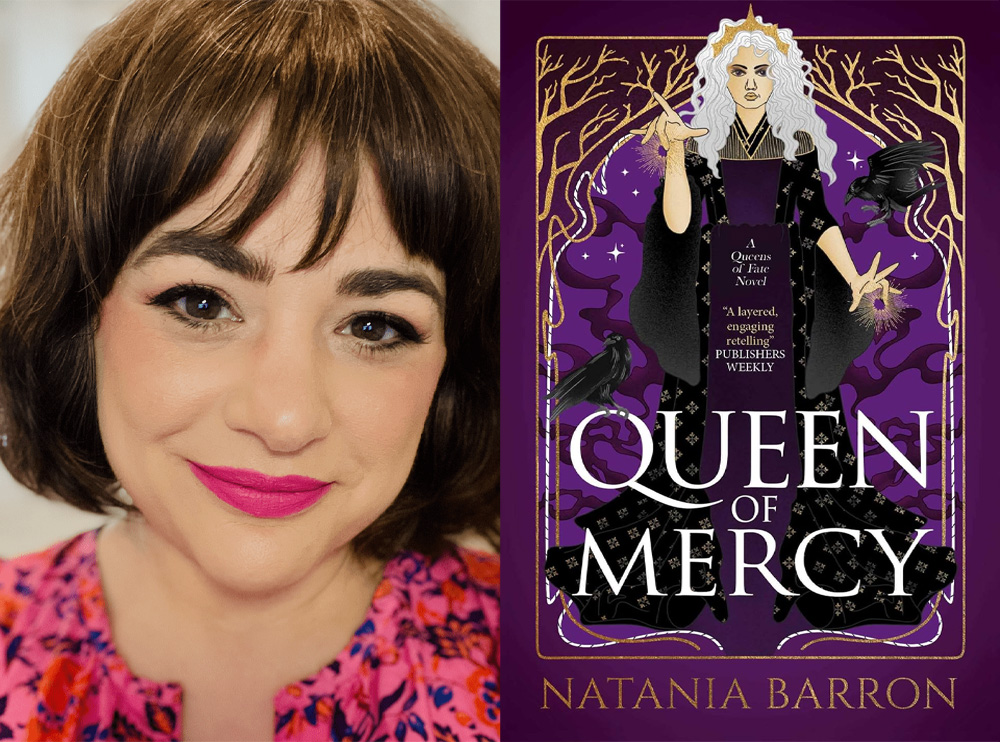
Guest post by Queen of Mercy author Natania Barron
Natania Barron is an award-winning fantasy author long preoccupied with mythology, monsters, and magic. Her often historically-inspired novels are filled with lush description and vibrant characters. Publications include her 2011 debut, Pilgrim of the Sky, as well as These Marvelous Beasts, a collection of novellas. In 2020, Barron’s Queen of None was hailed as “a captivating look at the intriguing figures in King Arthur’s golden realm” by Kirkus, and won the Manly Wade Wellman award the following year. Her shorter works have appeared in Weird Tales, EscapePod, and various anthologies, RPG, and game settings. In addition, she’s also known for her ThreadTalks, which dive deep into the unseen, and often forgotten, world of fashion history. Barron lives in North Carolina, USA, with her family and two dogs. When she’s not writing, you can find her wandering the woods, tending her garden, and collecting rocks.
About Queen of Mercy (out June 5th 2025): The gorgeous final chapter in the critically-acclaimed female-led Arthurian Fantasy Romance trilogy
“When we lose our myths we lose our place in the universe.” – Madeleine L’Engle
“For myth is alive at once and in all its parts, and dies before it can be dissected.” – J.R.R. Tolkien
“Only fools want to be great.” – T.H. White
The inception point of myths has always fascinated me—the first song, the first poem, the first drawing, the first sculpture—not because it is easy to find, but for the precise opposite of that: myth emerges from a mist, without exception, and is reborn again and again, filtered through the lives of generations upon generations. We cannot prove where the story began. It is, and always will be obscured to us. But, be that is it may, we know the myth persists. We know its shape and its design. We feel its humanity though its inception remains invisible.
And in the West, there are few myths as enduring as the Matter of Britain or, more commonly known, the tales of King Arthur. This king, this great uniter of a fractured nation, is at once the saviour and the tragic hero, a model of chivalry and a cuckold, a devoted husband and a failure as a father. And this makes sense when one pulls back from the story, for Camelot is at once glorious and full of decay, that perpetual oxymoronic balance Tolkien refers to. Above all, though, Arthur himself lives at the centre of the tale and yet always at the edges. He is as much of a setting—“in the time of King Arthur”—as he is a character.
In some ways, Arthur himself is the mythological inception point. The idea of the chosen monarch, blessed with divine providence, is no new theme but one refined within these tales time and time again. Indeed, throughout the entire Arthurian oeuvre, of which I firmly insist there is no single canon, Arthur remains relatively fixed, especially compared to the other characters. Individuals like Gawain, Morgan, Merlin, and Lancelot, morph and change over time as the story moves from region to region, their natures and motivations swinging wildly from shining hero to conniving villain. As cultural mores and politics shift, the stories adapt to them as needed.
That malleable nature is precisely why Arthuriana has endured and evolved for over 1,000 years. It is, at the heart, what we might now call fanfiction. The genre is quasi-historical to begin with, but so much of what we consider essential to fantasy was established, or at least solidified, in these tales. We like the idea of the “first fantasy novel”—but I would argue that secondary world fantasies are just the natural evolution of mythologies like Arthuriana or the Carolingian romances or the Bhagavad Gita. Fantasy is simply baked in. The bones, one might say, remain, though the flesh is reshaped.
When I read T.H. White, I see how he wrestled with the questions of his own age, how fascism and anti-intellectualism shaped the tensions and trials in The Once and Future King. Thomas Malory, who inspired T.H. White and Tennyson, lived in a war-torn England barely keeping itself together, and yet devoted years of his life while imprisoned to make a cohesive English myth—cobbled together from French sources. Marie de France used her lais to find favour at court while stubbornly insisting on her own authorial voice: signing her name to the work lest monks take credit for her writing.
In a more modern context, Tracy Deonn’s Legendborn series tells a modern version of the story through the lens of a young African American woman destined to carry Excalibur. And even a film as baffling as Guy Richie’s Legend of the Sword is very much of its time, a slapdash, bizarre interpretation of the King Arthur tale that could, for all its lack of connection to the original tales, be secondary world save for its marketing. To say nothing of the rise of the feminist tale in the 70s and 80s.
Not all these stories are meant for everyone, nor for in every time. For hundreds of years, the bulk of Arthurian storytellers and myth-weavers were anonymous. Their stories remain. Even as the myth itself is solidified, the scribes and poets themselves seem to evaporate. But context remains.
It is, of course, perilously difficult to look at context from within the machine. When I began writing my own Arthurian retelling, I was a young mother dealing with a crisis of self. My sister was undergoing cancer treatment, I had just given up on my academic career, and I’d emerged from months of postpartum depression a half stranger to myself. As I sat down to write Queen of None, I was searching for a woman lost to Arthuriana, Arthur’s sister Anna Pendragon, who appeared almost off-handedly in Geoffrey of Monmouth’s Historia regum Britanniae before being absorbed into the myth and vanishing.
Finding a missing woman in that time is not surprising given my own authorly context.

In the ensuing years, as the story has grown in my own mind and on the page, I’ve spent a lot of time contemplating my own choices. I knew, early on, that each book would feature a different woman. But, as most Arthurian writers before me, I also knew the story was not a happy ending. Yes, Queen of Fury ends on a happy note. But there are always shadows in Arthuriana, portends and prophecies. Morgen—I chose to spell her name in the oldest Welsh form for my own purposes—was the right woman for the job in the third book. However, she could not be the only voice. The structure of the books move from one point of view character to two, and then to a split narrative between Morgen’s story and multiple third person points of view.
That was a bit risky on my part, and not something I had encountered in Arthuriana before. Yet, as a scholar on the subject, I wanted to show that the story was not just growing but it was fragmenting. Hwyfar and Gawain, who narrated the second book, become more distant in the third person. Morgen, who has always lived on the margins of the tale, comes into focus as a woman past her prime, carrying the weight of hundreds of choices and preparing for the consequences while, even as she observes, the larger story whirls and eddies around her, spinning off into other tales she will never see.
We modern writers have what those came before us did not, for in this age of technology we have endless source material. In a way this means more intentionality. In a world where AI can churn out thousands of pages of content on any given subject within a matter of minutes, we myth-weavers stand at a precipice. Retelling is powerful, so powerful that even the Nazis reshaped the figure of Parzival for their ends, forever changing how that one character was perceived and interpreted.
Now, I stand here and think, well, a machine cannot re-interpret a story. There are mad kings in the woods, powerful weapons in the hands of those who would do harm, and a continued tension between Might and Right. The world of Arthur is no different from ours in so many ways, though the trappings change: within we wrestle with what it means to be human. We struggle with love and violence; we face horrific monsters; we live and die.
But the bones remain. Even if the authors disappear. Even if the stories disappear. Try as I might, even though we are living through decidedly challenging times, I find comfort in leafing through various chapters in Arthurian lore: in seeing Sir Palomides without his helmet, speaking in a foreign language; in the face of Sir Morien, the Moor; in the power of Morgan le Fay and her enduring character; and even in Lancelot, always striving to be more while falling short time and again. I find comfort in my books, dogeared and worn as they are.
For they were all once tales told by the fire in the dark, and we are but the echoes on the cave wall reverberating back in reply.