

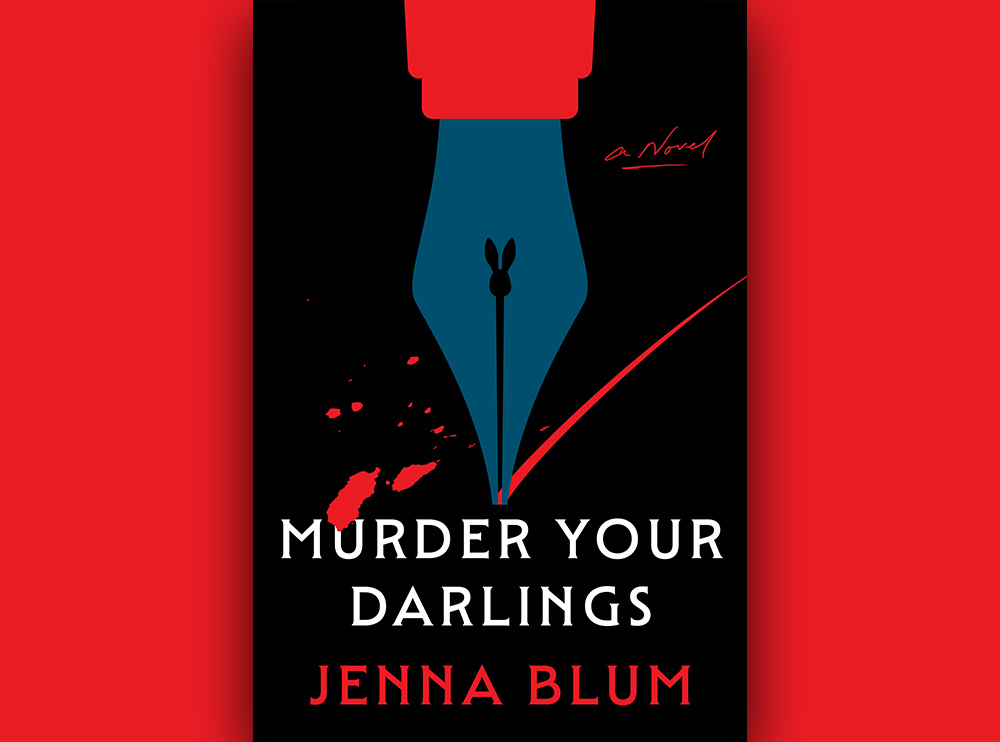
For every woman who’s ever fallen for a bad man comes a hilarious and eviscerating tale of love, loss, and deadlines from New York Times bestselling author Jenna Blum.
Intrigued? Well read on to discover the synopsis and an excerpt from Murder Your Darlings by Jenna Blum, which releases on January 13th 2026.
Known for such brilliant historical novels as Those Who Save Us and The Lost Family, A Mighty Blaze co-founder and New York Times bestselling author Jenna Blum now offers a contemporary, suspenseful novel about love, loss, and revenge in the world of books.
Simone “Sam” Vetiver is a mid-career novelist finishing a lukewarm publicity tour while facing a deadline for a new book on which she’s totally blocked. Recently divorced, Sam is worrying where her life is going when she receives glowing fan mail from stratospherically successful author William Corwyn, renowned for his female-centric novels. When William and Sam meet and his literary sympathy is as intense as their chemistry, both writers think they’ve found The One.
But as in their own novels, things between Sam and William are not what they seem. William has multiple stalkers, including a scarily persistent one named The Rabbit. He lives on a remote Maine island, where his writer life resembles The Shining. And when writers turn up dead, including from The Darlings support group William runs, Sam has to ask: Is it The Rabbit—William’s #1 Stalker? Another woman scorned? Can William be everything he seems?
Narrated by Sam, William, and The Rabbit, Murder Your Darlings is a wickedly witty look at today’s literary landscape and down-the-rabbit-hole tale of how far people will go for love.
CHAPTER 5
The Virtuoso
Sam found herself driving across Boston in a nor’easter to one of her favorite indie booksellers. This wasn’t something she’d normally do so soon after finishing her tour; Sam loved bookstores, naturally, but having been in so many the past month, she needed a break. However, she also needed a respite from Ole Nielsen. Sam had tried that damned opening chapter every way she could think of: first-person, third, omniscient, even from the one-legged prostitute’s POV. She’d started with Ole’s steerage experience on the emigrant ship. She’d chosen a scene from the novel’s middle. Nothing. It was like taking a run at a mountain of ice, getting a few feet up, sliding back down every time.
And Sam might have had an ulterior motive for going to the bookstore: curiosity. William Corwyn was in town, reading his latest instant New York Times #1 bestseller All the Lambent Souls, and Sam needed to know, as William himself had predicted she might ask: Who was this guy? Nobody wrote missives like the one he’d written to her, nobody. Most writers received fan mail; Sam was the grateful recipient of reader praise about once a week. These messages were a paragraph or two tops. Nothing like the epistle William had fired across the bow, complete with page-referenced quotations. No writer took valuable time and energy from his own work for that.
So what did William want? Did he have some ulterior writer motive? Unlikely, since he was in a more powerful publishing position than Sam, but possible. Was he nuts? Or did he aspire to get into Sam’s pants? Having done some cursory research on William, Sam had to admit she wasn’t entirely averse to that prospect. William was older than Sam by ten years. He was also unmarried with no kids, a red flag; if a man was a lifelong bachelor, there was usually a reason. But it certainly was not that William was gay, according to the Writer’s Digest cover story proclaiming him “The Most Lit Bachelor” and his borderline flirtatious responses to his raving female fans online. He seemed to be that rarest of all things: a straight, solvent, creative professional man.
Sam was a little worried about how much she wanted him to be real. She arrived at the bookstore late and dashed through the rain to the vestibule, where she was greeted by William Corwyn—a life-size cardboard cutout of him, anyway. He was propped in the vestibule, arms crossed, glowering soulfully. Around his neck he wore a sign that read Mega # 1 New York Times Bestselling Author William Corwyn Here Tonight, 7 PM!!! and was decorated with lipstick kisses. “Well,” said Sam. Their publisher had never made her into a cardboard avatar, though Sam had once, for a brief and glittering week, been a subway ad. She went into the bookstore, which was empty—everyone was in the reading room in the back, where Sam’s Sodbuster event had been a month before. Late as she was, Sam detoured to the New Releases table, seeking her novel among its bright and glossy brethren, shining beneath artfully placed track lighting. She found it with sad placement on a corner. Sam waited until the bookseller on register was scrolling her phone, then moved Sodbuster to prime position: propped up facing the store entrance, replacing a summer romance whose author, Sam felt, would not miss a few sales. Sam patted her book and headed into the back room.
Where she ran smack into a human wall. “Okay,” Sam muttered. Unlike her own recent tour with its half-empty seats, William Corwyn’s attendance was not soft. There had to be a hundred readers here, squeezed into a space meant for forty. There was standing room only. Sam pushed her way through as gently as possible, murmuring, “ ’Scuse me, sorry . . . ,” to a spot against the rear shelves, next to a woman with coils of gray hair who was clutching William Corwyn’s latest novel to her breast as though it were an infant.
Thanks, Sam mouthed. The woman gave her the most cursory of smiles, then returned her attention to the podium. The man of the hour was speaking.
As she got her bearings, Sam tried to collate her online William Corwyn knowledge with the actual man. There were just so many ways these days to get to know a person. He was a big guy, tall and solid, like he’d grown up eating only hamburgers—Sam’s type. She loved men big enough to flip her like a flapjack or toss her up on a countertop. He also still had the hair featured in his author photo, dark and only slightly receding, with the showy silver streaks at the temples Sam always thought looked dyed. He also, sadly, had a goatee, which Sam disdained as the facial hair of indecision—either grow a beard or don’t—but maybe he thought it made him look Shakespearean? His voice was low and sonorous, reminding Sam of an article she’d read about how women love men with deep voices because it indicated the presence of testosterone. And he had horn-rimmed glasses, over which he was now glancing meaningfully this way and that as he read. Sam recognized this move, targeting friendly faces in every quadrant of the audience so no reader felt left out. William Corwyn was the real deal.
Or was he, though? Unlike most male authors Sam knew, who showed up for readings in garage-band wear, William Corwyn was wearing a seersucker suit. Who wore a seersucker suit on tour? Then there was what William actually wrote. The New Yorker had dubbed him The Virtuoso because every one of William’s novels was different. His debut, The Girl on the Mountain, published when he was still in grad school, had been a Gothic coming-of-age story about a young woman trapped in a family hell, like Flowers in the Attic set in the New Hampshire Whites. Some trades had slammed it as melodramatic and derivative, but it had been a Book of the Month selection, and William’s sophomore effort, a contemporary romance called You Never Said Goodbye, stayed on the New York Times Bestsellers list for over a year—in hardcover. His third novel, The Space Between Worlds, was a sci-fi fantasy about a lost tribe of fierce intergalactic women fighting for a planet to call home, and his fourth, Medusa, a retelling of the classic myth, was so successful that it inspired a whole line of au naturel hair-care products that Sam remembered seeing at Target, and that was clearly responsible for all the wild manes in the room. Now he was on tour with his fifth, All the Lambent Souls, a poetic family saga set in the land of Joyce and narrated by the dead matriarch. There was already talk of the Booker Prize.
“Oh, that guy,” Mireille had snorted, when Sam called to debrief and mentioned William’s name. Mireille sounded like a sexy villainess from a Judith Krantz novel at the best of times, and now she spoke in almost a growl. “He is a virtuoso like I am a trapeze artist. You know what he really is? A dilettante. He cannot choose one lane and stick to it. And you know what really gets under my skin,” Mireille continued. “It is this whole woman thing. This privileged white male, this . . . man, he has to write every book from the female point of view? Come on. He is perceived as so sensitive, so evolved, whereas you know what I think it is? I think it is pure commercialism. He knows, this fucking guy, that ninety-nine percent of fiction readers in this country are women. So what does he do? It is not appropriation, exactly, more like . . . faux sycophancy, this ingratiation, as if he is telling us, I understand you. But really he is just printing money. And another thing,” Mireille added, really on a roll now. “Whenever I read his books, and okay, so I have read only one of his books, that ridiculous what was it, Aphrodite, no, Medusa, I get the feeling that he does not actually like women. Not that he’s gay, it is more like the writing is . . . how do you say, ersatz, like he has a bouquet in one hand and a hammer behind his back. Do you know what I really think?” Mireille was winding up for the finale. “I think this Monsieur Corwyn does not like women at all, that Maman Corwyn was very mean to bébé William, and he now spends his entire adult life trying to win positive female attention. Voilà!”
Mireille laughed merrily.
“Now,” she purred, “enough of my half-ass psychology. Let’s get back to YOU. And your new bestseller Gold Digger. When can I see pages?”
As she watched William now, Sam thought it was entirely possible that Mireille was correct, agents being the savvy scholars of human nature they were. They had to be, not only to negotiate deals but to manage their writers’ significant neuroses. It was curious that William was so versatile. Most writers, Sam included, wrote variations on a theme. Sam’s books would always be about love and trauma, no matter what the context. It was a sort of writer DNA forged by personality and circumstance, as particular as a thumbprint and as impervious to change.
But this was not true, apparently, of William Corwyn.
Sam wondered if perhaps she was a bit jealous. If she could write something entirely different, would she be as successful as he was? Would her books feel less stale? Would her readership revitalize? And how did one even do this, changing genres with every novel? Again Sam thought: Who was this guy?
As if he’d caught the question, William glanced at Sam. His brows rose over his horn-rims; his face split in a sunshiny grin. He mouthed something that looked like It’s you! Heads turned. William inclined toward Sam in a way that was not quite a bow, more a sunflower bend toward the light. Then he resumed reading.
“Thank you,” he said to room-shaking applause when he wrapped up. “You are so kind.”
Laura, the bookstore owner, stepped over with a mic. “That was absolutely riveting, William. Will you take a few questions?”
William inclined his dark head. “My favorite part.”
“ARE YOU SINGLE?” yelled a woman knitting in a middle row—of course there was a knitter. Everyone laughed.
“To the best of my knowledge, yes,” said William, and a happy noise ran through the crowd—which, like Sam’s audiences, was primarily female. Strike that, Sam realized, looking around: This one was all women. Nary a long-suffering husband in sight.
Laura delivered the mic to another reader. “Mr. Corwyn,” she said, “your books are PART of me. I carry them right here.” She tapped her chest. “My question is, how do you write women so well?”
“First, thank you,” William said, “and second, dozens of female readers on Goodreads and Amazon disagree with you.” More laughter. “Seriously, I get this question at every reading, and it perplexes me as much as honors me. Why wouldn’t I be able to write women well? We’re all just people, with hopes, dreams, loves, and fears—we’re all lambent souls,” he said, gesturing to his book poster on an easel next to the podium, the title embossed in gold over green Irish hills. “Or maybe I’m fibbing. Maybe I write female protagonists because what straight male writer would not want to spend all his hours in contemplation of the fairer sex?”
Oh my God, Sam thought. Did he really just say that? It sounded like something from Pygmalion. This roomful of feminist women would tear him apart. Instead, they laughed some more. Only one woman didn’t join the jollity: She was standing a few feet away from Sam, wearing a librarian’s flowered dress and a baseball cap pulled low, so all Sam could see was an overbite, a waterfall of blond curls, and a posture of concentration so rapt, she didn’t seem to be breathing. Yeesh, thought Sam, and I thought I had superfans.
Laura ferried the mic to another woman, who said, “William, your books have been so influential for me—I’m a writer, too, though nowhere on your level. But what I wanted to ask about isn’t your novels, it’s the Darlings. Can you talk about them, please?”
“Yes,” William said, with emphasis. “Thank you. If you’ll indulge me, I’ll tell you about the Darlings by spinning a yarn, trick of the trade.” Sam squinted. Why did this sound familiar? Then she remembered William’s letter: If you’ll indulge me, I’ll explain by spinning a yarn. Professional hazard. She did this, too, running lines in writing and then verbalizing them, in a sort of unconscious rehearsal.
William came out from behind the podium and sat on the edge of the signing table with the mic. He shrugged off his suit jacket and rolled up his sleeves to show his forearms. “Oh my GOD,” the knitter said.
“Once upon a time,” said William, “there was a young man who wanted to be a writer. He wasn’t very good, but he was determined. And he worked hard. He wrote and wrote and wrote, and by some grace of God, after college, he got into a graduate program for creative writing. The young man was in heaven. He was learning from some of the best literary minds in the country. Every day he got to talk craft, debate, exchange shop talk with other writers. And just when he thought his life couldn’t get any better, he fell in love with a woman in his program.”
He drank from the bottle of water Laura had set out. The room had grown so quiet, Sam could hear the hiss of car tires on the wet road outside the store, birds chittering in the bushes. Even the knitter’s needles had paused.
“They did everything together,” William continued, “eat, sleep, write, critique. They spent whole weekends in the bathtub reading to each other, wrinkling like raisins.”
He took out a handkerchief and blotted his forehead, sweating visibly now.
“In the early spring of their second year, the young man proposed. Which he did in workshop, by way of a terrible poem. The young woman said yes, and they began planning their wedding.
“Because they were in love, because he believed he knew her better than anyone on earth, because of their dreams . . . it came as a great shock to the young man when, that summer, he came home to find that she—forgive me, this is sensitive—she had . . . taken her own life.”
A woman in the front row gasped. Sam flinched. For a second she saw her own hand reaching for a doorknob, the beige carpet soaked in blood.
William gulped his water and continued.
“The young man was devastated. Everything he’d loved had vanished, in the most sudden and shocking way. He couldn’t eat. Couldn’t sleep. Couldn’t read or write. Everything lost all meaning. All he could think was: Why. Why?”
Sam shuddered. She rubbed her arms, which had seized in goose bumps.
“After a few weeks, the young man realized he was in danger of following his darling into the darkness, and part of him wanted that. So he did the only thing he could think of. He invited everyone in their program to his apartment. All the writers came, and it turned into an impromptu memorial that lasted three days. The writers comforted the young man, talked about his darling, tried to understand what happened. There was plenty of beer, and there might have been . . .”

William pantomimed smoking a joint. There was some uncertain laughter, though there was more sniffling. Some audience members took advantage of the moment to wipe their eyes.
“And something extraordinary happened, even more so than the generosity. The writers started to share. First one, then another, then they all confessed their struggles. Some, perhaps like the young man’s fiancée, had depression, what Billy Styron called Darkness Visible. They all had doubt. Impostor syndrome. Worry how they’d earn a living. Fear of what they’d do if they didn’t make it—they were all career writers; they’d never wanted to be anything else.”
Yes, Sam thought. She was unaware she’d breathed it aloud until her coil-haired neighbor glanced her way.
“It was such a helpful jam session,” said William, “that we—because of course I was the young man—decided to keep it going. We met every week until graduation, and I maintained the group after that, wherever I happened to be. Because talking to one another about the problems was so helpful in siphoning off the darkness.
“So that is the Darlings,” said William. “A support group for writers. A sort of moveable feast of camaraderie that takes place around New England. Because I failed my darling—I failed to see she was in distress, to reach her—I help others as they helped me. It’s the least I can do.”
He stopped and drained his water. After a moment of stunned silence, the room burst into applause so explosive Sam felt it in her throat. The women gave William a standing ovation, Sam included. The only one who seemed unimpressed was the librarian in the baseball cap, who was doing a golf clap.
Laura came to William, and they hugged, rocking back and forth. “Oh, I got mascara on your suit!” she said, laughing and wiping her eyes. “Thank you, William. We’ll check out the Darlings for sure . . . William will be signing here at the table, folks, and you can buy more of his books at the register.”
“William thanks you too,” called William, his voice almost lost in the scrape of chairs and stampede of feet. “Oh, and the Darlings meetings are free!”
Sam stayed put, waiting for the room to clear. She felt stun-gunned, limbs weighted in a familiar way. Part of her wanted to go home and crawl onto the couch. But she still wanted to meet William, now more than ever. Laura spotted her and waved Sam over.
“Two Sam sightings in a month,” she said, “how lucky am I! Do you know William? You guys are both published by Hercules.”
“Only by reputation,” said Sam. “And he wrote me a lovely letter about Sodbuster.”
“C’mon, let’s cut the line,” said Laura. “Author perk.”
At the signing table, William was scrawling his signature in a hardcover with a Montblanc fountain pen that put the disposable in Sam’s braid to shame. He smiled up at the reader he was signing for. “Is that Barbra like Streisand or Barbara old-school?” he asked, and then he saw Sam. His face went still for a second, then lit again in that delighted grin. “Excuse me a moment,” he told the reader. He stood and walked around the table.
“It is you,” he said to Sam.
Then he was hugging her. Sam stood inhaling his woodsy-musky cologne and a sharp note of sweat. He was roasting hot and damp, as she always was after she performed. His heart thudded against her cheek.
“You came,” William said, when he released her. “Hi. Hi.”
“You’re so tall,” Sam said idiotically.
“Comparatively,” he agreed, smiling. He turned the mic back on. “Ladies and . . . ladies! You’re in for a treat. Tonight you get two writers for the price of one: Sam Vetiver is here! Author of the classic The Sharecropper’s Daughter. Her new book is just out, you can buy it up front, and she’s agreed to sign with me.”
He put down the mic. “Okay?” he said.
“Okay!” said Sam. “If you’re sure. I don’t want to intrude—”
“You can’t intrude if you’re invited,” said William. He smiled and lifted one of the folding chairs over the table as easily as if it were a marshmallow. “Come,” he said, and patted it. “Please. Sit here by me.”