
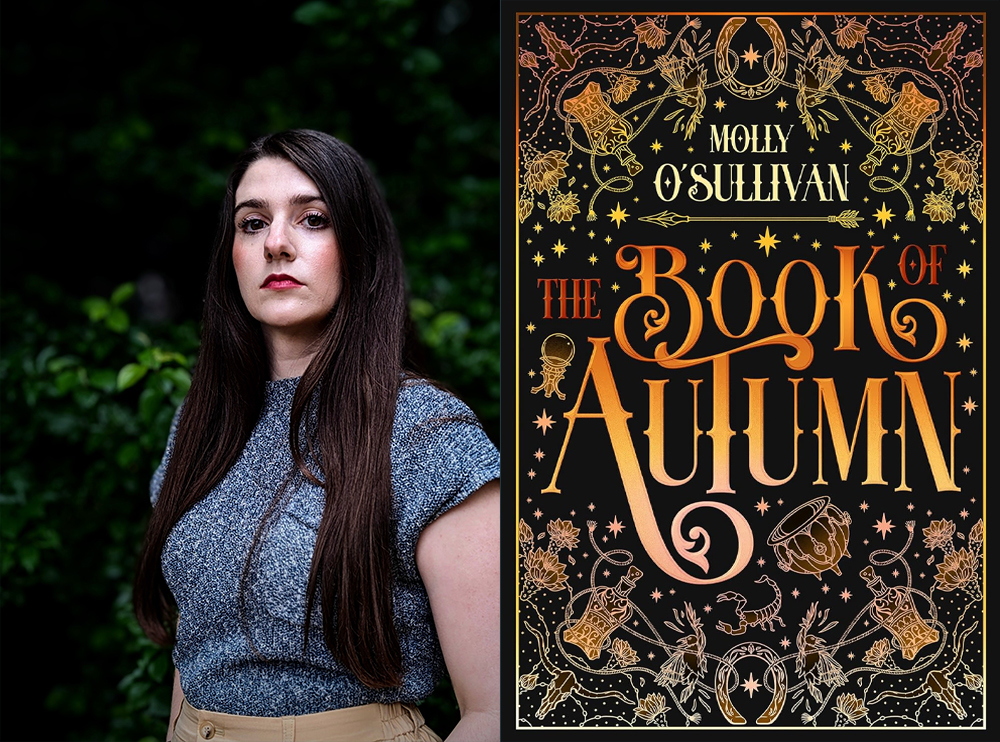
Guest post written by The Book of Autumn author Molly O’Sullivan
Molly O’Sullivan is a cybersecurity engineer turned speculative fiction writer with a deep love for the natural world, tea, and for characters who, despite everything, still manage to hope. Originally from South Carolina, she has lived all over the country but now resides outside Seattle. Visit her online at MollyOSullivan.com.
About The Book of Autumn: For readers of Adrienne Young, Olivie Blake, Erin Sterling, Hazel Beck, and Leigh Bardugo’s Ninth House, a spellbinding debut about ambition, privilege, second chance romance, and ancient magic set at an enchanted school tucked among the red mesas of rural New Mexico, where a formidable pair of magicians are summoned to pursue an alleged killer. Out October 28th 2025.
Lately, I’m finding that I love books that feel like an experience. With the rise of Booktok and Bookstagram, authors are experimenting now more than ever with new, fresh ways of engaging their audiences. They include playlists, interior art, character art, bonus scenes, maps, aesthetic videos, and moodboards, all to make their stories feel more real, more immersive, more shareable, and of course, more fun.
My debut novel, The Book of Autumn, is written in the form of a research record, a collection of notes from an investigation at a haunted college in the desert where one student ends up dead and another is floating in the infirmary and growling guttural nonsense. Through entries from the floating girl’s diaries, annotations from philosophers, real-world ancient grimoires, and old religious texts, as well as footnotes from other characters interjecting with their own opinions into the investigation, Cella and her partner Max slowly piece together the clues of what’s gone wrong. The inspiration for this format was one of my obsessions—a copy of House of Leaves that consumed me. I loved how it was the sort of text you could engage with, and how you could pick up more things on subsequent reads. It felt like it wasn’t experimenting just to experiment, but to make a really entertaining and interactive experience for the reader.
I wanted to highlight six other books (plus one short story) that similarly experiment with form and structure to create an engaging and immersive experience that wholeheartedly sucks you into the story.

House of Leaves by Mark Z. Danielewski
One of the most widely recognized pieces of experimental literature. It focuses on found footage: a fictional documentary film called The Navidson Record which deals with the owner of a house discovering it is bigger on the inside than on the outside. Running commentary from the narrator occurs through extended footnotes throughout the text as they find themselves haunted by this story. It includes citations for works that don’t exist, appendices, and words written literally around the page. Truly a wild ride and one I suggest you try at least once.

Emily Wilde’s Encyclopaedia of Faeries by Heather Fawcett
Probably the most approachable item on this list. Emily Wilde is a curmudgeonly Cambridge professor and dryadologist, an expert on faeries. She travels to Norway to collect information on different species of faeries for the encyclopedia she’s writing with the help of Wendell Bambleby, a rival professor. It’s written in the form of Emily’s notes on faeries and what happens to her and Wendell on their exhibition, as well as footnotes of different faerie lore and culture that will help them survive their trek. It’s cozy and cute, but also a little spooky at times.

Possession by A.S. Byatt
This one follows two scholars researching the love life of two famous fictional poets. Following clues left inside diary entries, letters, and poetry from the nineteenth century attributed to the two poets, the scholars uncover the truth of their secret relationship. The novel flips between present day and past, culminating in a gorgeous narrative exploring art and ownership.

S by Doug Dorst and J.J. Abrams
This novel includes several inserts that supplement the text—postcards, newspaper clippings, and maps—to help puzzle together the mystery behind a book, Ship of Theseus, its fictional author, V.M. Straka, and the two college students leaving notes to each other in its margins. The book itself is aged and looks like a worn, used library book, and the notes in the margin are in different handwriting and colors that get more chaotic as you delve deeper into the mystery.

The Historian by Elizabeth Kostova
A story within a story that spans time periods, continents, and characters, this follows a young historian who discovers a mysterious book and cache of letters in her father’s library, plunging her into her father’s past and a search for truth about Vlad the Impaler, the medieval ruler who inspired the legend of Dracula. Much of the story is told in letters by her father and historical research through ancient documents. You really feel like it’s all real as you dive into the different texts.

Vita Nostra by Marina and Sergey Dyachenko
Another dark academia, this one follows young girl Sasha who gets a strange invitation to attend a specialized university where she’s asked to complete nonsensical tasks and read books that are impossible to read. Her education becomes increasingly absurd and intense until she undergoes a transformation. A bit of a mind trip told with no chapter breaks. Think if Kafka went to magic school.

Where Oaken Hearts Do Gather by Sarah Pinsker
Experimentation is where short fiction really shines. If you’re interested in more, I suggest checking out SFF stories and poetry. This particular piece by Sarah Pinsker is one of my favorites. It’s written in the form of comments on a forum discussing a very old, very spooky folk ballad and the ensuing search to discover its origins. The piece is very interactive and even includes a hyperlink to a YouTube version of the song.