


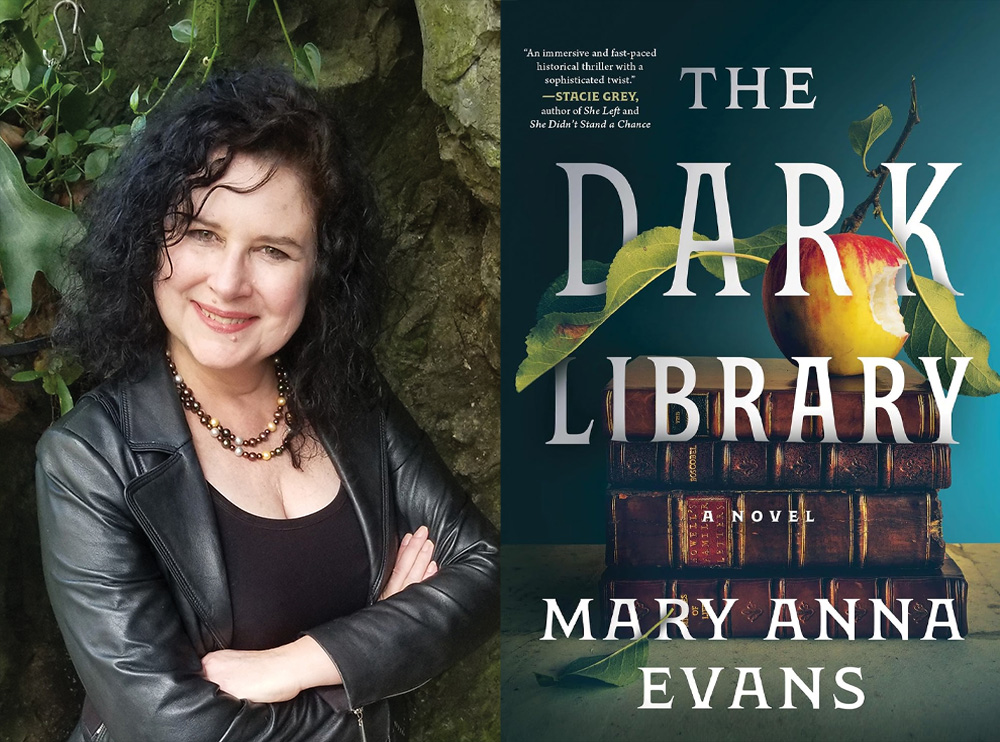
Guest post by The Dark Library author Mary Anna Evans
Mary Anna Evans is the author of the Faye Longchamp archaeological mysteries, which have received recognition including the Benjamin Franklin Award, the Mississippi Author Award, and three Florida Book Awards bronze medals. She is an assistant professor at the University of Oklahoma, where she teaches fiction and nonfiction writing. Winner of the 2018 Sisters in Crime (SinC) Academic Research Grant.
About The Dark Library: Suspenseful and unsettling but ultimately triumphant, The Dark Library by acclaimed author Mary Anna Evans is a compelling tale of mystery, family secrets, and the quest for truth.
“I’m a writer and, therefore, automatically a suspicious character.” ― Alfred Hitchcock
“Where do you get your ideas?”
It has been more than twenty years since my first book came out. Even after all this time, the question I’m asked most often has never wavered. People want to know how a book comes to be, and they are particularly interested in the first step in the process. So where do those ideas come from?
I always try to answer seriously, because a flip answer—“I find them lying in ditches by the side of the road”—disrespects the person who is asking a serious and valid question, despite the fact that my “roadside ditches” joke has some basis in fact. The germs of the plots of my first two books came to me while I was making boring interstate drives that I’d made many times before. At such times, the mind wanders, and sometimes it stumbles over a good idea while it’s roaming around. When you’re a crime novelist, those good ideas often involve murder and darkness. Most importantly, they involve suspense, because it’s the emotion that makes readers turn pages.
In a suspenseful novel, every page promises more excitement to come, and the book is a promise that all this excitement will come to an emotionally satisfying and logical ending. This approach to plot—a logical sequence of promises that lead to a satisfying conclusion—goes back to Aristotle, and it is also true of storytelling that don’t involve pages. In the world of film, Alfred Hitchcock was a master of plotting and suspense, and it was to Hitchcock, not a fellow novelist, that I turned when I was writing The Dark Library. I wanted a story so steeped in foreboding that I didn’t have to tell readers, “This situation is creepy!” They would automatically know.
Nobody working in the past century could instantly signal that sense of dread better than Hitchcock. In the previous century, though, writers of Gothic fiction—many of them women—laid the groundwork for his films. Thanks to the Brontës, Mary Shelley, Ann Radcliffe, and their fellow Gothic writers, we know that the gaiety of a costume ball is a frail disguise for the secrets the guests are hiding. (And don’t we all have secrets?) We know that a young woman, alone in the world, who sets out to earn a living as a governess or paid companion, is exquisitely vulnerable to the people who pay her wages, but we cheer her bravery in doing it anyway. We know that the crumbing ruins at the top of a windswept cliff are dangerous, but their beauty makes them an irresistible draw. We know that jewelry given by someone who wishes you ill is cursed.

With those things in mind, imagine how much I love my new home in a quaint town nestled between cliffs lining the Hudson River, a place so beautiful that it inspired a whole school of artists. It’s a landscape that’s been inhabited for so long that ruins and graveyards and battlefields are everywhere, reminding us of death in the midst of life.
In North by Northwest, one of Hitchcock’s most famous films, Cary Grant’s character takes a train ride out of New York City on a track that hugs the Hudson’s curves. As he flirts with a mysterious woman played by Eva Marie Saint, the dramatic cliffs of the Palisades parade past the window behind them. This evocative landscape is the reason, I think, that Hitchcock chose to put Grant and Saint on that particular train. The scene fascinates me personally, because the train passes a certain beautiful hill that I can see from my kitchen window. Its soft beauty and dangerous height put me in a Gothic frame of mind, and I like thinking about how this view that inspires my stories also inspired Hitchcock more than sixty years ago.
As it turns out, I don’t even have to drive down the highway looking in ditches for story ideas. I can just look out my kitchen window.