


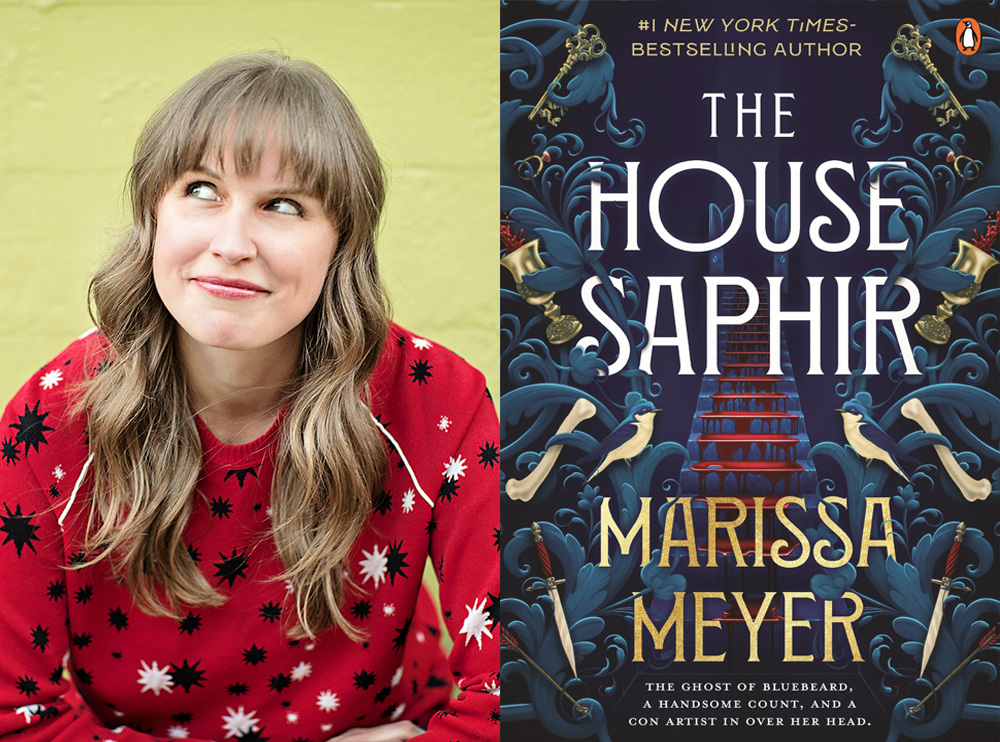
We chat with author Marissa Meyer about The House Saphir, which is a thrilling tale based on the infamous Bluebeard legend. Fans of Holly Black and Leigh Bardugo will adore this perfect combination of romantasy and murder mystery.
Hi, Marissa! Welcome back! It’s been three years since we last spoke for the release of Cursed. How have you been and what have you been up to?
Thank you for having me back! It’s certainly been a busy few years, with the release of With a Little Luck (my D&D-themed romcom), Let It Glow (my first middle grade, co-written with Joanne Levy), The Happy Writer (my first nonfiction writing guide), We Could Be Magic (a sweet, body-positive graphic novel), and now The House Saphir! I also got to announce recently that my first series, The Lunar Chronicles, is being adapted for film by Locksmith Animation, with a planned release date of Fall 2028. So many great things to celebrate!
Your latest novel, The House Saphir, is out November 4th! If you could only describe it in five words, what would they be?
Con artist versus murderous ghost.
What can readers expect?
The House Saphir follows Mallory Fontaine, the foremost expert on Monsieur Le Bleu – a man who murdered numerous wives a century before. Though Mallory and her sister are descended from a line of witches, Mallory has no magic other than the ability to see and speak to ghosts. But when the handsome Count Saphir asks for her help to exorcise Le Bleu’s ghost from his family manor, and offers a large sum to do it, Mallory gladly accepts. But when murder again comes to The House Saphir, she wonders if she could be in over her head – not only in facing down a murderous spirit, but also because she seems to be losing her heart to a boy who might just be a killer himself.
There are heavy gothic romance vibes in the book, but I also had a lot of fun playing with language and levity to sprinkle in a fair amount of humor as well. It was super fun to write, so I hope readers will find it just as fun to read!
Where did the inspiration for The House Saphir come from?
This books is inspired by the fairy tale “Bluebeard,” which is about a girl who marries a wealthy aristocrat, only to discover he murdered his previous wives and is coming for her next. This story captivated me when I first read it as a child, in part because it was in a little book of children’s stories, yet was so very unlike the stories of “Cinderella” and “Sleeping Beauty” I was more familiar with. I’ve been wanting to give my own spin to the story for a long time, and eventually started to ask what happened to the wife that survived in the fairy tale, and what might happen if the ghost of Bluebeard ever returned.
Were there any moments or characters you really enjoyed writing or exploring?
Many! I think the character that stole my heart the most is Triphine, the ghost of Le Bleu’s first wife. She’s a bit of a hypochondriac (even though she’s dead), and also has no filter in a way that really keeps Mallory on her toes. Originally Triphine was only going to be in the opening sequence of the book, but she kept making me laugh as I was writing her, so at some point I realized that I needed to find a way to weave her into the rest of the plot.
Can you share with us a bit about the timeline from concept to completed book?
The concept started growing in my mind many years ago . . . I’d say close to a decade at this point. But in its earliest stages it was going to be a contemporary setting. It wasn’t until after I finished Gilded and Cursed and knew there was more to be seen of that world that I began to explore setting my Bluebeard retelling in a different country within that same world, where I could piggyback on a lot of the established mythology and magic. That’s when the story really started to come together. My memory is fuzzy on specifics, but I think it took about nine months to write and revise once I got started – though I was balancing other projects at the same time, which is always the case these days.
Did you face any challenges whilst writing? How did you overcome them?
In my early planning of the book, I got really hunt up on the idea that Count Armand needed to get married as a part of the magic that would expel the wicked ghost. I couldn’t shake it for the longest time, and kept trying to work with this plotline. At first he was betrothed to one of Mallory’s childhood friends, then I changed it to him being betrothed to Mallory’s sister, and for a time I thought maybe him and Mallory would have an “engagement of convenience,” but nothing ever felt right. Finally I decided to go back to the drawing board and see if I could scrap the whole marriage thing entirely, and that’s when the plot really started to fall into place.
What’s the best and worst writing advice you’ve received?
Best: Don’t worry about writing a terrible first draft. Hush that inner editor and get to work. Focus on getting the ideas down and following the inspiration, and know that you can make it better later.

Worst: Write what you know. Gosh, I hate this advice. I know people mean well, but I find it so limiting. I prefer to tell people to write what they’re curious about, because that will keep you inspired and make the research more fun.
What’s next for you?
My first murder mystery is coming out in April: The Escape Game, co-written with Tamara Moss. It follows four teenagers through an escape room reality TV show competition in which one of the former contestants wound up dead. It’s twisty, turny, and puzzle-heavy, and we are so excited about it!
Lastly, what books have you enjoyed reading this year? Are there any you’re looking forward to picking up in 2026?
Two books that I’ve loved recently include Most Likely to Murder, a fast-paced thriller by Lish McBride that is coming out next spring, and Wayward Gods by Amanda M. Helander, the second part of a fantasy duology with a delightfully snarky protagonist.