


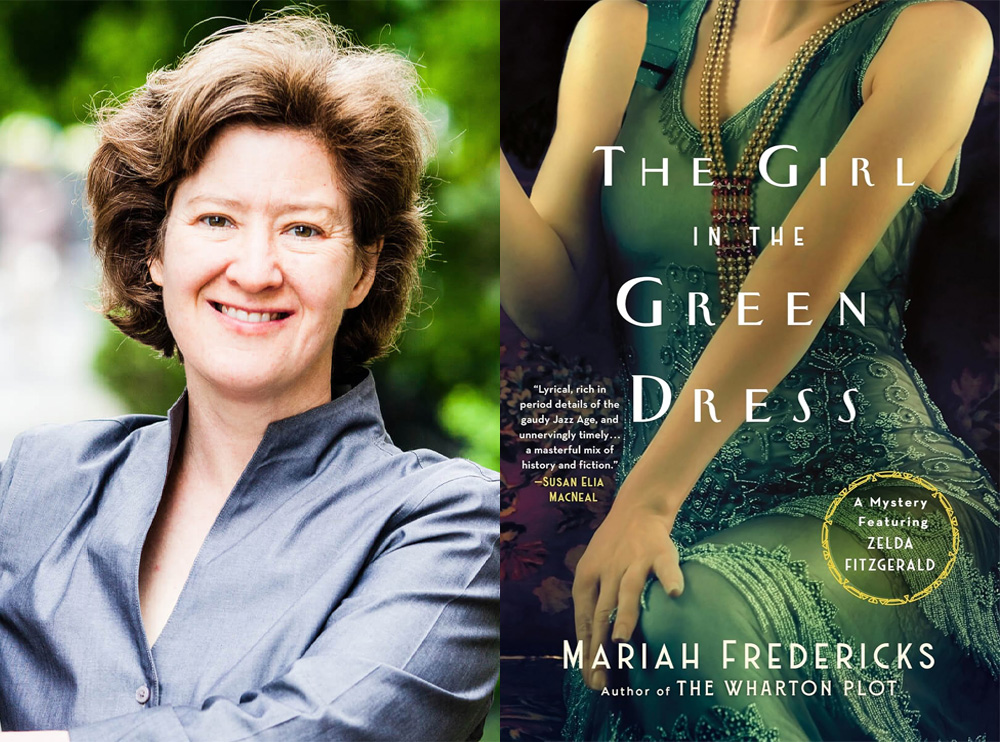
We chat with author Mariah Fredericks about The Girl in the Green Dress, which is an evocative mystery about the 1920 murder of the gambler Joseph Elwell, featuring New Yorker writer Morris Markey and Zelda Fitzgerald.
Hi, Mariah! Can you tell our readers a bit about yourself?
I’m a story junky. I’m the author of seventeen published books, with an eighteenth on the way. A lifelong New Yorker. Dog lover, although my French bulldog is more than cat than canine. I love the things most story junkies do: theater, British TV, cities, gossip, true crime.
When did you first discover your love for writing and stories?
Richard Scarry’s What Do People Do All Day? There was something about all those little animals living in houses and you got to peek inside their windows and see what, in fact, they were doing that got me fascinated with people’s lives. I had a speech impediment and didn’t speak clearly as a child. Writing was a much safer way to communicate.
Quick lightning round! Tell us:
- The first book you ever remember reading: Pat the Bunny. I thought it was about a bunny named Patrick.
- The one that made you want to become an author: Tinker, Tailor, Soldier, Spy. I was seven. I didn’t read it. But my parents were obsessed with the story, and I understood writing a book like that as a way to get attention and admiration.
- The one that you can’t stop thinking about: Lincoln in the Bardo. I read it once a year. It has everything I love in a story: history, death, tragic children, secrets, scandal, horror and humor. It’s so far beyond anything I can write, but the storytelling has my values.
Your latest novel, The Girl in the Green Dress, is out now! If you could only describe it in five words, what would they be?
- 1920s
- Zelda Fitzgerald
- Locked room
- Romantic
- Celebrity
What can readers expect?
They should expect to experience the fantastic, frenetic Jazz Age—and see that it was huge fun for many, but not all, and not always. They get to hang out with the newly married Fitzgeralds. I hope they find the real-life characters compelling and believable, the themes of success and failure in America poignant. And I hope, of course, they’re surprised by whodunnit.
They should not expect the novel to be told from Zelda’s point of view. She was having far too much fun to be focused solely on a murder investigation. She only gets involved because Scott is being boring and working too much.
Where did the inspiration for The Girl in the Green Dress come from?
The idea came from a 1950 Esquire article on the cold case of Joseph Elwell, a gambler and lothario who was found shot through the head in his NYC townhouse in 1920. That same year, the author of the article, Morris Markey, was found in his home, also shot through the head. A writer who dies in the same way his subject did—but thirty years later—was fascinating to me.
Were there any moments or characters you really enjoyed writing or exploring?
Elwell was last seen in public at the notorious Midnight Frolic, an after hours cabaret created by Ziegfeld. The Fitzgeralds often attended the Frolic, so they take Morris Markey in search of the people Elwell was with the night he was shot. It was a wild, hedonistic scene and great fun to write.
With The Girl in the Green Dress set in the 1920s, can you tell us a bit about your research process?
For details on the Elwell murder, I relied on The Slaying of Joseph Bowne Elwell by Jonathan Goodman and tabloid newspaper reports. For the Fitzgeralds, the many biographies of them, plus the memories of people who knew them at the time like Edmund Wilson and Alexander McKaig. McKaig is particularly good on the early days of the Fitzgerald marriage and Zelda’s adventures without Scott. Morris Markey left a treasure trove of magazine articles. I focused chiefly on his voice with the New Yorker, and he is described in the letters of James Thurber and James M. Cain.
Did you face any challenges whilst writing? How did you overcome them?
It would be very easy to present a Southern manic pixie dream girl and call her Zelda. I didn’t want to do that, despite the fact that was a role she was playing at the time. So I leaned into her more complicated side. She could say childish, hurtful things—why did she say them? She was fiercely frivolous—why? What example of womanhood had been presented to her? What does it mean to be famous so young? The book is not from her point of view, but I always ran the situation through her perspective in my head.

Second, there are three theories as to how Morris Markey died: accident, suicide, and murder. There are compelling arguments for the last two. Finding what I felt was the truth was a deep—but rewarding—challenge.
What’s next for you?
My Christmas album! A mystery set against the backdrop of the Macy’s Thanksgiving Day Parade. It’s 1932 and someone is trying to kill Santa Claus.
Lastly, what books have you enjoyed reading this year? Are there any you’re looking forward to picking up?
The problem with writing about writers is you don’t get to read much beyond their work. John Copenhaver’s Hall of Mirrors was knockout. I’m reading The Topeka School because my son told me to. I’m dying to read Susan Elia MacNeal’s upcoming book, Last Mission to Paris and Sujata Massey’s new Perveen Mistry, The Star from Calcutta.