


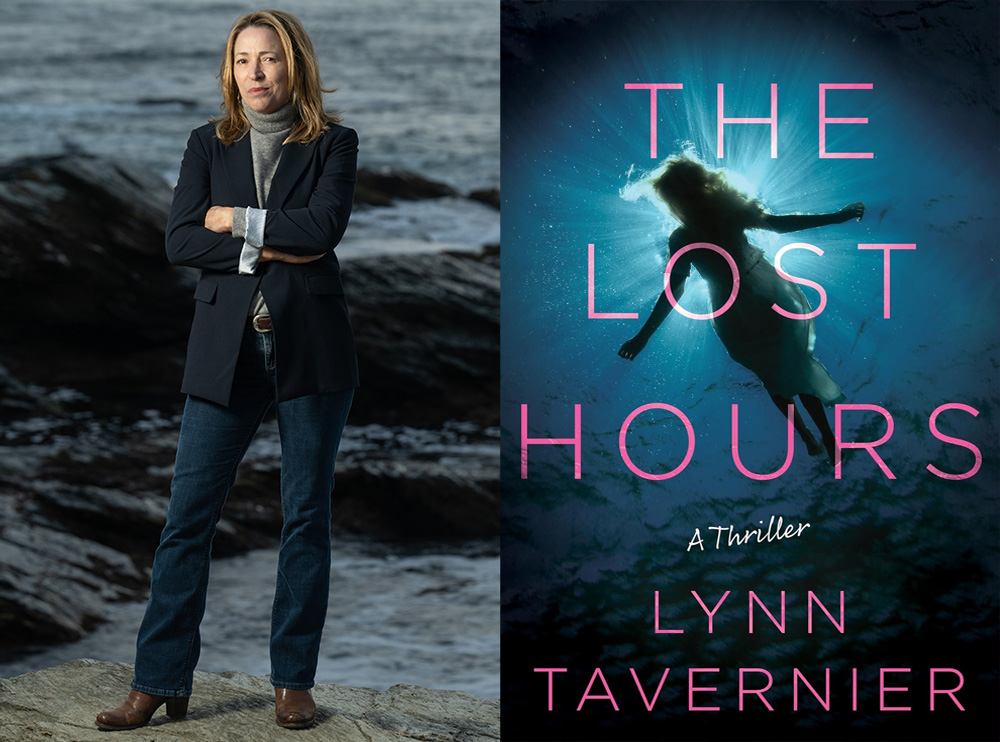
We chat with author Lynn Tavernier about The Lost Hours, which follows an embattled detective who investigates the suspicious death of a wealthy young socialite and she unearths long-buried family secrets.
Hi, Lynn! Can you tell our readers a bit about yourself?
I grew up in the mill town of Woonsocket, Rhode Island. After graduating from Sarah Lawrence College, I spent twenty-five years in restaurant management including owning the French bistro, Chez Pascal, on the East Side of Providence. After selling the restaurant, I began a second career in residential real estate sales. I started The Lost Hours years ago and while I fiddled with it from time to time, the manuscript collected dust while life got in the way. When the kids were finally launched and the days felt ever precious, I knew it was time to give my dream a chance and got to work editing the manuscript with the goal of publishing. I submitted to two writing contests while revising, and to my surprise, I received a Claymore Award for Best Unpublished Mystery at the Killer Nashville writing conference, and they recognized me as a finalist for the CWA Debut Dagger Award. Both instilled confidence and encouraged me and gave me some sense that I just might be on to something.
When did you first discover your love for writing and stories?
I cut my teeth on Nancy Drew, then fell in love with the mystery classics: Agatha Christie, Dorothy Sayers and P.D. James among so many others. My itch for writing, however, arrived in the 7th grade with an assignment in English class to write a short story. On the day it was due, a classmate asked if I’d read his story and he offered to read mine. I attended a Catholic school and the brothers were strict, so when the bell rang signalling it was time for homeroom, I held out my hand for my work. My classmate insisted he needed to find out how the story ended. I was a nervous kid and dreaded explaining to my parents why I’d been kept after school, but I was so taken by his enthusiasm for my writing that, in that magical moment, getting detention for being late didn’t matter.
Quick lightning round! Tell us:
- The first book you ever remember reading: The Wonderful Flight to the Mushroom Planet by Eleanor Cameron.
- The one that made you want to become an author: The Nancy Drew Series. I would read the books slower as I neared the end fearing I’d miss my character friends. After I closed the last page, I wondered idly what Nancy, George and Bess could be doing. I began to speculate if I, too, could create a story and characters that would enchant a reader and make them yearn for another adventure.
- The one that you can’t stop thinking about: Crime and Punishment by Fyodor Dostoevski. I continue to be fascinated by the belief held at the start of the narrative by the main protagonist, Raskolnikov, that certain crimes are justifiable for some greater good, and then, once committed, the unexpected mental anguish and other effects that arise. This storyline has always made me think of the endless possibilities of unforeseen consequences that can ensue from the commission of a heinous crime. I somehow equate these possibilities as the seeds of books yet to be written.
Your debut novel, The Lost Hours, is out now! If you could only describe it in five words, what would they be?
Gripping, atmospheric, and richly written.
What can readers expect?
Detective Andrea Stuart thought her weeklong escape to the quiet shores of Jamestown would be a time to rest, to reconnect, to forget. But a blocked call in the early hours of the morning pulls her back into a world she’s been trying to leave behind—and into a case no one wants her to solve.
Hope Philbrick—young, beautiful, and heir to one of Rhode Island’s most powerful families—has fallen to her death from a seaside cliff after her lavish pre-wedding celebration. Everyone says it was an accident. Her fiancé is grieving. The family wants silence. And Andrea has been told, in no uncertain terms, to keep her head down and follow orders.
But something about the scene doesn’t sit right. Not the missing witnesses. Not the body’s position. Not the lies—because Andrea can smell them. The deeper she digs, the more the glittering façade of privilege cracks, revealing a dark web of pressure, secrets, and betrayal that threatens to destroy more than just reputations.
To uncover the truth, Andrea must risk her career—and confront a haunting past she’s never truly escaped.
Where did the inspiration for The Lost Hours come from?
I’d been writing the second book of a mystery series for the middle grade reader when I began toying with the idea of a main protagonist for an adult series. It’d be a woman, of course. She’d be a detective but, never having considered law enforcement, an unlikely one. And if that was the case, how did this career come to be? Then I had the dream. Three times. You’re skeptical, I know. For what it’s worth, I’d be suspicious too.
In this short, vivid dream, I watch as a woman, early twenties, mascara smeared beneath her haunted eyes, pushes through a heavy, thick-glassed door. The dream returns the following night and, as the door swings open, I see the reflection of sunlight on her forehead, and the rough gray concrete of an exterior wall reminiscent of some sort of municipal building. On the third night, the sequence repeats, except this time I notice her expensive high heels. I’m wide awake and wondering, who the hell is this woman? Is that a police station she’s leaving? And if so, why had she been there? I turn on the light and jot the details in the notebook I keep on the bedside table. The dream never returns, but my questions multiply and the answers to them become the beginnings of a character profile for Andrea Stuart, the main protagonist of The Lost Hours.
Many weeks later, I’m fascinated by a disturbing story dominating the news. It’s hard not to gawk when the headlines involve the very rich perpetrating unconscionable acts. It makes me wonder what would compel someone who wants for nothing to behave in a manner that risks their family, their wealth, their freedom. The answers to these questions circle the fundamental yearnings of every man and woman regardless of economic class. Just like that, my ideas coalesce; I have an unlikely main protagonist, know her backstory, and why she gave up higher education to become a cop. I know who my antagonist is and what compels them to commit the unthinkable. It thrills me to imagine pitting one against the other.
Were there any moments or characters you really enjoyed writing or exploring?
I loved writing all the characters and feel that I am some part of each of them. But I have a soft spot for my main protagonist’s mother (yet unnamed), and I look forward to exploring her evolution as a role model and her changing views on life as she ages and on motherhood as the series moves forward.

Did you face any challenges whilst writing? How did you overcome them?
I outlined and completed a first draft and then a second, but there were problems. The story dragged when the dramatic tension should have been ramping up. With a towering stack of books to be read, boredom is the death knell of just about any book I’m reading. After much furrowing of the brow, it finally occurred to me that my error was in the liberties taken with the novel’s structure. Once again I outlined, this time including what each scene needed to accomplish and the specific piece of information each would deliver and, most important, that the major plot points arrived at the right place within the narrative. Reviewing these bullet points with the corresponding chapter helped eliminate extraneous material that didn’t move the narrative forward and dragged the pacing. This process also helped identify what was missing and to tie up dropped threads. It wasn’t the most efficient way to write a novel, but as I work on the next book in the series, the lessons learned are gratefully paying off.
This is your debut novel! What was the road to becoming a published author like for you?
None of my preconceived notions of the publishing process were remotely correct. I received incredible support and guidance from my literary agent from Trident Media Group, Mark Gottlieb, and my acquisition editor, Tara Gavin, and from the editorial and marketing teams at Crooked Lane Books. I am grateful for their assistance while I worked to finetune my manuscript into a book that I am extremely proud of.
What’s next for you?
I’m at work on the second book in the series and am thrilled to have a new complement of unseemly and disreputable individuals in my head. Rhode Island, in close proximity to New York and Boston, has a colorful history of organized crime, and given the small size of the state, I expect we’ve all had our brushes with it. My parents owned a locally famous chicken restaurant that had evolved from a neighborhood social club and began in the cellar of our family home. A patron and friend of the family was a federal marshal who started the witness protection program with Bobby Kennedy. Very few knew, of course, but what’s more astonishing is that he brought several of his charges to dinner. However, instead of going through the front door of the restaurant, he hustled them, guarded by a consort of agents, through the back door of my family home and down a set of stairs into one of the dining rooms. A few years later, I put two and two together after seeing the book, My Life in the Mafia, by Vincent Teresa, on my parents’ nightstand. There was no mistaking the large man on the book flap with the man who I feared might become stuck in the narrow passageway that led into the restaurant. My work in progress has been simmering for some time and, of course, involves an element of modern-day organized crime.
Lastly, what books have you enjoyed reading this year? Are there any you’re looking forward to picking up?
When I’m writing, I like to read beautifully written, sweeping narratives, as well as work that inspires my craft. This past year I enjoyed Abraham Verghese’s The Covenant of Water, and Maggie O’Farrell’s The Marriage Portrait. I also decided to reread Christie’s Miss Marple series. The Marple books are well-plotted and instructive in the deft manner with which she inserts clues. And, finally, I read the eighth book in Adrian McKinty’s Sean Duffy novels, Hang on St. Christopher. Set in Northern Ireland, McKinty writes what he knows, and he knows his people. His character development is inspiring in that his characters leap fully formed from the page and stay with you long after you’ve finished the book. I can only hope that one day someone feels the same about my own.