

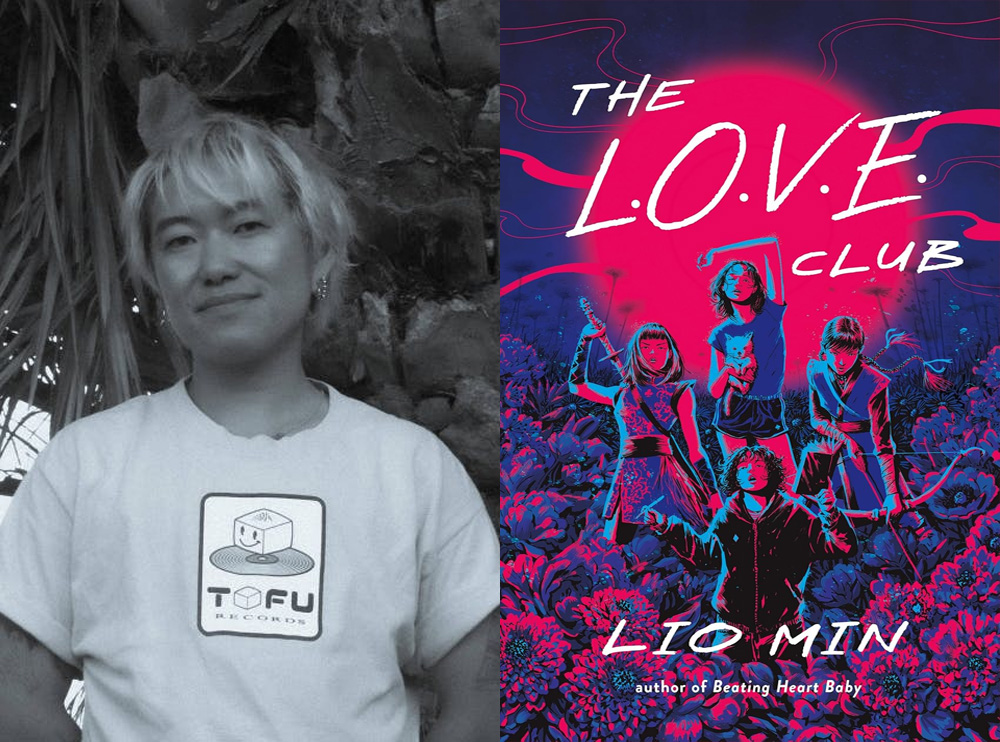
We chat with author Lio Min about The L.O.V.E Club, which is an immersive novel following three estranged high schoolers who are pulled into a video game to pursue the disappearance of their friend.
The L.O.V.E. Club is an immersive novel following the friendship of three estranged high schoolers who are pulled into a mysterious video game after the disappearance of their fourth friend. Can you tell us a little bit about where the idea for this book came from?
Some years ago, I learned that something had happened to a girl I’d grown up with, who had, at various points in my life, been one of my best friends. This got me thinking about a lot of the girls I grew up with, most of whom I am not in contact with now. As a kid, I constantly compared myself to these girls, many of whom shared the same ethnic heritage and (in my mind) outperformed me when adhering to and fulfilling that heritage’s standard of girlhood and then womanhood. This feeling eventually evaporated when I came to the realization that the friction between us was almost entirely self-manufactured. But the wounds that I’d given myself and then reflected back onto those relationships remained, and I wasn’t sure if or what could heal them. The L.O.V.E. Club is my attempt at an apology, but more intrinsically it’s an attempt to unravel the behavioral patterns we’d repeated through our generation, and which remain (and perhaps have even strengthened) in the generations that have come after mine. Or more simply, how misogyny embedded in tradition is passed down as a curse.
The shorter but maybe more true answer: I woke up from a dream with tears in my eyes and immediately knew that what I’d just dreamed would become the keystone scene of whatever I wrote around it.
Following your acclaimed debut Beating Heart Baby through the contemporary world of art and music, your sophomore novel The L.O.V.E. Club ventures into the world of video games and science fiction. What interested you about writing within the SFF genre for this novel?
Having now met a lot of children’s authors, I hear a lot of them say, “I wrote this novel for my younger self”… My younger self would not have picked up Beating Heart Baby! The stories I’ve been drawn to the most throughout my life have all been genre fiction. That baseline, combined with a scholarly interest in video game storytelling—how video games as a set of mediums can be applied structurally to the novel— pushed me into writing The L.O.V.E. Club as a genre novel. Beating Heart Baby was an extension of my working life as a music journalist; The L.O.V.E. Club is pulling from a much more foundational part of my person.
Which video games or other media influences do you feel inspired the creation of The L.O.V.E. Club and the world of Morning Glory?
The biggest influence on TLC is a subgenre of magical girl anime that I would broadly label as
“psychological horror mind games.” I would not recommend these to first-time anime watchers: Revolutionary Girl Utena, Wonder Egg Priority, Puella Magi Madoka Magica, From the New World, Land of the Lustrous, Sonny Boy. I would recommend these though: Witch Hat Atelier (actually a manga), Cardcaptor Sakura and its follow-up Tsubasa Reservoir Chronicle. I also thought a lot about the films Paprika and Annihilation.
As far as video games go, I actually don’t play many (or any actively). But I drew inspiration from video game-adjacent books like the novel Tomorrow and Tomorrow and Tomorrow by Gabrielle Zevin, the essay anthology Critical Hits: Writers Playing Video Games, and the scholarly work Games: Agency as Art by C. Thi Nguyen.
Our main character O has been struggling with Elle’s disappearance and the estrangement of their remaining best friends Vera and Liberty before they are transported into a video game world.
What do you think O’s greatest strengths are that support them through the trials of Morning Glory?
There’s a meta-narrative throughout the book about tapping into creativity as a way to imagine a future that seems impossible now. O doesn’t know this at the start of the story, but the way she perceives the world—closely, with an attention that’s borderline obsessive—is a quality that allows her to see the bigger picture of Morning Glory on macro and micro levels. She’s the kind of person who notices patterns and sees how they fit into larger designs: a very useful skill for artists in any medium.
Flowers and Elle’s love for them are such a key element that we see throughout the story. Why were you interested in using botanical motifs in this narrative?
My relationship to the natural world changed when I read Jenny Odell’s low-key manifesto How To Do Nothing. Among other things, it helped reorient my attention to seasonality and locality. I started paying attention to neighboring flowers and trees and started seriously gardening, like, growing veggie starts from seed and using raised beds and keeping a fertilizer schedule serious. I even worked in the floral department of a local grocer for a while… Not just for research purposes but also, kind of.
What truly solidified the botanical background of the story, and became an anchoring image in The L.O.V.E. Club, was when I learned about a type of flower mutation called “fasciation.” I had this moment of, “Every single person in the world should know what this is,” and the floral imagery really bloomed forth after that.
The L.O.V.E. Club thoughtfully explores the complexities of the relationships between the four lead characters through racial identity, gender expression, sexual identity and class. Why was it important for you to write this YA narrative with a focus on queer Asian American friendship?
This is maybe the one thing that The L.O.V.E. Club has in common with Beating Heart Baby… The short answer is that I pay attention to Asian American kids out in the world and observe how this broadly classified demographic has, and hasn’t, changed in behavior and beliefs from my own childhood. One of the biggest barometers of change in the past couple of decades is if/how gender and sexuality are openly expressed and accepted in “the culture.” Both of my books attempt to thread the needle of giving a lay of the land now, while offering a way forward into deeper understanding and acceptance.
Each of the characters plays a different role in their friendship as they do with the classes they play as when they game together (tank, archer, healer, thief). Why do you think they are best fit for these classes and what class do you think best aligns with you?
The classes came before the characters and helped define their personalities and arcs. I picked the class archetypes that make up a well-balanced fighting/exploration team and fragmented Chinese
American femininity through them, then crystallized those exaggerated qualities in the characters. One example: the tank, the brute strength enforcer, isn’t equated with soft interiority. This characterization might work for a fighting game but it immediately expresses something different when the vessel is a teenage girl who plays sports, particularly a teenage girl whose cultural background values a narrow aesthetic of strength and power in women.

The qualities that make up a well-balanced fighting team don’t necessarily make for the qualities that make up well-balanced friendships. Much of The L.O.V.E. Club is spent clarifying who the girls actually are versus how the girls act when they’re with each other and in the world out of habit, and then, how do their true selves work together? Can they work together anymore? I’ll leave it at that.
As for myself, it’d be so sick to be a sorcerer but in a world with magic, I’m gonna keep it real and say that I probably wouldn’t have powers. Maybe I’d run an inn, keep a garden and feed wayward travelers.
Without giving away any spoilers, what was one of your favorite scenes in the book to write?
The first time I unlocked the crane scene, I knew I’d be able to do the rest. That alone makes it a favorite.
What books are currently on your nightstand?
Jamie Hood’s Trauma Plot, which I won’t recommend casually, and Dean Spade’s Mutual Aid, which I think should be injected directly into the brain stem of every person in the world.
Lastly, we have to ask – what are you working on next? Without giving too much away, can you give readers any hints as to what they can expect from your next book?
Idols, illness, and eco-terrorism :^)