
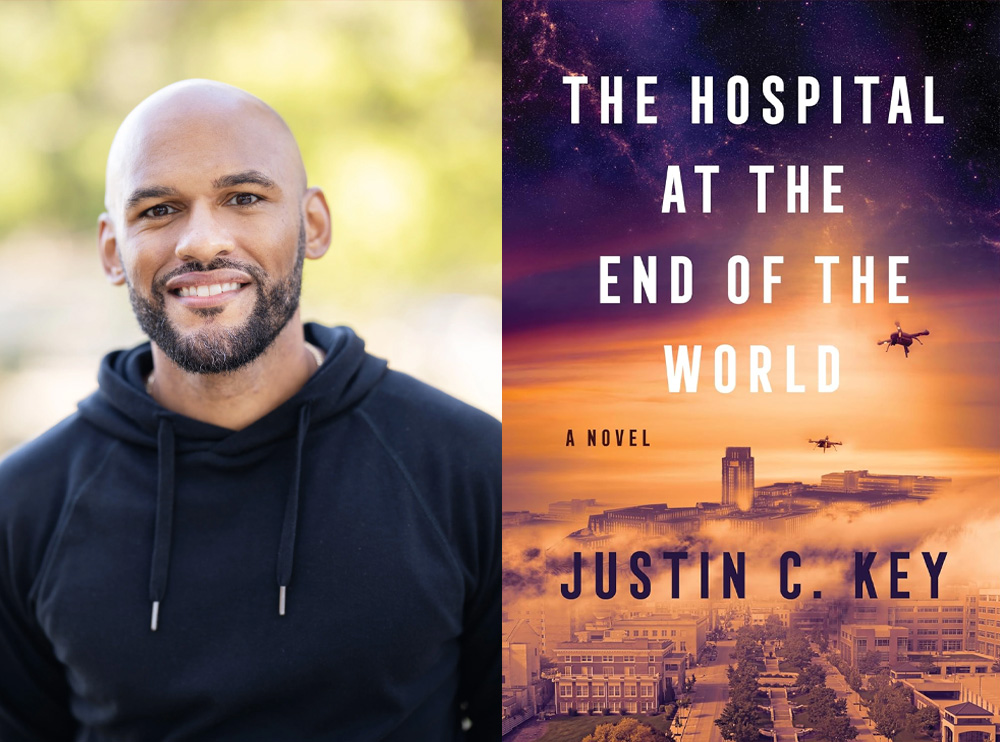
We chat with author Justin C. Key about The Hospital at the End of the World, which is set in a near future where artificial intelligence runs the world, involving a young medical student who must unravel family secrets to uncover the truth of his father’s mysterious death.
Hi Justin! Can you tell us a little bit about yourself?
I am an author and a psychiatrist. I say it in that order because I’ve been a writer for a very long time. I was a writer as I went to med school, as I went to residency. I started off writing horror, but then as I went through medical school, I just naturally shifted more towards science fiction. So, I’m a psychiatrist, I’m an author, I’m a husband, I’m a father— I can go into more detail, but that’s me.
In a few words, can you sum up for us what your The Hospital at the End of the World is about?
The Hospital at the End of the World is my first novel, a speculative fiction thriller that follows the Afrofuturism tradition of Octavia E. Butler. It focuses on the broader implications of medical treatment and the value of human connection in the age of AI, but it applies to so many other things – art, law, sports. I wanted to explore the idea that as technology goes forward, hopefully we can use it as a tool to enhance human connection instead of to replace it.
The novel follows young medical student Pok as he flees an AI-driven New York City to learn old-fashioned medicine in New Orleans, the last hold-out city that’s refused to adopt AI. Pok must navigate the difficulties of medical school while unraveling family secrets to uncover the truth of his father’s mysterious death.
Where did the idea for The Hospital at the End of the World first come from?
I was just starting medical school in New York at the Icahn School of Medicine at Mount Sinai, right in the middle of Manhattan, between the Upper East Side and East Harlem. I had been writing a lot going into medical school and had started submitting to short story magazines. There was one, Crossed Genres, which would do themed submissions. And I saw one of their themes was school and I thought “I’m in school, and I love school stories,” so I sat down, tried my hand at a short story about AI and medicine and medical school and then it evolved over time. Thankfully, I didn’t sell it then. It wasn’t ready – and I wasn’t ready.
How did the story evolve?
Over time I was able to think, “Okay, what is it that I really want to say? What has changed as I have gone through medical school and become a doctor?” In the very beginning I’d only gone through a few medical school classes, and then over the years, as I’ve come back and I’ve expanded the story, I’ve thought about what it means to be a doctor. I’ve also thought about what it means to use technology as a doctor, and some of the threats of technology. The story of Pok and the shepherds was always an AI versus medicine one at its core. And then, boom, in the last few years, the future is almost here. It’s a very timely topic. And now, being a practicing physician, it has evolved from an interesting thought experiment to a deeply important topic. I want to make sure it’s all portrayed on the page responsibly: the importance of thinking about AI responsibly and its role in medicine and also include a lot of warnings as well.
Do you feel like your time at med school and as a doctor has really informed your writing and in particular, this book?
One of the things that’s been very rewarding for me in writing this novel is being able to rediscover the power and the joy of becoming a doctor, because it’s very hard going to medical school, very difficult to feel that it’s rewarding in the moment because you’re worn down over work, anxious and exhausted, having to fight in this hierarchy with all of these other overachievers while trying to actually learn patient care. And that’s reflected in the book as well. And, as I was writing, I was also able to think about – what are the powerful moments about being a doctor? That informed my writing.
I definitely like to draw a line between reality and fiction and I don’t ever actively think about how a patient’s presentation could be used in my writing, but more about what it means to treat patients and be a healer. A lot of the beats, the emotional beats, the character interactions and just the difficulties of becoming a doctor, those very much inform what makes it on the page.
What excites you most about the potential advances in AI medicine, and what worries you?
What excites me the most is thinking of technology as a tool where it can help fill in some of the gaps of human fallacy and help the doctor patient relationship be more dense with humanity, so that there’s less time spent transcribing notes, reviewing all the different labs, or trying to sift through years and years of patient history to bring out insights. AI could be very powerful in consolidating all that data and in being able to reference insights from all the billions of different patient interactions in the world and pull from all the latest research.

A powerful, responsible AI could function as a resource in real time for physicians, so that they are more confident that they’re not missing anything. Then they could spend more time worrying and thinking about the person in front of them. What scares me the most is the idea of AI replacing human physicians. There are many issues with our current healthcare system and many barriers for people getting care and, understandably, a lot are turning to AI as a replacement because they have nothing else. Even thinking more nefariously, how long until insurance companies say, it’s cheaper for you to meet with this AI doctor?
And while there may very well be things that can be taken care of with a chatbot, I only have to think about my experience with over-the-phone AI customer service. Ninety-five percent of the time, after three minutes, I’m asking, “Can I get to a person?” And just imagine experiencing this as you urgently seek medical care. Overall, I believe that there’s innate value from that humanto-human interaction that I just don’t see AI replicating. Doctors are also frustrated that their patients don’t have better access. The solution isn’t to replace them with bots, but to enhance them with tools.
Are there one or two key messages that you really hope readers will take away from reading your novel?
The future can be exciting and can push us to have better lives and better quality of life, but there’s a lot to be wary of in terms of how responsibly new technology is being implemented. Also, recognizing that a step forward for one person could be a step back for another. For example, a tracking device that tracks all metrics can give helpful insight for one individual to achieve their best self while for another, it can just add to an existing anxiety. More information isn’t always better. Our whole nervous system has evolved to silence what’s not needed so that we don’t spend the whole of our consciousness monitoring our heartbeats or the process of food digestion, for example. And then there’s the importance of human interaction. The Hospital at the End of the World is about medicine, but the value of human-to-human interaction applies to all types of things. It applies to sales, to sports, to law; it applies to art, and definitely to reading. My hope is that, no matter the shiny new tech, we don’t lose sight or the value of that human-to-human connection. Keeping that in mind, hopefully we can make sure we’re using new tech as a tool to enhance that human connection instead of replacing it.