

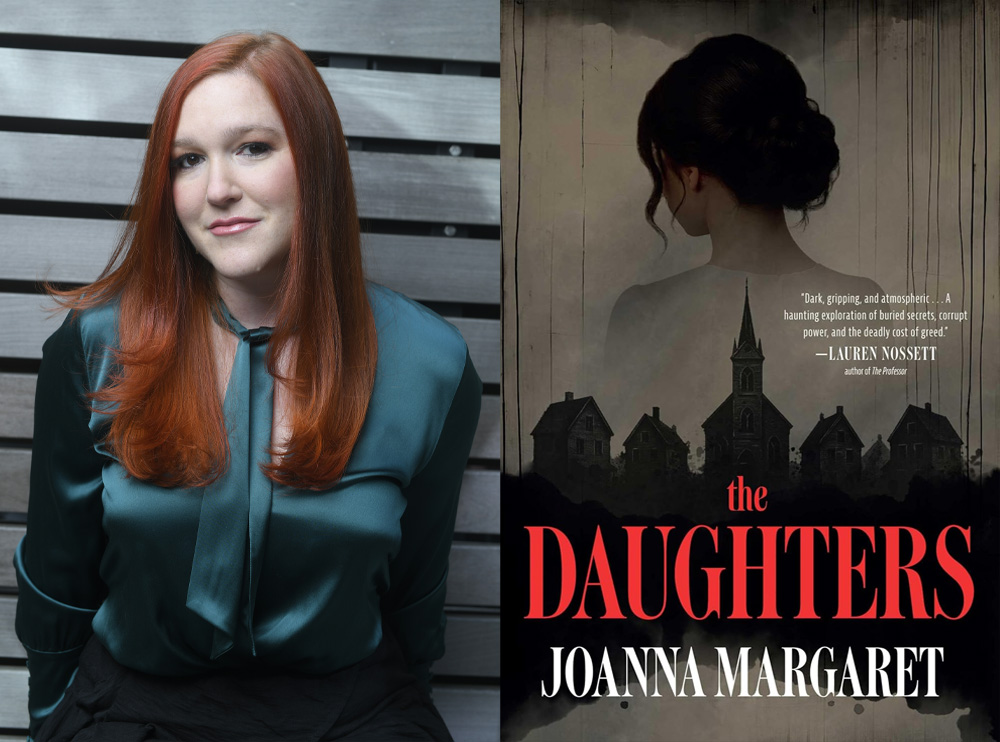
In Joanna Margaret’s second novel, The Daughters, Genevieve Tompkins uncovers a lot more than she bargained for while working as an archivist for the descendants of a New York town’s founding family. What begins as a plan to start fresh in a new place quickly turns into a series of twisted mysteries, both past and present, that she is compelled to solve no matter the cost.
Read on to learn more about how Margaret made the switch from being a historian to a writer, what famous author mentored her, and which book left her inconsolable at age 10.
Hi Joanna and thank you so much for taking time to chat with The Nerd Daily! To start, tell our readers a bit about yourself.
Thank you so much! I have a PhD in early modern history from the University of St Andrews in Scotland, and an MFA in Creative Writing from NYU. My first novel, The Bequest, was published in 2022 and follows a group of scholars in Europe who become embroiled in a 450-year-old mystery, which has eerie repercussions with their present lives. I also write short fiction. My short story, “Malena” was published in the Akashic anthology, A Darker Shade of Noir, New Stories of Body Horror By Women Writers in 2023. My second novel, The Daughters, is coming out on March 17th !
Your new novel, The Daughters, packs a lot into one story—including some interesting twists and turns! For those who may not already know the premise, how would you tell readers what to expect without spoiling any of the fun?
The Daughters follows a grieving PhD student, Genevieve, who drops out of her graduate program and moves from New York City to a small town in upstate New York to organize the archives of the town’s founding family, the Wiltons, who are rumored to be cursed. After Genevieve arrives, things start to take a dark turn, with strange disappearances among local women. Genevieve uncovers a brutal 18th century witch trial, which may somehow be connected with the ancestors of the Wilton family. Before too long, she gets caught up in a web of conspiracy and doesn’t know who to trust.
Fill in the blank: If you liked _______________, you will love The Daughters.
The Twisted Ones by T. Kingfisher
Sharp Objects by Gillian Flynn
American Gothic by Robert Bloch
What sparked the idea for this novel and what did the writing process look like for you?
When I graduated with my MFA, I was nominated for a scholarship by Joyce Carol Oates at the New York State Summer Writers Institute in Saratoga Springs New York. I lived there for a month and was struck by the unique architecture, geography, and remote and historical upstate vibes—I knew some sort of fantasy Saratoga Springs (plus Sharon Springs and some other upstate towns) would be the perfect setting for a novel.
I tend to do a lot of research before I start writing, in this case, I researched the history of American and European witch trials.
It’s fascinating to me (and makes perfect sense, considering the subject matter of your novels) that you were a historian before becoming a writer. What made you want to change fields to begin writing fiction?
I loved studying and teaching history. But, as a historian, I always felt limited by the historical record, with actual facts, formal letters, and mostly legal documents, and wanted to know what was happening in people’s minds and the behind-the-scenes versions of historical events. I think both careers have a lot of common ground, in that you’re a storyteller either way, but with a novel, you can follow your own imagination. There’s a great quote by E.L. Doctorow who founded the NYU Creative Writing Program “the historian tells you what happened, but the novelist tells you how it felt.”

How has this background in history influenced your writing and the way you approach the craft?
I had to sort of teach myself how not to write for an academic audience! Especially when you’re writing a suspense novel, you have to learn how to hold back from revealing too much information right away, which is the opposite of a historian who spells out a thesis right at the beginning. Also, I tend to do a lot of research, which is great for the historical portions of my novels but you have to be careful not to go down too many rabbit holes and start writing!
Are there any lessons you learned from writing your first novel, The Bequest, that you found helpful when working on The Daughters?
I think to limit the historical research and focus on telling your story. Also, I learned a lot about writing a mystery, and how to make more of my characters seem suspicious so a reader feels off kilter and not sure who is telling the truth.
Readers will also be excited to learn that Joyce Carol Oates was your thesis advisor in the MFA program at NYU. Can you share any lessons from her that really stuck with you?
Joyce Carol Oates was an incredible mentor and teacher. I was really inspired by her work ethic, teaching multiple classes and writing at the same time. I remember being in her workshop, she assigned stories from her own edited anthologies to go along with our workshop submissions and started class with in-depth craft analyses of the stories, alongside our own work. This was really useful in the context of a workshop for developing our craft. She really stressed the importance of developing a unique voice, and that stuck with me.
Let’s Get Nerdy: Behind the Writer with 5 Quick Questions
- The book that made you fall in love with reading: Little Women by Louisa May Alcott—I read this at 10 and was inconsolable when Beth died.
- A movie you know by heart: Dirty Dancing
- A song that makes you want to get up and dance: I Wanna Dance with Somebody by Whitney Houston
- Introvert or extrovert: Introverted Extrovert! Or is it the other way around??
- Coffee, tea, or something else: Both!