


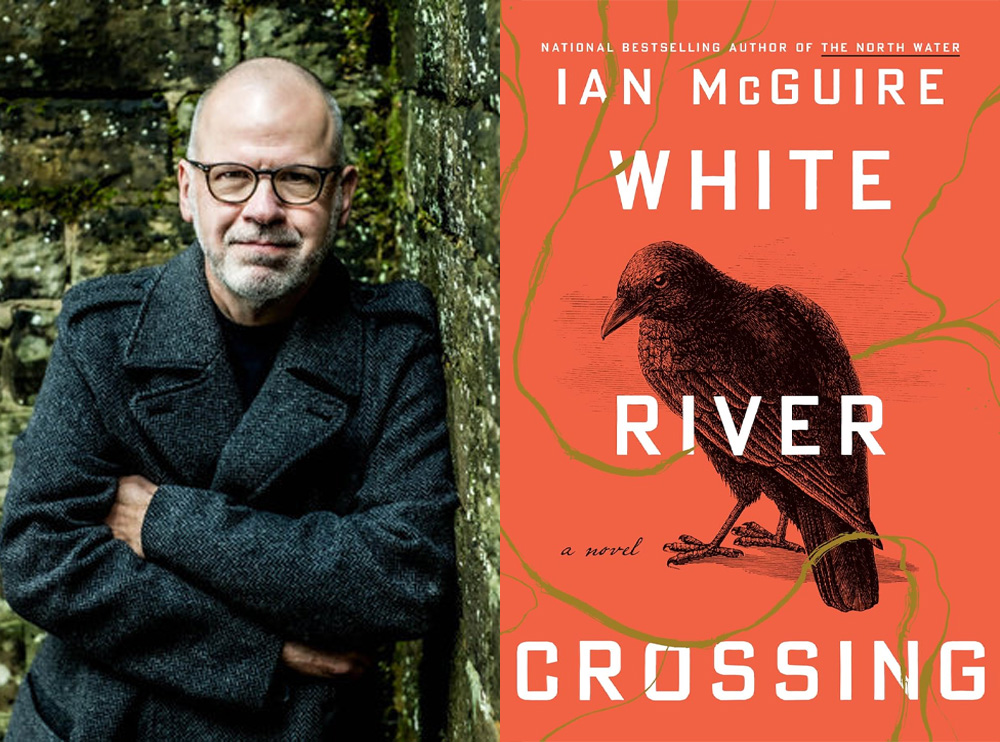
We chat with author Ian McGuire about White River Crossing, which is a breathtaking and cinematic novel about the lust for gold and its bloody consequences, set in the unforgiving landscape of the sub-Arctic Canadian wilderness, from the acclaimed author of The North Water.
Hi, Ian! Tell us a little about the history of the Hudson’s Bay Company.
The Hudson’s Bay Company is the oldest corporation in North America. It was founded by the English King Charles II in 1670 in an attempt to gain a monopoly over the North American fur trade and has, incredibly, survived to the present day, although it is presently, I believe, on the verge of bankruptcy. King Charles II, of course, had no right to grant anyone control over vast tracts of land around Hudson Bay, and the founding of the Company was, in that sense, an act of extraordinary (if, for the time, not untypical) colonial hubris.
What types of research did you conduct to capture eighteenth century Canada and the colonial fur trade? What was one of the most interesting pieces of information you came across?
I travelled to Canada in 2023 and spent some time in Northen Manitoba and Nunavut where the novel is set—mainly to experience the landscape of the Barren Grounds which resembles the moorland of northern England more than I expected it to, although there are many more lakes and the whole thing is on a much grander and vaster scale. I also visited the Hudson’s Bay Company archives in Winnipeg and spent a lot of time back home in Manchester reading first-hand accounts written by eighteenth-century fur traders.
Can you share more about the three indigenous groups the British colonialists in this area traded with during this time and that feature in White River Crossing? With so much of these groups’ history being oral, how did you go about researching these cultures and their relationships with settlers?
As a historical novelist dealing with primary sources, you learn to take certain things with a pinch of salt, to read between the lines and also to be aware of what’s not being said. When the primary sources are written by European colonists describing the manners and customs of indigenous populations, you have to be even more cautious and skeptical. Ideally, I try to strike a balance—not simply dismissing the ideas or opinions of people who were actually there, and who were often thoughtful and intelligent, but also recognizing that they were men of their time and that a history written by the Dene, Cree or Inuit would be quite different.
The North Water was similarly set in the sub-Arctic. What do you enjoy about writing these treacherous landscapes?
The job of the novelist is to make his or her characters suffer because that’s where the drama comes from and putting them into really tough environments is a pretty good way of doing that. I suppose I’ve been attracted to the Arctic as a setting because I like to strip away all, or most, of the the accoutrements of culture and civilization and then see what’s left and whether what’s left is enough for my characters to live on.
Many of your stories revolve around themes of men vs. nature, and you’ve been compared to literary trailblazers like Cormac McCarthy and Herman Melville, to name a few. Who are your literary influences?
McCarthy and Melville have been important for me as has Joseph Conrad. When I was younger, Treasure Island was a favourite book of mine, and I think my recent work owes a debt to that tradition of the Victorian adventure story. In terms of living writers, I really admire the South African Nobel laureate J.M. Coetzee, and his fantastic novel about imperialism and empire, Waiting for the Barbarians, was very much on my mind as I worked on White River Crossing.
Describe White River Crossing in three words.

Gold, cold, un-consoled.
You are joining John Shaw’s party searching for gold in the winter of 1766, bound for Ox Lake. What are the essential items you’re taking with you?
I’m a modern city-dweller who doesn’t like the cold very much, so for me a journey like that would be appallingly difficult. What would be essential to make it survivable (apart from having travelling companions who can hunt really well) would be the right clothing. In northern Canada in 1766, long before fleeces and puffer jackets existed, this meant clothes made from caribou hide with the hair left on, which, when properly prepared, is both very lightweight and amazingly warm. According to one source I read, it’s possible to sleep comfortably outside in temperatures of minus 20 Fahrenheit using only a caribou-hide ground cloth and a caribou-hide sleeping bag.
You’re sitting down to read White River Crossing. What would the ideal drink pairing be? (It can be anything: alcoholic or not, historical, etc.).
It’s a chilly novel so the drink has to be warming. Whisky or whisky-based I think. A good single malt or perhaps, if you’re feeling more frivolous, an Old Fashioned.