


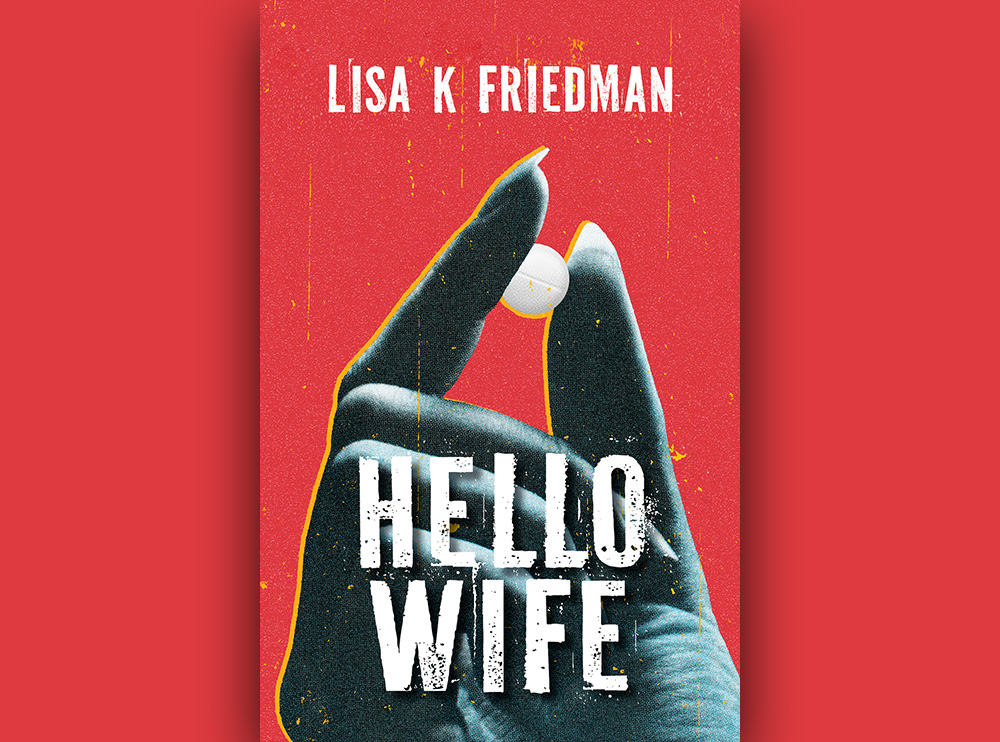
In this bittersweet, heart-piercing tale about one woman’s fierce determination to capture what she’s always wanted, despite the consequences, Lisa Friedman explores sisterly bonds, the strength of families, and the devastating impact of opioid abuse in modern America. Poignant, and at times darkly humorous, Friedman reveals the moments of grace and care that can emerge in all of our darkest days.
Intrigued? Well read on to discover the synopsis and an excerpt from Lisa K. Friedman’s Hello Wife, which releases on September 30th 2025.
Single, unfulfilled, and well into middle age, Charlotte Lansing desperately seeks love and acceptance. When she announces her engagement to an unemployed morphine addict, her family is thrown into turmoil. Her mother tries to prevent disaster, her father tries to bridge the divide, and her sister clings to the hope that their bond will protect Charlotte. But Charlotte, believing she’s finally found happiness, resists their efforts. Ultimately, they can only watch as she disappears into her husband’s addiction…
Excerpted from Hello Wife, by Lisa K. Friedman. Santa Fe Writers Project, 2025. Reprinted with permission.
I was remembered as a gorgeous child. Wisps of breezy hair, light as morning, swept across my forehead. “The color of tea with milk,” my mother described my hair color in the padded pink baby book, given to her as a gift. My eyes were a stunning centerpiece in my face, large and green in tone, fringed with dense black lashes that looked stained with ink. The rest of my features were dwarfed in comparison, little buttons of mouth and nose, hardly noticeable. My skin was a dewy pale pink. My eyes were magnets, pulling strangers in for a closer look.
“What a beautiful little girl.” Strangers stopped my mother as she pushed the stroller along the sidewalk. “Such a gorgeous face.”
Beauty is a difficulty. It inspires too much appreciation, too much attention. Beauty in a child suggests an easier life ahead. What fortune! That face is certain to open a lot of doors.
My mother described me as joyous. She said I had a ready smile. My father called me Sunshine because, as he liked to say, my face lit up the room whenever he walked in. My grandmother remembered that when she pushed me in the stroller, strangers would comment on my sparkling personality. But that was not to last.
When I was ten, my elementary school hosted a fifth-grade graduation party at the end of June. We were to gather in the gym after school for music, food, and ceremony. All day, my belly was full of twitching rabbit whiskers. I wasn’t nervous. I was excited.
Someone’s older brother volunteered to be the party photographer and he wandered along the perimeter of the gym in his all-black Ninja outfit, a camera strap secured behind his neck.
We posed together, we danced to the disco music flooding from a borrowed set of crotchety stereo speakers, we ate cupcakes and cookies baked by the PTA. We drank fizzy punch with blueberries bobbing amid the bubbles. Bliss. Until I hopped up onto the radiator where my friends perched like pigeons, and I felt my jeans tear in the back.
Of course, the students noticed. A white-hot flash of embarrassment bled across my face as boys and girls raced at me, pointing and shrieking. I didn’t see the boy with the camera, kneeling beside the bleacher.
Ratty Fatty!
I ran for the hall.
Hey, Fatso where’re you going?
Even my friends were laughing.

The photos followed me for years. In middle school, someone taped the black and white picture to my locker where everyone could see it, causing a dreadful first-day uproar. An enlargement found its way to the high school, where it was found glued to the wall above the sinks in the boy’s bathroom. An image of fat me, from the back with an apple-sized wad of white cotton bulging from between the seams of my too-tight jeans.
My mother was always careful about my weight. She deemphasized the superficial simplicity of physical beauty and held her praise for true achievements. Her compliments were not frequent, but they held a significance that I cannot explain. More than filling the library reading list chart with shiny stick-on stars. “Anyone can be beautiful,” my mother often said. “Not everyone can be clever.”
“Charlotte’s a good girl,” she’d brag. “She’s smart as a whip.”
I wasn’t smart. She simply assumed I was smart because she didn’t yet know otherwise.
By the time of my puberty, I had become an ordinary-looking girl. Moppish hair in a moody brown. Freckles like smudges darkened my once light skin. Worse, I’d inherited my father’s physique: dense layers of adipose tissue padded my short frame, thickening my limbs and banding under my chin. My shoulders sloped forward as if under constant duress from my excess weight. My eyes remained sprightly, shining green and festive with lashes like flags.
During high school, I had a summer job in my father’s office, opening mail and filing papers into folders while making cheery conversation with the secretaries. They liked me. They told me I was smart and funny and generous and kind. They told me how much fun I was to have around, and that they were sure to miss my smiling face when high school started in fall. They remarked on everything but my appearance, an absence loud as a gong.
ABOUT THE AUTHOR
Lisa K Friedman is an award-winning essayist, author, and educator. Her work has appeared in The New York Times, Smithsonian Magazine, The Huffington Post, and other publications. She is an avid sailor, an adventurous traveler, and an active participant in arts and education. She lives in Washington DC. Find her at lisakfriedman.com.