

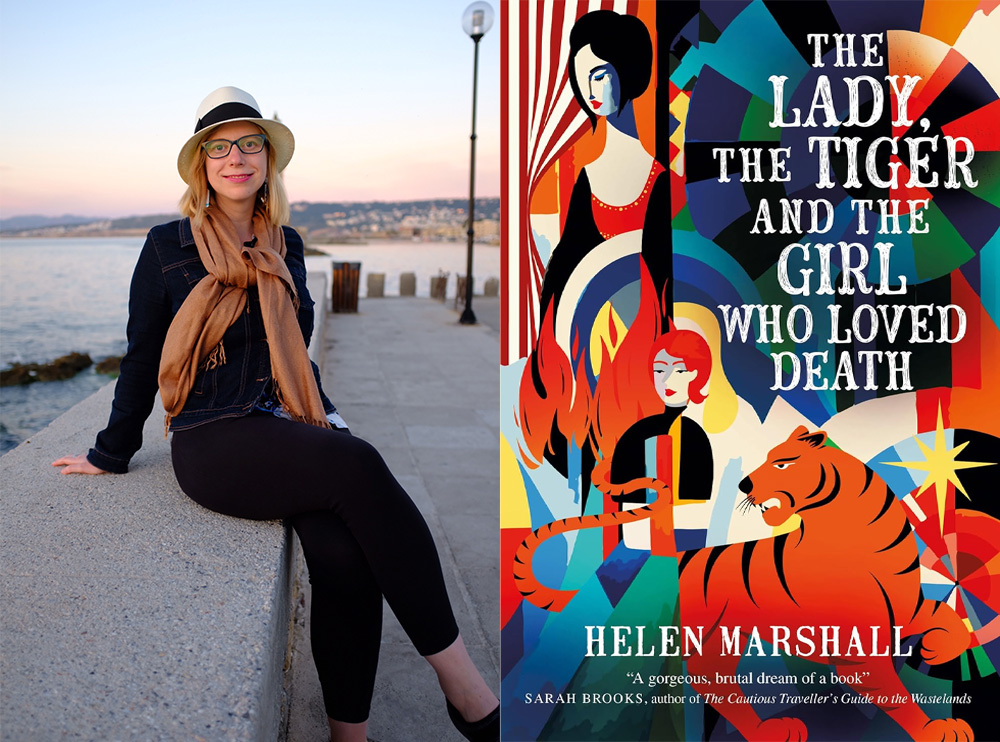
We chat with author Helen Marshall about The Lady, the Tiger and the Girl Who Loved Death, which follows a young woman who is seduced by the glamour of the circus and drawn into a dangerous world of violence, cruelty and revenge, perfect for readers of Erin Morgenstern’s The Night Circus and Helen Oyeyemi’s Mr Fox.
Hi, Helen! Can you tell our readers a bit about yourself?
I suppose my path to becoming a novelist has been wonderfully winding. I started out as a medievalist—specifically as a book historian, studying networks of book production in the fourteenth century. This meant diving deep into the mechanics of how medieval texts were actually made and distributed. I spent time doing quite meticulous work, like spending two weeks in a monastery measuring punctuation marks to understand scribal practices and how different scriptoriums operated.
What fascinated me was uncovering these intricate networks—how books moved between monasteries, how scribes influenced each other’s work, how ideas spread across medieval Europe through these handwritten manuscripts. But somewhere along the way, I discovered that what I really wanted to do was create stories of my own rather than just study how other people’s stories had been preserved and transmitted.
I’ve been quite the nomad over the years—I’ve lived in Canada, the UK, and I’m currently based in Australia. Each place has left its mark on my writing in different ways. Growing up in the small Ontario town of Sarnia, I always felt restless, like I was searching for something. That sense of displacement and searching for home has become a recurring theme in my work.
What’s interesting is how my academic background in medieval studies actually feeds into my fiction. There’s something about understanding how stories were physically crafted and shared—the labor that went into each manuscript, the networks that kept knowledge alive—that gives me a deep appreciation for the power of storytelling itself. My latest novel, The Lady, The Tiger and the Girl Who Loved Death, definitely draws on that tradition while examining very modern concerns about political spectacle and the stories we tell ourselves to survive.
When did you first discover your love for writing and stories?
Honestly, I think my love for stories has been with me all my life, but there was a pivotal moment when I was about thirteen that really crystallized it. I joined the Society for Creative Anachronism as a medieval bard, which sounds quite grand but essentially meant I spent a lot of time learning the art of formal poetry and singing around campfires at medieval reenactment events.
That experience was transformative in ways I didn’t fully understand at the time. There’s something magical about sitting around a fire, sharing stories and songs with people who are all committed to this collective act of imagination—everyone dressed in medieval garb, everyone agreeing to step into this other world together. I spent countless hours mastering the technical aspects of formal poetry, learning about meter and rhyme schemes, but more importantly, I was absorbing the rhythm of language itself.
It was through this that I developed a deep love for fairy tales and the way they work. These old stories have this incredible power—they can be deceptively simple on the surface but carry these profound truths about human nature, about power, about the costs of our choices. The oral tradition taught me that stories aren’t just entertainment; they’re a way of understanding the world and our place in it.
That early experience with the bardic tradition definitely shows up in my writing now. I’m always thinking about the music of language, about how stories can cast spells over their audiences—which is actually quite relevant to The Lady, The Tiger and the Girl Who Loved Death, where the power of performance and storytelling becomes central to the plot.
Quick lightning round! Tell us:
- The first book you ever remember reading: The Last Unicorn by Peter Beagle – This book is pure magic. Beagle’s prose is so lyrical and enchanting that I find myself returning to it every few years, like visiting an old friend. There’s something about the way he writes about loss and beauty and the terrible cost of immortality that gets under your skin. It taught me early on that fantasy could be both heartbreaking and transcendent.
- The one that made you want to become an author: The World More Full of Weeping by Robert J. Wiersema – but not for the reason you’d expect. I saw this beautiful novella in a bookstore, held it in my hands, and had this lightning-bolt moment of recognition: I can do this. It wasn’t intimidatingly thick like some literary doorstop. It was elegant, perfectly formed, and I wanted desperately to create something that looked that beautiful on a shelf. Sometimes it’s not the content that inspires you—it’s the physical possibility of the thing itself.
- The one that you can’t stop thinking about: Basically everything by Nicola Griffith. I find myself reading her Aud Torvingen crime series every year or so, which is unusual for me with mysteries. But Griffith’s writing manages to be simultaneously immersive, exciting, and incredibly humane. Her protagonist is this fascinating, complex woman who sees the world differently than most people, and Griffith never lets you forget that violence—even justified violence—has real consequences. It’s crime fiction that trusts its readers to think.
Your latest novel, The Lady, the Tiger and the Girl Who Loved Death, is out now! If you could only describe it in five words, what would they be?
Tigers, witches, and state-sponsored lies.
What can readers expect?
Readers can expect a story that doesn’t pull its punches. This isn’t your typical fantasy—it’s dark, politically charged, and deeply concerned with how power operates through spectacle and deception.
At its heart, you’ll follow two women separated by generations: Sara, a circus master’s daughter seeking revenge for her husband’s death, and her granddaughter Irenda, who becomes entangled in a web of state-sponsored illusions decades later. The circus in this world isn’t just entertainment—it’s where the line between reality and performance becomes dangerously blurred, and where political control operates through the very human desire to be dazzled.
Expect tigers—both real and mythical—that embody something wild and untameable. Expect magic that comes with real costs. And expect to be uncomfortable in the best possible way, because this book asks difficult questions about the stories we tell ourselves and the spectacles we’re willing to accept in exchange for being entertained.
It’s a book about grief and love echoing across generations, but also about resistance, about what it costs to defy power, and about finding meaning in a world where truth itself has become a kind of performance.
Where did the inspiration for The Lady, the Tiger and the Girl Who Loved Death come from?
The inspiration came from several converging streams, but it really started with my own family’s fragmented history. My mother grew up in Cape Town, and after my grandfather’s death, she discovered traces of a family story she’d never been told—about displacement from central Europe, about a relative named Rudolph Lubinski who was one of the greatest art nouveau architects in Yugoslavia and worked on the Great Synagogue in Sarajevo.
In 2010, my sister and I traveled to Croatia to see the buildings he’d designed, including these gorgeous National Archives with four green owls representing illumination. But Croatia was still recovering from the Yugoslav Wars, and I remember seeing bullet holes in walls, hearing our host say his people were “much better in war than they were in peace.” That comment haunted me.
I became fascinated by tigers after reading John Vaillant’s incredible book The Tiger, about an Amur tiger in Russia that seemed to systematically hunt a poacher in what appeared to be an act of revenge. I wanted to explore this tension between what can be tamed and what remains wild and dangerous—there’s a line in my novel, “A big animal makes you think of death,” that captures this visceral reaction we have to these magnificent creatures.
But what really crystallized the political themes was reading about Vladislav Surkov—Putin’s former deputy chief of staff who simultaneously wrote avant-garde novels under a pseudonym. He essentially turned political manipulation into performance art, creating what he called a “theater of life” where reality and fiction became deliberately blurred. That’s when I realized I wanted to explore how spectacle isn’t just a distraction from power—it’s how power operates.
All of these elements came together: family displacement, the aftermath of war, the relationship between beauty and violence, and our very human love of being deceived by a good performance.
Were there any moments or characters you really enjoyed writing or exploring?
Absolutely. There’s a section near the end of the novel that follows Sara—Irenda’s grandmother—and shows her life growing up, learning to train the tiger, and traveling around Strana, my fictional Eastern European country. I have to say, writing that section was one of those magical experiences every writer dreams of. The entire 20,000 words poured out in just two days, and I changed very little of it afterward. It was like Sara had been waiting to tell her story, and once I gave her the space, she just took over.
In many ways, that section became the anchor for the entire book. As other parts evolved and changed through various drafts, I kept coming back to the voice and character I had established there. Sara has this incredible strength and complexity—she’s someone who’s experienced tremendous loss but refuses to be broken by it. She’s manipulative when she needs to be, tender when she chooses to be, and always, always dangerous.
What I loved most about writing her was how she embodies this tension between victim and perpetrator that runs throughout the novel. She’s been shaped by violence, but she’s also willing to use violence to achieve her ends. She understands spectacle and performance intimately, but she’s also deeply authentic in her grief and her love for her granddaughter. Getting to explore that psychological complexity, especially in those flashback sections where we see how she became who she is, was absolutely riveting to write.
Sara’s voice became the heartbeat of the book—everything else had to measure up to the intensity and authenticity I found in those sections.
Did you face any challenges whilst writing? How did you overcome them?
Oh goodness, yes—I did twenty drafts of this book! It has quite a complicated structure with a frame narrative, characters telling stories to each other within stories, multiple timelines… it’s a bit of a narrative puzzle box. And it took me an embarrassingly long time to work out how to make it all hang together properly.

The breakthrough came in the final set of drafts, which I worked on with my then-agent Anne Perry. We realized that I needed to tighten the narrative much more firmly around my main character, Irenda. This meant taking a number of sections that had been narrated by other viewpoint characters and switching them to her perspective. Sounds simple, but it meant radically rewriting entire chunks of the book.
But here’s the thing—it was actually a huge amount of fun! It felt like writing fan fiction in my own world. I got to flesh out character relationships I’d only hinted at before, peer into hidden corners of the story, really dig into how Irenda would experience and interpret these events. It was like being given permission to explore my own creation from completely new angles.
I think the key was learning not to be precious about the work. Yes, I’d spent years on some of those sections, but if they weren’t serving the story, they had to go or be transformed. That willingness to keep reshaping the material, even after so many drafts, was what finally unlocked the book’s potential. Sometimes you have to be willing to tear down what you’ve built to find the story that was hiding underneath.
What’s next for you?
I’m working on a science fiction novel called Intercession, which is quite a departure from the fantasy world of The Lady, the Tiger and the Girl Who Loved Death, but it’s exploring some similar themes about power, responsibility, and what we owe to future generations.
It’s set in 2067 and follows Avleen Spence, a negotiator who’s part of humanity’s first democratic assembly in space. The premise is that after barely averting climate catastrophe on Earth, fifty ordinary citizens must decide whether humanity deserves to colonize Mars at all. It’s what I’m calling “hopepunk”—it’s not dystopian, but it’s not naively utopian either. It’s about messy utopias and the hard work of building something better.
The book is complete, and I’m really excited about where this story goes—there’s actually a follow-up novel called The Demon Wall that continues exploring these themes of what it means to be human when consciousness itself becomes malleable.
Lastly, what books have you enjoyed reading this year? Are there any you’re looking forward to picking up?
This year has been fantastic for reading! I’m currently enjoying Mad Sisters of Esi by Tashan Mehta, which is this incredible intergenerational novel about two girls living in a whale made of dreams. Yes, it’s as inventive and wonderful as it sounds! It reminds me of Susanna Clarke’s Piranesi and Christopher Priest’s Dream Archipelago series, but it’s completely its own glorious thing. We need more writing like this—writing that takes chances and takes your breath away with its audacity.
I’m also absolutely fascinated by Nick Harkaway’s work. He’s what I think of as the perfect writerly ventriloquist—he can slip into completely different genres and voices with such skill that you almost forget it’s the same author. Whether he’s writing the gonzo tech-noir of Gnomon or the more recent Titanium Noir, he has this incredible ability to inhabit the linguistic DNA of whatever genre he’s working in while still making it distinctly his own. There’s something almost magical about watching a writer who can shape-shift like that while never losing their essential voice.
I absolutely loved Sarah Brooks’ The Cautious Traveller’s Guide to the Wastelands this year—what a brilliant conceit, doing weird fiction on the Trans-Siberian Express! The way she uses the guidebook format to slowly reveal this increasingly strange and dangerous journey is masterful. It’s both a love letter to travel writing and a genuinely unsettling piece of speculative fiction.
I’m always hunting for more books that do what the best speculative fiction does: use impossible worlds to help us see our own more clearly. I think what draws me to all these writers is that they’re not content to just tell a story—they’re interested in how stories work, how they can reshape our understanding of what’s possible. That’s the kind of writing that excites me both as a reader and as someone trying to contribute to these conversations through my own work.