


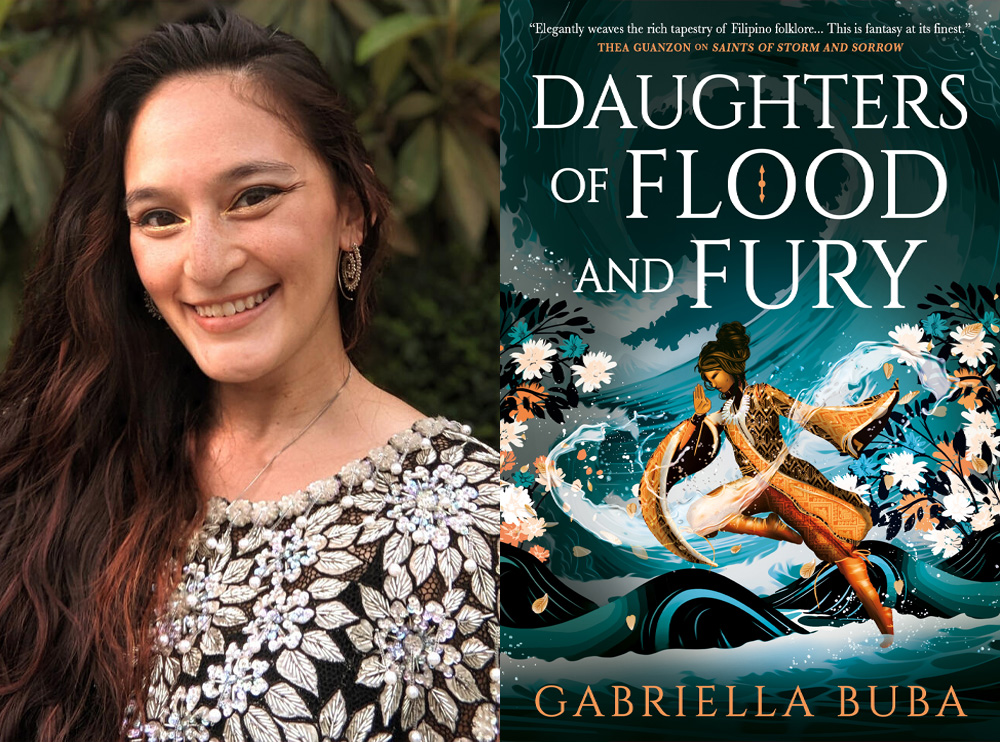
Guest post written by Daughters of Flood and Fury author Gabriella Buba
Gabriella Buba is a mixed Filipina-Czech author and chemical engineer based in Texas who likes to keep explosive pyrophoric materials safely contained in pressure vessels or between the covers of her books. She writes epic fantasy for bold, bi, brown women who deserve to see their stories centered.
About Daughters of Flood and Fury: This powerful sequel to Saints of Storm and Sorrow brims with unruly magic and pirates, moon-eating dragons and sizzling Sapphic romance. Enthralling Filipino-inspired fantasy for fans of The Hurricane Wars, R.F. Kuang and Tasha Suri. Out July 22 in the US and July 25 in the UK.
The first book in the Stormbringer Saga, Saints of Storm and Sorrow, takes place on an archipelago inspired by the pre-colonial Philippines, and yet very little of the book takes place at sea. In the Philippines before the advent of air travel, the sea was not a barrier, but a vast highway connecting distant islands and providing a rich bounty to those who dared. The sea brought trade, cultural exchange—as well as pirate raiders, and all manner of monsters of the deep.
In Book 2, Daughters of Flood and Fury, I sought to bring the wonders and terrors of Southeast Asian seafaring culture up close and personal. Before colonization, the Philippines was not a united nation. Instead, many kingdoms, sultanates, and city-states flourished across the islands. An archipelago with a thousand ports and many local leaders in competition with one another created an environment in which piracy and raiding flourished. This continued after colonization, with the Spanish-Moro Conflict, and to this day with modern piracy in the Sulu and Celebes Sea.
Among northern and central Philippine groups, Kapampangans and the Visayans conducted seasonal sea raids on karakoa warships outfitted with heavy bronze lantaka cannons. The warships were such a thorn in the side of the Spanish that by the end of the 16th century, they denounced karakoa ships and banned the building of them.
So it made sense in Daughters of Flood and Fury to introduce a Kampampangan pirate captain and firetender, Umali, who spends her time harrying foreign tradeships. Umali welcomes our protagonist Inez aboard, happy to show her the more dangerous side of the South Sea.
But the Great South Seas of the Stormbringer Saga, and real-life Southeast Asia are hunted by more than just human raiders. Let’s start with one reader’s of Saints of Storm and Sorrow will recognize.
The laho (Tagalog) or bakunawa (Cebuano) is the Filipino moon-eating dragon from the prologue of Saints of Storm and Sorrow. In most depictions, the Filipino sea dragon has a single horned nose and a looped tail. It is a vast serpent capable of causing earthquakes and storms at sea.
In Daughters, the laho will return with an even bigger role to play. The laho is responsible for eclipses when it swallows the moon. It is vital for people to come together to scare the laho into spitting the moon back out. In Daughters, I called this event an Amihan Moon, and Lunurin and Alon are preparing with all of Aynila for the coming eclipse and their role in ensuring the moon’s return. But don’t worry: Inez, off at sea, will have her chance to encounter my favorite sea monster too. Traditional karakoa were carved with fearsome sea dragon prows—a detail I preserved in Captain Umali’s ship the Agawin—to keep the ship safe from laho-riled storms
But the laho isn’t the only Southeast Asian sea monster Inez will face on her adventures. Since the end of Book 1, Inez has been named a tide-touched and has been hearing crocodile whispers from one of my favorite traditional anito (ancestor spirits, nature spirits, and deities in Philippine mythology).

The Philippines is home to two crocodile (buwaya in Tagalog) species, the Philippine Crocodile, and the Saltwater Crocodile. Daughters of Flood and Fury focuses on saltwater crocodiles, for whom Inez develops an affinity she finds both fascinating and frightening.
Crocodiles were venerated in pre-colonial times, often referred to by respectful familial terms of address such as nono (grandfather), especially those crocodiles with extraordinary traits. It was taboo to kill crocodiles or eat their meat. They were viewed as reincarnations of ancestors or embodiments of powerful nature spirits, and guardians of the spirit world who guide the dead. Pre-colonial Filipinos made offerings to them, and crocodiles were common funerary motifs to protect the spirit of the dead. Crocodile teeth were worn as agimat (magical amulets) to protect against disease and evil spirits.
The Spanish wrote that it was strange how closely Philippine villages lived with the crocodiles, with only bamboo fencing to keep them out. It was believed that crocodiles never attacked arbitrarily; that attacks meant the victim had broken some taboo, or that it was punishment by the spirits for breaking an oath. In fact, the famous Lakandula of Manila and Tondo’s treaties with Miguel Lopez de Legazpi in 1572 were sworn on the condition that if he broke the promise, he would die and be eaten by crocodiles.
Given their importance to Philippine mythology and way of life, the crocodiles of Daughters were a delight to weave into the story as guides to Inez while she explores her tide-touched abilities.
I dedicated Daughters of Flood and Fury “to all the ones who survived, but healed wrong. They broke our halos so we grew teeth.” I couldn’t think of a better place for Inez to learn her own strength than with some of the terrors of the Great South Sea. I hope you’ll come along for her high seas adventure.