
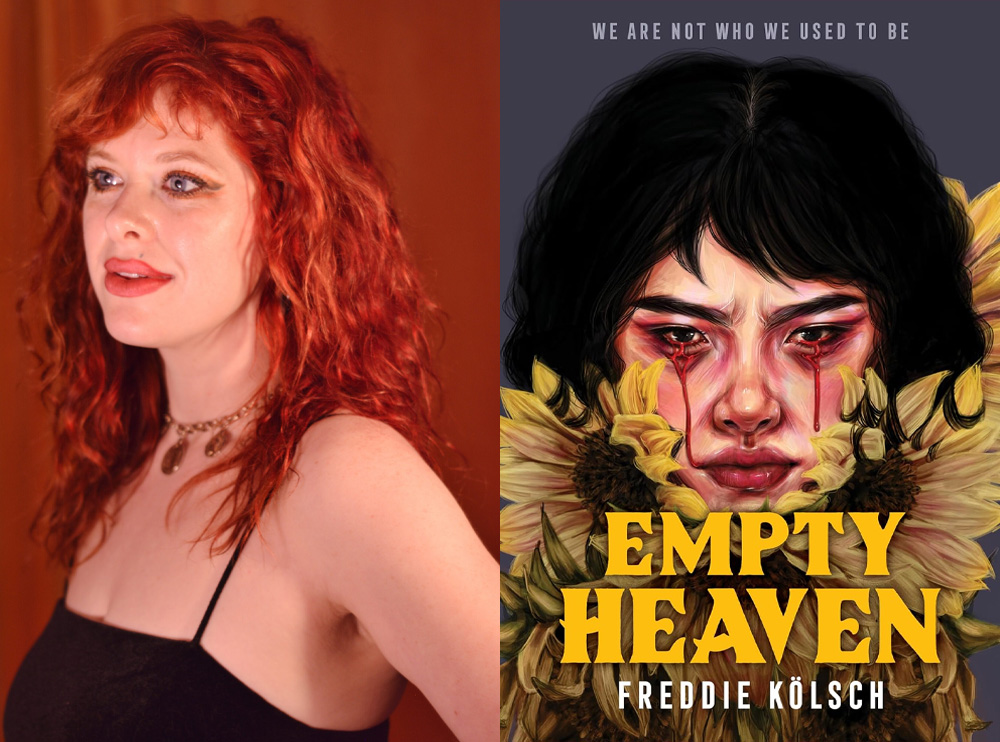
Guest post written by Empty Heaven author Freddie Kölsch
Freddie Kölsch is a connoisseur and crafter of frightful fiction (with a dash of hope) for teens and former teens. She is the author of Now, Conjurers. She lives in Salem, Massachusetts, with her high school sweetheart-turned-wife, a handful of cats, a houseful of art, and a mind’s eye full of ghosts.
About Empty Heaven: Empty Heaven is a propulsive and original love story, a darkly funny tribute to the power of queer found family, and a haunting exploration of the hidden horrors of beautiful places. Out August 26th 2025.
As a lesbian with a second horror book (Empty Heaven) coming out, my mind has been turning lately to my favorite works in the genre of ghosts and goblins, and the queer authors who created them. Actually, my mind is always turning toward that, book release or no. Without further ado, here are some of my all time favorites:
The Turn of the Screw by Henry James (1898)
Here’s a tale that you can hardly escape the pop-cultural reach of: if you haven’t seen The Innocents (with a wonderful performance by Deborah Kerr and a wonderfully creepy screenplay by Truman Capote), no worries, there are another nine films, a chamber opera, a Broadway play, and a miniseries by Mike Flanagan for your viewing pleasure.
Henry James was so much Edith Wharton’s gay best friend that he had his own dedicated guest room at her home in Massachusetts. When James was dying, Wharton, then considered a bad influence (as a divorcée), was barred from coming to say her goodbyes by James’s sister-in-law. Yet in The Turn of the Screw, James has given us a story containing such furtive volumes of (possible) deviance and depravity that it took more than a quarter of a century for it to be seen as anything but a straightforward ghost story.
It was Edna Kenton in 1924 who first put forth the theory that perhaps the hauntings in the story are taking place in the mind of the unnamed governess. (Kenton wrote a hollow earth book, but was pretty astute in regards to literary criticism.) This revelation was echoed by Edmund Wilson in 1934, who of course got all the credit. Even now, people remain divided on their interpretations of The Turn of the Screw, but most of them agree that it is a piece of writing that well-deserves its influence. I think so, too.
Lolly Willowes; or The Loving Huntsman by Sylvia Townsend Warner (1926)
This is barely a horror story, if I’m being honest, but it IS a story where the main character is a witch and she ends the book by having a nice chat with Satan; it’s also completely delightful, so I wanted to include it.
Sylvia Townsend Warner was an English poet and novelist who, along with her partner Valentine Ackland, was part of a literary lesbian antifascist cool-girl clique that makes me think of The L Word as produced by Julian Fellowes, and her first novel, Lolly Willowes, is a clear example of early feminist literature. The story centers on poor Laura Willowes, a spinster aunt caring for her brother’s children at the thoroughly advanced age of 48, who tires of her routine and moves to the country. There she meets a number of interesting characters and begins to truly live for herself at long last. She enjoys living for herself so much, in fact, that when her adult nephew moves to the country and demands she care for him once more, she makes a pact with the Devil himself in order to avoid having to devote all of her time to the needs of men.
This book is light and funny and sometimes moving, and Laura’s witchy fumblings toward feminism and freethinking (along with a charmingly-drawn Satan) make for good supernatural fun with a heart and mind. It never veers into preachiness, and I promise you’ll finish it with a smile on your face.
The Elementals by Michael McDowell (1981)
McDowell, who died from an AIDS-related illness in 1999, was the screenwriter for Beetlejuice, a contributing writer on The Nightmare Before Christmas, and a terrific novelist in his own right. McDowell was the master of several genres and a sort of writer’s-writer; google him and you will find Peter Straub and Stephen King quotes praising his work. In fact, after his death, McDowell’s estate tapped Tabitha King to complete his final book.
My favorite novel by McDowell (thus far) is the fabulous Southern Gothic The Elementals. Like the movie Midsommar, it plays the neat trick of having all the horror take place in the unforgiving clarity of a sun-drenched landscape: in this case, a remote outcropping on the Alabama panhandle called Beldame, miles from anyone or anywhere. This retreat consists of three Victorian houses lined up along the beach. The first and second are intact, the third is being slowly consumed by a sand dune…and something is waiting within it.
Two wealthy Southern families, bound by marriage and brought together by the death of their matriarch, decide on a getaway to Beldame. It is not a good decision, as main character India and her single (and definitely gay) father discover when they make the mistake of coming back to renew their relationships with their antiquated kin. The vibes are immaculate, the sense of dread insane, and the setting creepy as hell.
The Gilda Stories by Jewelle Gomez (1991)
The most representative American stories come from the darkest corners of our history. In much the same way that Stephen Graham Jones’s The Buffalo Hunter Hunter (his masterpiece, in my opinion) is the ultimate American version of Dracula—an intimate, epic, deeply sad story about a Blackfeet vampire named Good Stab who seeks revenge on the white hunters slaughtering the buffalo as part of their ongoing attempt to commit total genocide against the indigenous population—The Gilda Stories is the ultimate American version of…pretty much every other vampire story, including Interview With the Vampire, which is already American.

The LGBTQ+ community has much to thank author Jewelle Gomez for (at various points she led the charge for same-sex marriage in California, ran the country’s oldest LGBT foundation, was a founding member of GLAAD, I could go on), and her contribution to the queer literary canon is profound. The Gilda Stories tells the tale of a nameless enslaved woman who masterminds her own escape, kills a bounty hunter, and is taken in by a brothel-owning vampire named Gilda. After Gilda’s death, our protagonist takes her name and begins her own vampiric walkabout. The novel becomes a series of vignettes: different American cities, different eras, new problems, old problems, all the way into the future. Gilda is, in my opinion, THE American vampire. Like the country, she takes a long time to grow up, and her journey turns a clear-eyed mirror back upon both the goodness and profound evil of our cultural legacies.
Lost Souls by Poppy Z. Brite (1992)
William Joseph Martin has transitioned since writing his early novels, but says he’s cool with work written under the Brite moniker still being referred to as such. Actually, cool is a pretty apt description for Martin, whose career embodies everything that made me admire Gen X when I was growing up. An unauthorized biography of Courtney Love that Love allegedly helped with? A spinoff novel in the world of that ultimate goth franchise, The Crow? He cites Kathe Koja as an inspiration and married a photographer named Grey Cross. He is cooler than cool.
But even Martin himself never quite approaches the level of coolness that his vampiric characters do. In Lost Souls, Steve and his psychic best friend, Ghost (lots of characters have names like that) run afoul of a New Orleans vampire coven run by Zillah. This book has it all: vampire fetuses that destroy their hosts (Twilight did not do it first), the highest levels of gay unresolved sexual tension in existence, someone having an affair with their own vampire father (gross), and lots and lots of monsters drinking Chartreuse and traveling around in a nasty black van with a stained mattress. It’s a wild ride.
Bonus: Spoiled Milk by Avery Curran (out in 2026)
I didn’t include Spoiled Milk in the main list because that seems unfair, seeing as how you can’t actually get it yet. But I, with my magnificent-fathomless-vast network of literary connections (Curran is the partner of my UK agent), had the pleasure of reading an early draft.
Spoiled Milk is a true treat in a dual sense. It takes a genre I find quite fun, the boarding-school book, and gives you all the trappings you remember enjoying…and then it stomps all over those tender trappings with knife-heeled boots, leaving gore, chaos, and total literary deconstruction in its wake. Imagine a sedate 1920s boarding school. Now the most popular girl in her form dies horribly, the ghosts are plentiful and murderous (and committing kills worthy of A Nightmare on Elm Street), and everyone is a repressed little lesbian. When Spoiled Milk is released, do yourself a favor and read it to see what the modern queers are capable of inflicting on our psyches (complimentary).