


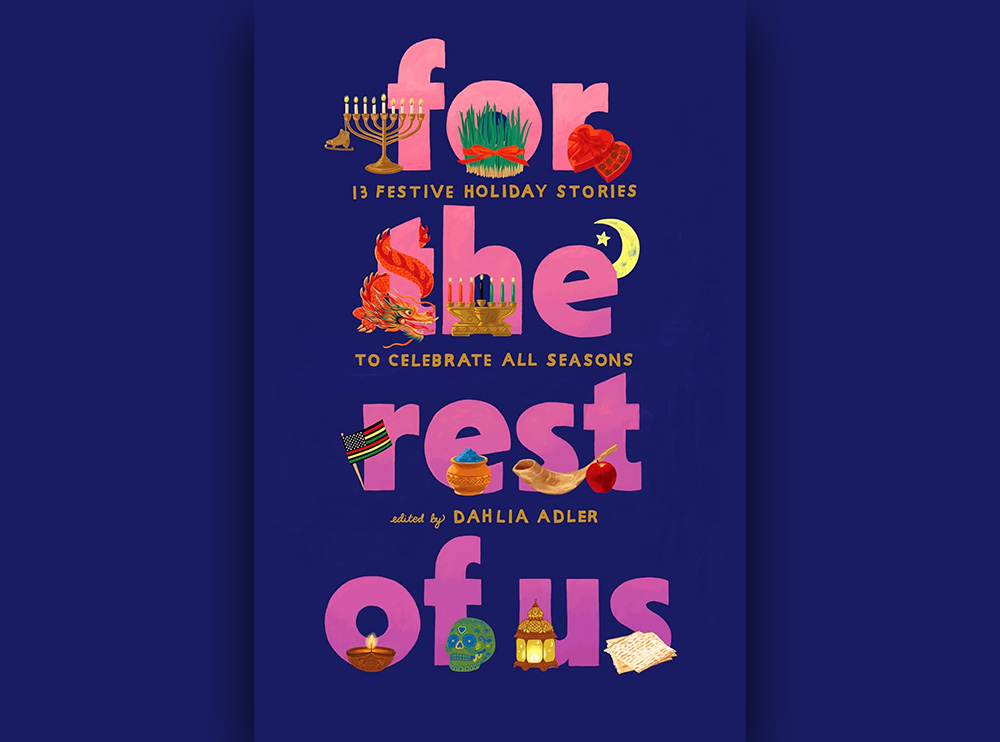
Fourteen acclaimed authors showcase the beautiful and diverse ways holidays are observed in this festive anthology. Keep the celebrations going all year long with this captivating and joyful read!
Intrigued? Well read on to discover the synopsis and an excerpt from For the Rest of Us: 13 Festive Holiday Stories to Celebrate All Seasons, which is out now.
From Lunar New Year to Solstice, Día de Los Muertos to Juneteenth, and all the incredible days in between, it’s clear that Americans don’t just have one holiday. Edited by the esteemed Dahlia Adler and authored by creators who have lived these festive experiences firsthand, this joyful collection of stories shows that there isn’t one way to experience a holiday.
With stories by:
- Dahlia Adler, Sydney Taylor Honor winner of Going Bicoastal
- Candace Buford, author of Good as Gold
- A. R. Capetta and Cory McCarthy, authors of the Once & Future series
- Preeti Chhibber, author of Payal Mehta’s Romance Revenge Plot
- Natasha Díaz, award-winning author of Color Me In
- Kelly Loy Gilbert, Stonewall Book Award winning author of Picture Us in the Light
- Kosoko Jackson, USA Today bestselling author of The Forest Demands Its Due
- Aditi Khorana, award-winning author of Mirror in the Sky
- Katherine Locke, award-winning author of This Rebel Heart
- Abdi Nazemian, Stonewall Book Award–winning author of Only This Beautiful Moment
- Laura Pohl, New York Times bestselling author of The Grimrose Girls
- Sonora Reyes, Pura Belpré Honor winner of The Lesbiana’s Guide to Catholic School
- Karuna Riazi, contributor to The Grimoire of Grim Fates
Holiday stories are hardly a new concept in young adult literature, but as an Orthodox Jewish reader, I always knew I wasn’t going to be cracking open those pages to find characters singing “Dayenu” at the Passover seder or shaking their noisemakers while wearing Purim costumes and listening to Megillat Esther. When I did finally start to see more varied holiday scenes making their way into books by some of my favorite authors—Juneteenth celebrations and feasting on mooncakes and an entire novel set over the course of a Ramadan—I immediately fell in love with celebrating them through the pages and the authors sharing their experiences.
What’s more, I realized how much I didn’t know—and how much I wanted to know—about these precious celebrations. And I knew I wanted to share some of mine, too.
Holidays are about tradition, and community, and coming together, and there’s nothing quite like being welcomed into someone else’s festivities, enjoying new food and music and decor, and feeling infused with the spirit of their joy. In For the Rest of Us, we open our own celebrations to you, the reader, and invite you to enjoy the tastes, sounds, sights, and meanings behind the days most special to us and our loved ones. Thank you for joining us.
—Dahlia Adler
ROSH HASHANAH, YOM KIPPUR, SUKKOT, SIMCHAT TORAH—THE MONTH OF TISHREI (SEPTEMBER–OCTOBER)
Making Up is Hard to Do
By Dahlia Adler
You could promise me forgiveness for every one of my sins until the end of time, and still I would not touch a fish head with a ten-foot pole.
“More eyeball for me!” my dad says gleefully, and if I weren’t waiting for exactly that sentence, I probably would’ve retched onto my honey-streaked plate. Instead, I just shudder and spoon up a pile of pomegranate seeds.
“I’m covered, thank you,” I tell him, gesturing at the dish full of Rosh HaShanah symbols in front of me. My sweet year–guaranteeing apple and honey are long gone, but according to the laminated card my family and I keep passing around our dining room table with all the different little Yehi Ratzon blessings on it, the twelve months ahead of me should be filled with merits (thanks to the ruby-red seeds) and the destruction of both our enemies and any evil decrees (thank you leeks, beets, and dates). If I have to pass on being like the “head” of the year rather than the tail by turning up my nose at salmon brains, that seems like a small price to pay.
Then again, I’m going into the Jewish New Year feeling very much like a tail, so maybe there’s something to sucking it up and chowing down on fish-face after all. Fenugreek, whatever that is, may be a good omen, but I’m pretty sure starting off the new year fighting with your best friend isn’t.
I hold out my hand for the card so I can look up the prayer over pomegranate seeds, but I can’t help scanning for an idea of which symbol on the table might help with our feud. Not that I’m not still mad—Shani Roth didn’t just switch schools for our senior year, but she did it without even telling me until the night before—but for a holiday about repentance, the vibes are just off. All I’m thinking about is how much work I’ve put into avoiding her since school began, going away every Shabbos so I won’t bump into her at shul, and now Rosh HaShanah’s going to ruin it.
I make my way through the seeds, a carrot, and another apple with honey—a little extra sweetness can only help—and push all thoughts of Shani out of my head. Maybe she’ll be sitting at a different minyan this year; with so many people not just coming to shul for Rosh HaShanah but having guests, we spill into every possible room of Sha’arei Shamayim synagogue. Usually, my family and the Roths sit in the social hall, but I can only pray (heh) that Shani asked her parents to switch it up this year (and had more success than I did with the same request, which was met with a mom eye roll for the ages).
It’s not hard to forget about her once the food comes out; both my mom and Bubbe Basha outdid themselves, as usual, and even my sister Michal contributed her apple kugel, which is literally just cake by a different name. The round, raisin-studded challahs drizzled with honey are perfection, and the chicken soup is hot and soothing going down, filled with everything from my grandfather’s fluffy matzoh balls (I may know that the secret is seltzer, but that doesn’t mean I can replicate it when I try) to meltingly soft parsnips and carrots. And then the main course: brisket glistening with sweet-and-sour sauce that drips into the crispy potatoes around it, garlicky brussels sprouts I can smell from across the table, the aforementioned apple kugel, a colorful salad spotted with yet more pomegranate seeds, and my favorite chicken with roasted apples and cabbage.
We take our Rosh HaShanah menu extremely seriously in this house. We haven’t even gotten to dessert yet, but I know for sure honey cake, apple cake, and sticky toffee pudding (my British cousin Ahuva’s recipe, naturally) will all be passed around the table along with ice cream made from whatever nondairy milk is big this season. Everyone will ooh and ahh and insist there’s waaaay too much, but it’ll all be gone by the end of the two-day holiday.
“So, Eliora, have you decided where you’ll be going to college yet?” Bubbe Basha asks, her eyes focused on me even as she taps frantically on Zaydie Anshel’s arm to stop him from taking a third slice of brisket.
“Well, I’ve decided where I’m applying,” I answer, confident I sound polite until a pinch on my thigh from my mom suggests I am not. “But applications aren’t due yet, so we have to wait and see where I get in.”
“You’ll get in everywhere,” Bubbe says confidently. “You’re a genius. All my grandchildren are geniuses.”
My smile at that is genuine—it’s Bubbe’s favorite refrain, and my cousins, siblings, and I repeat it constantly, especially when we do incredibly stupid things. But applying for college, deciding where we’d go together to be roommates, was another me-and-Shani thing. I don’t even know if she’s still applying everywhere we discussed. For all I know, she could be planning to go to school across the country. “And what about that friend of yours?” Bubbe continues, as if
reading my mind. “Does she know where she’s going?”
The sweet chicken turns to ash in my mouth. “I wouldn’t know.”
It’s a tradition for my mom to buy each of us a new article of clothing for the new year, and almost as traditional for us all to secretly hate her choices. (Except my brother, Eyal, who always gets something totally innocuous, like a plain leather belt.) However, unlike my sister Aderet, who graciously accepts whatever it is and then shoves it in the back of her closet, never to be seen again, I always try to make it work.
This year it’s a new shawl, and it’s been . . . a challenge.
I always take my time getting ready for shul on Rosh HaShanah, because I do not have the capacity to sit for five hours of davening, but between the grandmotherly shawl and the idea of seeing Shani again for the first time in months, I’m dragging my feet extra slowly.
“Are you coming or what?” Michal asks, swinging open my door and sticking her head inside, her perfect curls swaying like a curtain in the breeze. “You’re gonna be late for Mussaf.”
“I will not. Yonah Marcus takes forever. I probably still have half an hour.”
“Ugh, I forgot he was leading davening. He’s the worst.” I love how on Rosh HaShanah, we all commit to things like not saying unkind things about other people, but trashing the chazan for being too slow is always acceptable lashon hara, even on the High Holidays. “But still. Hurry up, or Adi and I are leaving without you.”
“So leave. I’ll go with Mom.”
Michal snorts. “Mom’s been gone for, like, half an hour. You think Bubbe was gonna wait around?”
Fair point. “Just give me five minutes.”
Michal twirls out, and I give myself a final look in the mirror. I’m dressed, but am I “see my former best friend for the first time in months and make absolutely clear I’m even better off without her” dressed? It’s hard to find the perfect armor for that occasion. A killer pair of heels would be the obvious choice, except that Rosh HaShanah davening lasts at least two hours longer than regular Shabbos davening (minimum three when Yonah Marcus is leading it), and I am simply not that resilient.

Finally, I throw on a necklace—in this house, we add an accessory before leaving to spite Coco Chanel—and stomp out after Michal.
“What are you so cranky about?” she asks as Aderet steps outside and determines that the September sunshine in our New York City suburb is strong enough that we don’t need coats. “The shawl isn’t that bad.”
“It is that bad,” says Aderet as we head out and she locks the door behind us, “but it’s not the shawl. Eli’s in a fight with Shani and doesn’t want to see her.”
“Shut up, Adi,” I say warningly. It should be a nice thing, having your sisters home from college for the holidays, but it always goes downhill fast.
“Oh, grow up.” We’re walking side by side, so I can’t say for sure, but I can feel Aderet rolling her big brown eyes. “Yeah, it sucks that she didn’t tell you she was switching schools, but if she switched for senior year, she had to have a good reason, right? It’s Rosh HaShanah. You’re supposed to be forgiving and forgetting.”
“Actually, you’re supposed to be apologizing, which is something she hasn’t done,” I point out. “And shouldn’t she be telling me that reason, if it’s such a big deal?”
“Maybe you should be giving her the benefit of the doubt that if she could tell you, she would,” Michal says, ever the angelic peacemaker. “But anyway, people are allowed to have secrets, even from their best friends.”
No, they’re not, I want to yell back childishly. Instead, I just pull my hideous new shawl around me tightly to ward off the early autumn breeze.
As soon as we get to shul, Michal takes a quick glance at the seating chart and strides inside, Aderet goes to the coatroom to change from the sneakers she wore for the walk into her ridiculous heels, and I sail straight over to the Cohen twins, Nili and Neima, who arrived just before we did and are instructing their little brother, Natanel, on where to find their father in the men’s section.
“Your mom gave you that shawl for Rosh HaShanah, didn’t she?” Nili asks immediately, her bright blue eyes dancing with laughter.
“She sure did. But I’ll be the one laughing when we get in a time machine to 1880s Poland, and I’m the one in style.”
The three of us head over to the seating chart, a feat of organization necessary only during the High Holidays, and I find our seats easily—our five Goldin seats are always located five rows from the back, with the Cohens two rows behind us. But I can’t help scanning the chart for the two Roth seats that are usually in the row in front of us and noticing that they’ve been replaced by a pair of Sterns.
She did it. Shani actually moved seats to get away from me on Rosh HaShanah. I can’t believe she did that. And despite the fact that it’s what I was hoping for, I didn’t actually think whoever organizes the seating would go for it.
Now I’m kinda pissed.
“If you’re looking for Shani and her mom, they’re at her aunt’s for yuntif,” Neima says, making me jump a foot in the air; I’d forgotten she and Nili were even there.
Nili looks over my shoulder. “Who are the Sterns?”
I have no idea, but somehow Neima does. Still, I don’t hear what she answers her sister. I don’t hear anything other than a voice in my head telling me that on this holiday of renewal and forgiveness, my best friend and I are further apart than ever.
Excerpts from For the Rest of Us and “Making Up is Hard to Do” Copyright © 2025 by Dahlia Adler. Reproduced by permission of HarperCollins Publishers. All rights reserved.