


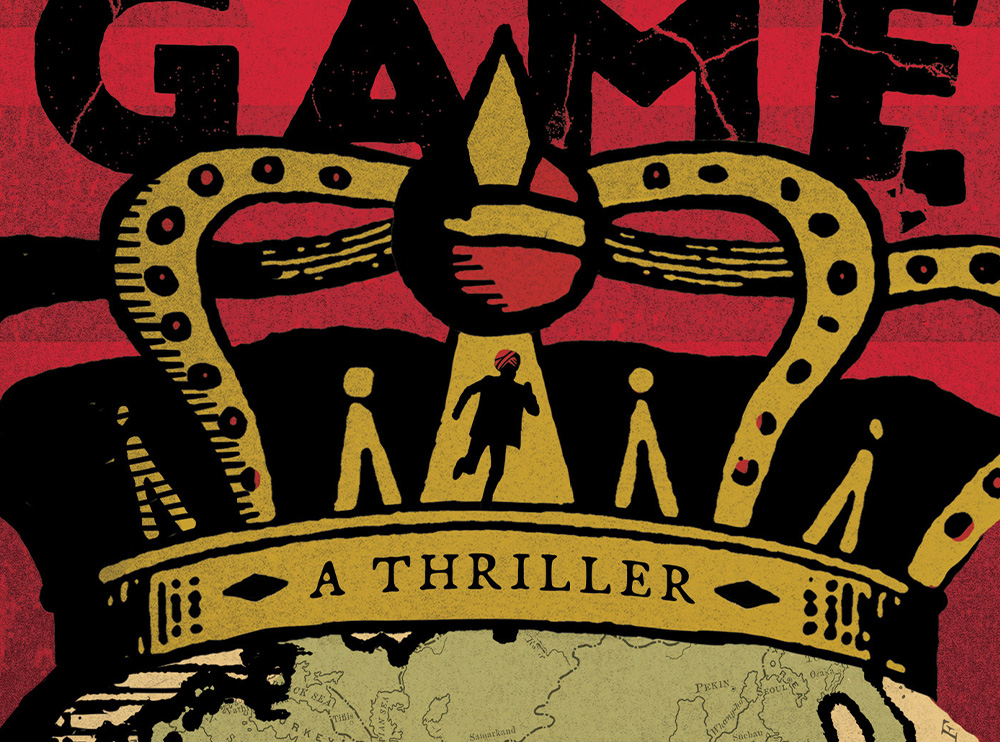
An outsider in London investigates a series of brutal murders targeting English aristocrats in a timely and provocative historical novel brimming with intrigue, wit, and rage.
Intrigued? Read on to discover the synopsis and cover for The Great Game by Arvind Ethan David, which releases on July 17th 2026. PLUS we have the first chapter to share with you too!

London, 1905: Law student and military veteran Balvinder dev Singh has found an extralegal way to fund his studies. As friend and accomplice to the infamous gentleman thief AJ Raffles, he rubs shoulders with the upper crust―and steals their valuables. That is, until their next mark, an imperialist general, is grotesquely murdered in the library of his Mayfair mansion. Bal and Raffles find themselves implicated in a series of killings that soon attracts the attention of Scotland Yard―and the aging Sherlock Holmes himself.
As Bal works to clear his name, he must hide his checkered past from a new acquaintance, the beautiful Irish violinist Maud Adler. Her fiery views lead Bal to question his own place in the world. But when he comes face-to-face with a plot to strike at the very heart of the British government, he must decide how much he’s willing to risk for his adopted city.
EXCERPT
Chapter 1
My Friend Raffles
Say what you will about my friend Raffles (and in my time, I’ve said plenty), he is not a man given to exaggeration, unsubstantiated claims, or hullabaloo of any kind.
Therefore, when, late in the evening on a cold September night in 1905, I responded to a frantic ringing of my doorbell and found Raffles standing outside, his head bare to the elements, his face pale in the flickering light of the street lamp, I was both shocked and intrigued.
“AJ!” I exclaimed. “What on earth’s the matter?! You look like you’ve seen a ghost.”
He pushed past me into the warmth of my little hall, muttering as he walked:
“A ghost I could have borne without complaint, Bunny. What I’ve witnessed tonight was more horrific by far than a mere apparition. It was the worst thing I have ever seen. For God’s sake, man, stop gawking and fix us some drinks.”
I looked out of my door to a largely empty street as a carriage rolled past, drawn by a handsome black horse, but otherwise the night was desolate, as it typically was at this late hour.
Raffles ascended my staircase, removing his coat and gloves as he walked, discarding them on the floor of my corridors like a great snake shedding its skin. He made his way to my nook of a study and reached for the shelf where he knew I kept the good whiskey just behind a copy of Gibbon’s Decline and Fall, which I regret to say I have never read.
I got some tumblers out, boggling and baffled. The worst thing he had ever seen? This from a man who had served alongside me in the bloodiest excesses of the Boer War, who had faced down the great batsman Ranji at Lord’s, and who only last October had arranged for us to be locked inside a bank vault for the purposes of strategically emptying it.
This level of agitation in him was very far from normal. For the most part, Raffles’ cool, calculating mind and his steely, sportsmanlike nerve mean that he is one who favours under-, not overstatement.
In this, as in all else, Raffles goes his own way, priding himself on his ability to keep calm under pressure. It is not natural for one’s constitution to respond to situations of danger or threat by becoming even more calm, yet that is what Raffles invariably does.
The hotter the crisis, the colder runs the blood of AJ Raffles.
I suppose this is part of what makes him such an extraordinary cricketer, the finest slow bowler in recent memory, a dangerous bat, and a brilliant field. When confronted by the fastest of fastballs, he neither doubts nor panics, but simply greets it with grace.
This characteristic is also what allows him to excel in his other profession. The profession in which I, to my enduring shame, assist him: that of gentleman thief. You see, Raffles is the greatest amateur cracksman there ever was, the most daring, most notorious, most successful society burglar of our, or any other, age. For more than a decade now, he has helped himself to the bounty of the idle rich: rare jewels, priceless works of art, the family silver—and whatever else catches his fancy.
At the point of these events, I had spent nearly three years as an ally of Raffles, an accomplice thief, and a cat burglar in training. The details of how this had come about are a matter to which I shall return, but know that it began out of necessity when I had fallen on hard and desperate times. Unlike Raffles, who stole, I think, for the sheer fun of it, and only secondarily because he enjoyed the proceeds, I had come to the disreputable business of burglary, to my current life of crime, not out of desire but out of need. I broke the law not because I enjoyed it but because I had no other choice.
At least that is what I told myself.
Finding the bottle, Raffles poured himself a heavy slug and downed it without comment, then refreshed his glass and filled a second, which he extended to me. As I took the drink, I saw, to my deepening surprise, that his hand was shaking.
“Raffles! Dear fellow, you’re scaring me. What is it? What have you done?”
He regarded me coldly; the drinks seemed to have done their work, and his usual hard façade was back upon him, his hands once again rock solid. “Done? Bunny, this ill becomes you. I told you I saw something. Why should you think I have done something?”
I bluffed and bustled, and my guilt at our shared criminal enterprise had me stammering like a schoolgirl: “Why, why, why, that is to say, I mean, dear fellow—you do have rather a habit of getting yourself—of getting me, come to that, of getting us, into all sorts of scrapes. So naturally, when . . .”
He laughed then. Starting with the little cynical chuckle I knew so well, but then something in him shifted, and he laughed more freely till his body was shaking and he was gasping for air. Not knowing what was so funny, and struck by how unusual this behaviour was in him, I nevertheless found myself laughing too, and we held each other for a moment, just laughing together.
When we were spent, he lit a cigarette, sucked it deep, and his grey eyes holding me lightly, exhaled and then spoke through the smoke:
“I was up at General Fitzwilliam’s place tonight. For his regular poker game.”
“I thought you despised Fitzwilliam!” I responded, surprised.
“I do, the man’s a brute, but I’m rather fond of his Golconda diamond.”
“You were on reconnaissance?”
“Something like that. In fact, I decided, somewhat on the spur of the moment, that it was the night to do the job.” There was a wink in his eye as he said this, knowing how galling I would find this information. As always, I took the bait.
“Raffles! How could you! These things take planning. Going in alone? Without me there to provide backup? What were you thinking?”

“Ah, my dear Bunny. How sweet of you to be upset at being left out. I’m not quite sure the general, good imperialist that he is, would have been comfortable with you at the poker table. But don’t worry, the jewels were left untouched, at least by me.”
“If not you, then by who?”
“‘Whom,’ dear boy, ‘whom.’”
“I do not require grammar lessons from you, AJ!”
“I apologize, dear fellow. My wits are somewhat scrambled by events. I seek order when I can find it, because there was precious little available to me tonight. Let’s fix another drink and I’ll tell you all from start to finish.”
He settled down in his chair, took another long dram of his whiskey, and then told me the following tale:
“The card game was coming to an end. As well as the general and myself, present were a couple of other military types: Lord Kitchener, fresh from his victory in Sudan; Frank Milton, the colonel’s old aide-de-camp; and young George Montagu, nephew of the Earl of Sandwich—and before you ask, yes, the colonel delighted himself by serving a round of sandwiches to the heir to Sandwich. Thought himself awfully clever. Dreadful man.
“Anyhow, as I say, the game was nearing its conclusion, and it had taken all my skill and self-restraint not to fleece the lot of them of all the money in their pockets, but I was hunting for bigger game tonight and wanted them all in a good mood. So, I folded when I should have called and let them all feel rather more accomplished players than they are, particularly the colonel, whose good humour I most needed.
“At about eleven, we all took our leave. Or rather, I should say, the others took their leave. I doubled back immediately after saying goodnight, knowing that the window in the front room was still open—”
“Why was it open?” I interrupted.
“Because I had arranged for it to be opened, of course, Bunny. Halfway through a hand, I complained that the room felt a little close, and of course all these Men of Empire, big game hunters all, used to cold nights in the Sahara, were hardly going to admit to a little effete cricketer such as myself that they were feeling chilly. Thus, the window was thrown open, even as the fire roared. Allowing me, a little later, to slip back into the drawing room and secret myself in a side closet until the house was all asleep.
“I didn’t have to wait long. Most of the staff had long since retired. After twenty minutes or so, it was clear that no one stirred, so I let myself out and made my way to the library, where the general keeps his diamonds on display. He had shown them to us all earlier that evening, boasting of the maharaja he had filched them from. I was in the room, and had just got the case open, when it started . . .”
He paused then, and I saw that he was gripping his glass tightly. So tight, I was afraid it might shatter in his hand. I reached out and took it from him. “What started, AJ? You can tell me,” I said as gently as I could muster.
“The screaming, Bunny. The screaming.”
Text copyright © 2026 by Arvind Ethan David

ABOUT THE AUTHOR
Arvind Ethan David is a writer and producer whose work spans Broadway, television, and film. He was a lead producer of the Tony and Grammy winning musical, Jagged Little Pill and has written and produced extensively in television, including Dirk Gently’s Holistic Detective Agency (Netflix), Anansi Boys (Amazon), and the Asian Academy Award winner, The Garden of Evening Mists.
His graphic novels include the Stoker-nominated Darkness Visible, and his stage work includes the adaptation of his late mentor Douglas Adams’ legendary The Hitchhiker’s Guide to the Galaxy. THE GREAT GAME, which Thomas & Mercer will publish in July 2026, is his debut prose novel. Arvind Ethan David was born in Kuala Lumpur, Malaysia, educated in England and currently lives in Southern California with his family.