

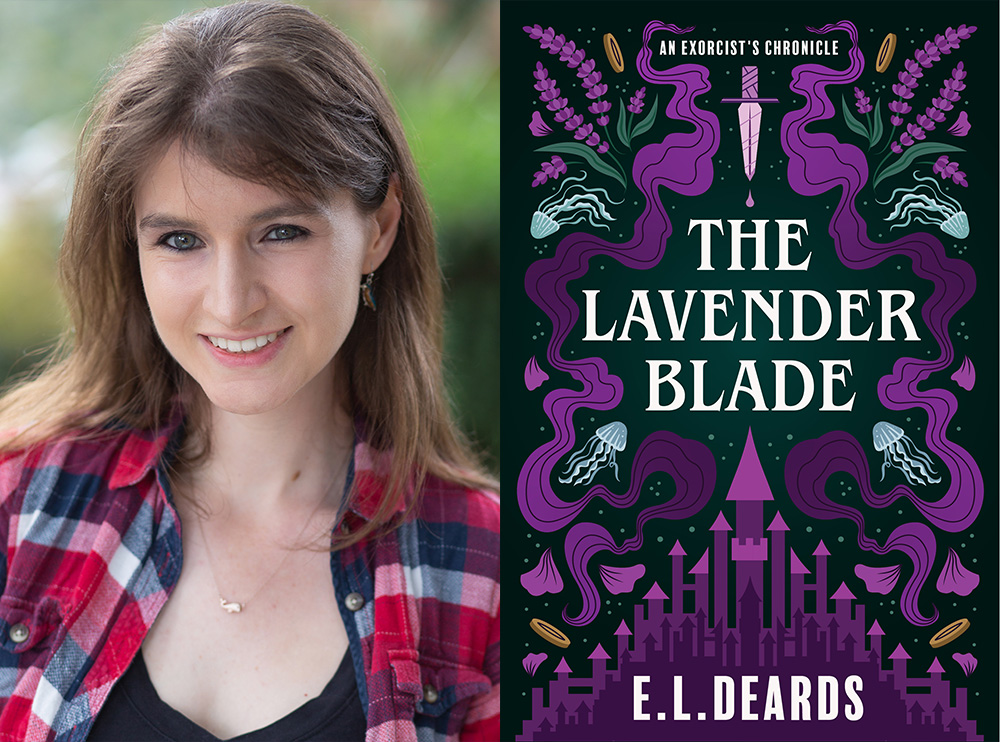
Guest post written by The Lavender Blade author E.L. Deards
E.L. Deards is a UK-based veterinary surgeon, occasional novelist, and recovering idealist. Her debut fantasy novel The Lavender Blade—featuring demons, exorcists, and people making very bad decisions in dramatic lighting—releases July 2025. She lives with a deep distrust of happy endings and at least one cat.
About The Lavender Blade: For readers who loved New York Times bestseller Gideon the Ninth, Deards delivers a queer speculative fiction novel about what happens when a con artist exorcist becomes possessed for real.
I didn’t set out to write anything relevant. I was aiming for demons, con-artists, and the world’s most dysfunctional exorcism business—an unholy blend of snark, betrayal, and performance art in a crumbling theocracy. That’s the promise at the heart of The Lavender Blade: come for the supernatural chaos, stay for the emotional damage. At no point did I think, Ah yes, this will be a literary reflection on ideological fracture and interpersonal grief. And yet. The things that haunt you have a way of sneaking in.
There’s a heartbreak that’s hard to explain. No screaming, no betrayal-by-text. Just a quiet, creeping realization: someone you loved is no longer who you thought they were. They don’t announce the change. They just start looking at you differently. Sharing things that make your stomach twist. You keep hoping it’s temporary. That you’re imagining it. But eventually, you know: the person you trusted is gone. And worse, they’re still right there.
That’s the kind of loss I ended up writing. In the book, one character doesn’t lose the other to a cause or belief system. He loses him to something more insidious: a slow, external corrosion. A presence that takes root before either of them realizes it. It’s not a clean break. It’s more like watching a house settle until the door won’t shut right anymore. You keep trying to fix it, but you’re not even sure what’s broken.
People have accused the book of being topical. I plead the fifth. The setting is a religious state propped up by spectacle and fear, where inequality is strategic and faith is weaponized. But I didn’t build it as a metaphor, I built it as a story. The metaphor slipped in through the back door, wearing a borrowed coat.
Because here’s the thing: you can’t always tell when someone you love starts believing things that leave no room for you. Sometimes you’re the last to know. And once it’s happened, it doesn’t matter how many jokes you make. The ache sticks.
I’ve lost people. Not to death, but to dogma. To narratives that demand loyalty over honesty. To politics that feel more like performance than belief. I didn’t change. I just didn’t fit the version of me they needed to keep loving. I don’t name names, I don’t start fights, I just write. And the writing always tells the truth, even when I don’t.

The Lavender Blade was a way to ask questions I didn’t have safe answers for: What happens when someone changes and doesn’t come back? How do you love a person who’s already halfway gone? What if the person corrupted isn’t the villain—but someone you still want to save? I don’t think I answered those questions. But I sure made them bleed a lot.
Fiction gives you space to linger where real life won’t. To give your characters the confrontation you never got, the goodbye you weren’t allowed, or the awful moment of realizing there is no resolution—just aftermath. Maybe that’s what the book is really about. Not ideology. Not politics. Aftermath. The echo of a trust that didn’t hold. The shape of a person who used to be yours.
I didn’t mean to write something relevant. I meant to write something sharp, weird, and a little sexy. But relevance crept in. Because the world crept in. And like any good demon, it made itself comfortable before I even realized what it had taken.