


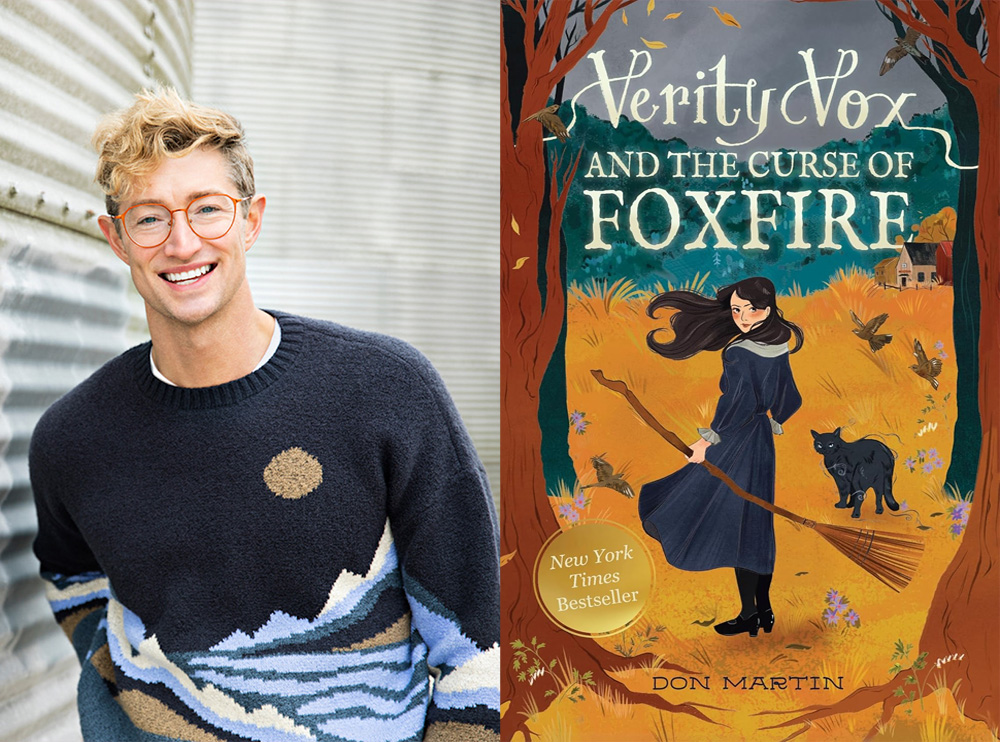
We chat with author Don Martin about Verity Vox and the Curse of Foxfire, which follows a witch-in-training on her journey to save a cursed Appalachian mountain town. PLUS you can listen to an excerpt from the audiobook at the end of the interview!
Hi, Don! Can you tell our readers a bit about yourself?
I’m your average former overachiever kid that became an overachiever adult. I’m a poet, nonfiction writer, and novelist who spends my free time reading comic books, watching anime, and wondering why it’s so hard to put an accurate portrayal of Jean Grey on screen.
When did you first discover your love for writing and stories?
Fifth grade! My teacher had a unit on poetry, and the writing bug bit me hard. I fell deep into the seedy underworld of the beatniks, slam competitions, and, worse, coffee shop open mic nights. From there I tried my hand at writing short stories, novellas, and a few half-finished novels. Then, when lockdown happened, like a lot of people who said “if I ever had the time” only to realize I suddenly had the time, I finally finished one of those novels.
Quick lightning round! Tell us:
- The first book you ever remember reading: This is tough, because I know I read a lot of mythology and fantasy as a kid, but the first title that comes to mind is The Dark is Rising by Susan Cooper followed or parallel with Animorphs by Katherine Applegate.
- The one that made you want to become an author: Oh I think I’d be lying if I didn’t also credit those two books with wanting to become an author. I’ve been chasing that high of “fantasy books about big ideas, tough questions, and folkloric worlds written for all ages” ever since.
- The one that you can’t stop thinking about: Above Ground by Clint Smith. It’s one of the best poetry collections I’ve ever read. And maybe the Grant Morrison run of New X-Men.
Your debut YA novel, Verity Vox and the Curse of Foxfire, is out now! If you could only describe it in five words, what would they be?
Witch With Cat Fights Demon
What can readers expect?
A world that feels at once familiar and new. Verity Vox reads like a classic young adult fantasy adventure novel—think A Wizard of Earthsea or The Lost Years of Merlin. It’s based in real world history and told like a folktale as though you’re sitting on a front porch hearing the story from a grandparent who lived through it. There’s something for lovers of traveling witch anime—like Wandering Witch: The Journey of Elaina, Kiki’s Delivery Service, or Flying Witch—but there’s also something for folks who enjoy horror anthology podcasts like Old Gods of Appalachia or Welcome to Nightvale. It’s light, it’s cozy, it’s dark, it’s creepy, and it’s the perfect love letter to kids or kids at heart that ever found themselves on the wrong end of scripture but the right side of choir.
Where did the inspiration for Verity Vox and the Curse of Foxfire come from?
Foxfire is not a real place, but it is based on a real place. The town of Vulcan, West Virginia was a real coal mining community settled in the early 1900s. It was unique in that, how it is positioned across the Tug River on the border between West Virginia and Kentucky, meant that employees had to row across the fast moving waters of the Tug in order to get to work. Should someone die on the river side of the town, those bodies would literally have to be drug up and over hills just to give them a decent burial. And so the company, both in an effort to make their employees’ lives easier and to ensure they could get to work on time, built them a bridge.
If you live in a bridge-dependent place like New York City or San Francisco you might think…what’s the big deal? Why are you talking about the bridge of an industry town in the mountains from a hundred years ago?
Because unlike those bridges in New York City or San Francisco, this bridge was a very small swinging bridge made of wood positioned exceptionally low above the river. It was originally too narrow for vehicles and was thus only suitable for walking across, however, in order to do so you first had to cross the busy train tracks carrying coal and other goods off from the mountains to lands beyond. One time a child lost a leg while trying to navigate those train tracks. However, at least with the bridge people could access daily needs in a less exhausting fashion and their dead could be buried with a bit more decency. This bridge became, and still remains, the only legal entrance and exit into this community.
By the late 1960s the coal had run out, the company had moved on, and the once thriving community had experienced severe depopulation. No industry bringing money into the region also meant nobody was keeping up the roads and bridges. Sure, those who continued to live there had attempted to keep up and even expand the bridge over the years so that they could drive across, but even that was exceptionally dangerous as reports from the time tell us that there was less than a thumb length margin for error on either side. Sneeze at the wrong time behind the wheel and your car went into the river.
Well, one night in July 1975 the old bridge finally collapsed and was carried away down the river. Those who still lived there were once again faced with either rowing across the water or navigating the razor thin mountain roads with their blind curves, sharp inclines, and precarious drop-offs for miles out of the way in order to get anywhere all while hoping not to crashing into the trains.
The people made do as best they could until a little old lady, 74 year old Nellie Holley, ordered a set of furniture from a company upstate and the driver refused to deliver it because he couldn’t safely do so. She had to hire a young man to illegally haul the furniture back on a private railway owned road, because, once again, the only legal way into the town had washed away down the river years ago. That’s when a man named John Robinette—an interesting character who was born in the area and had lived an interesting life having been at one time a carnival barker, car mechanic, and notary public—decided someone needed to fix the situation. If nobody was going to come take care of the people of Vulcan, he would. He appointed himself mayor and set about lobbying the county, state, and federal governments to come help this forgotten coal mining town and the very real people who still lived there carving out a life in that lush, ancient landscape.
They were ignored and written off. Their community wasn’t a priority. There was no budget. They’d just have to get on how they’d been getting on. Wait no it’s actually worse than you think. In an article from the New York Times in 1978 Phyllis Blankenship, the town’s postal employee who operated their 16-box post office, recalls they went to governor Arch Moore’s office. The governor is said to have picked up the phone and declared he wanted that bridge built immediately…it never was. Phyllis said “He probably was calling the next room for all I know.”
And that’s when John Robinette and the people of Vulcan decided to make a deal with the devil.
Or, rather, the Soviet Union.
I’ll quote from the New York Times again: He wrote Leonid I. Brezhnev twice, sent the letters by registered mail. Mr. Brezhnev did not reply, but Iona Andronov, a writer for a weekly publication in Moscow, got wind of the story and wound up in Vulcan on Mr. Robinette’s arm.

The Soviet government saw an opportunity to embarrass the United States on its own soil, helping people the government ignored. It’s said that within one hour of Andronov arriving in Vulcan, the West Virginia state government authorized the building of the bridge. The bridge they built still stands today and was christened at its opening in 1980 by mayor John Robinette with two bottles of Russian Vodka.
The town is real. The people are real. The bridge is real.
Were there any moments or characters you really enjoyed writing or exploring?
Oh man… So much was pulled in whole or in part from my childhood and my family tree. I enjoyed portraying gossip as a kind of magic, in the way it moves through a small town and the tiny rituals that keep it alive. I loved setting a fantasy novel in what to me is the most beautiful place on earth, a state often forgotten about because there isn’t a lot of money or voters so both culture and politics overlooks them. However, these ancient hills are filled with magic and stories and cryptids. I wanted to give kids permission to romanticize their own backyard and remind them there is magic here.
Did you face any challenges whilst writing? How did you overcome them?
I think when writing for children there’s always the line of how much is too much, and when can you still trust the reader? Kids are far more mature and capable than adults seem to think they are, which allowed me permission to lean in on some of the darker elements. I didn’t feel the need to explain every new word or shy away from big topics like the realities of what happens to bodies who are sacrificed to a coal mine so your family can eat another day. Young readers are smart, inquisitive, curious, and excited to take what you’ve given them and go look up the rest. Everything from nightjars to the different cryptids. Even the songs and rhymes Verity uses! I’ve heard from parents and educators that the kids who are reading it have started researching Appalachia and all the different real world connections.
What’s next for you?
Hopefully, I’ll be visiting Foxfire again! But, in the meantime, I have a nonfiction audiobook called Where Did Everybody Go? coming out this November about the loneliness epidemic. I promise it’s much more upbeat than it sounds!
Lastly, what books have you enjoyed reading this year? Are there any you’re looking forward to picking up?
I’ve literally been rereading the Animorphs series as audiobooks through my library this year. They hold up so well. I’ve also loved The Singular Life of Aria Patel by Samira Ahmed, The Corruption of Hollis Brown by K. Ancrum, Motheater by Linda Codega (another YA Appalachian Witch novel exploring similar themes for an older audience), and Even Though I Knew the End by C.L. Polk!
I’m keen to pick up Witchcraft for Wayward Girls by Grady Hendrix and The Macabre by Kosoko Jackson.