


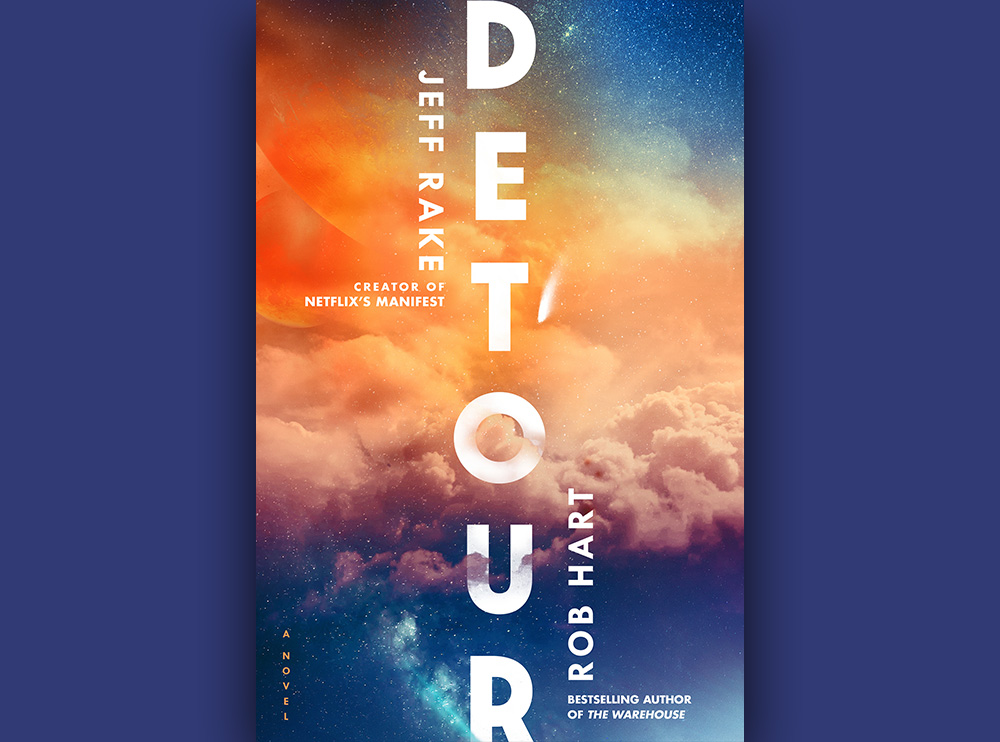
A space shuttle flight crew discovers that the Earth they’ve returned to is not the home they left behind in the first book of this emotional, mind-bending thriller series from the creator of the hit Netflix show Manifest and the bestselling author of The Warehouse.
Intrigued? Well read on to discover the synopsis and an excerpt from Detour by Jeff Rake and Rob Hart, which releases on January 13th 2026.
Ryan Crane wasn’t looking for trouble—just a cup of coffee. But when this cop spots a gunman emerging from an unmarked van, he leaps into action and unknowingly saves John Ward, a billionaire with presidential aspirations, from an assassination attempt.
As thanks for Ryan’s quick thinking, Ward offers him the chance of a lifetime: to join a group of lucky civilians chosen to accompany three veteran astronauts on the first manned mission to Saturn’s moon Titan.
A devoted family man, Ryan is reluctant to leave on this two-year expedition, yet with the encouragement of his loving wife—and an exorbitant paycheck guaranteeing lifetime care for their disabled son—he crews up and ventures into a new frontier.
But as the ship is circling Titan, it is rocked by an unexplained series of explosions. The crew works together to get back on course, and they return to Earth as heroes.
When the fanfare dies down, Ryan and his fellow astronauts notice that things are different. Some changes are good, such as lavish upgrades to their homes, but others are more disconcerting. Before the group can connect, mysterious figures start tailing them, and their communications are scrambled.
Separated and suspicious, the crew must uncover the truth and decide how far they’re willing to go to return to their normal lives. Just when their space adventure seemingly ends, it shockingly begins.
RYAN CRANE
WASHINGTON, D.C., CARTER MEMORIAL HOSPITAL
“Mister Crane?”
Ryan jerked awake from where he’d been dozing in the waiting room. It was a wonder he’d even fallen into that twilight space, given the harshness of the fluorescent lights and the chair that seemed to be designed to inflict pain.
He looked up to find a tall, absurdly handsome man in a white lab coat—square jaw and salt-and-pepper hair, with a twinkle in his blues.
“I’m Doctor Antonio Segura,” he said, smiling and extending his hand. “I performed the surgery on your wife.”
“I hope she was under the whole time,” Ryan said. “You look like one of those TV show doctors. Last thing I need is my wife waking up and running off with you.”
Segura smiled in a way that made Ryan think people often commented on his appearance.
“I’m sure your wife is quite taken with you,” he said. “She’s doing fine, by the way.”
“Kinda figured. You didn’t have a bad-news face on.”
Segura took a breath. He was probably tired. So was Ryan, and he dealt with difficult emotions by plastering them over with humor. Which not everyone liked, but it worked for him. And the truth was, he’d spent the night absolutely terrified. Appendectomies were routine, Carter Memorial was a good hospital—but sometimes things went wrong.
“How’d the surgery go?” Ryan asked, trying to be a bit more serious.
Segura sat on the chair next to him and folded his hands. “Very well. Our preference is to do it laparoscopically, which means smaller incisions. Given the advanced stage we were worried about a rupture, so we had to do an open surgery. The only difference is a slightly bigger scar, and we may want to keep her one more night, just to keep an eye on things.” Then the doctor laughed. “I have to tell you, your wife has a high tolerance for pain. Most people come in well before that.”
“She’s a hell of a woman, and she can put up with a lot,” Ryan said. Then he smiled. “After all, she married me.”
Segura laughed again. “I can see how that might take some degree of patience.”
“So can I go in and see her?”
“She’s sleeping right now, and she will be for a little while longer.”
“Okay then,” Ryan said, trying to rub the sleep from his face. “Where can I get a good cup of coffee around here?”
“Not in the cafeteria, that’s for sure,” Segura said. “There’s a place down the block. TradeRoast. They’re usually a little busy around this time but it’s worth it. Good food, too.”
Ryan felt a grumble in his stomach at the mention of something to eat. Coffee and a muffin sounded really good about now.
“Okay doc,” he said, shaking the man’s hand again. “Love of my life in there. Thanks for taking care of her.”
“She did great,” Segura said. “When you come back, if I’m not here, the nurse will go over the aftercare. But just remember, plenty of rest and fluids, and easy on the canoodling for a bit.”
With a smile, the doctor hustled off. Ryan headed for the front doors of the hospital, into the blazing sunlight. It was the start of September. He remembered when September brought the promise of temperate days and cool nights; now they were lucky if the mercury dipped below 90 before October.
In the morning heat, he felt crusty—unshowered, unshaven, wearing a pair of jeans that may have been dirty, a t-shirt, and the closest pair of boots he could find. He scratched his face and considered driving home to check on the kids, but he didn’t feel good about leaving Nina. He wanted to be there when she woke up.
As he strolled down the block, hoping it was the right direction, he called Darnell, who answered on the second ring.
“How’s she doing?” he asked.
“All good,” Ryan said. “She’s sleeping now. How are the kids?”
“Teddy ate. Got him downstairs just fine. He’s doing some cool drawing. Scarlett has me watching Frozen 3. Man, this movie is good.”
“I prefer the second one, but hey, there’s much crappier fare she could be subjecting you to,” Ryan said. “Listen, Nina’s still out, and…”
“Dude, we good,” Darnell said. “It’s a quiet day for me, you know I don’t mind hanging with the kids.”
“And they’re okay?”
“They get it,” Darnell said. “I told them their mom was fine and you were with her and she was with the best doctors in the world. Man, you got some good kids right here.”
“They’re just good to you because you know where we keep the real snacks.”
“Whatever works.”
“Exactly. I owe you, bud.”
“You always get my back, I always get yours. Do your thing and let me know how it goes.”
“Okay, can I talk to Scarlett?” Ryan asked.
There was a shuffling sound, and then Scarlett’s tiny voice sounded through the phone.
“Hey daddy,” she said. “Mommy is okay, right?”
“She’s fine. She’s sleeping now. More importantly, are you taking good care of Darnell?”
“I’m mad at him,” she said.
“Why?”
“Because he said I could have some candy but I wanted more candy and then he said no.” Ryan could hear the pout on her face.
“Well, kiddo, the way you eat candy, you’re literally going to turn into candy, so I think he made the right call. Listen, I love you, tell Teddy I love him, and I’ll let you two know what’s going on soon, okay?”
“Okay, daddy.”
Ryan waited a moment, thinking Scarlett might pass the phone back to Darnell, but she just ended the call. He laughed and stuck the phone in his pocket, in time to look up and see a gaggle of reporters outside NASA headquarters, the massive concrete and glass behemoth across the street. Must be some kind of event or something. The reporters were surrounding someone who seemed to be trying to get to a black SUV parked at the curb. A very expensive, luxury SUV, so probably not a politician.
But then his attention was diverted to a beaten white delivery van slowly coasting to a stop across the street.
Twelve years on the job, and Ryan had developed a pretty good sense of when something bad might be about to happen.
The sounds of the street—the traffic, the shouting reporters—all of it faded as his focus narrowed on the van. From where he was standing, he couldn’t make out the driver. The window was tinted.
It sat there, idling. Not putting on its flashers. No one hopped from the back to deliver something. It wasn’t branded. The paint was scratched and the engine was heaving; it was old, in disrepair. Weren’t a lot of old vans in a state of disrepair cruising around this neighborhood.
He glanced over at the scrum across the street and caught a glimpse of a tall, handsome man in the middle of the crowd, wearing a purple suit.
John Ward.
Things were starting to add up.
Ryan didn’t have his service weapon on him, and his personal gun was stashed in the bedside drawer at home. He hadn’t thought to bring it, and he suddenly wished he had it. Not that he liked carrying a gun around with him—the burden of it always felt a bit too heavy—but better to have it and not need it.
As he glanced around for some kind of makeshift weapon, the side door of the van slid open.
A man stepped out wearing a black ski mask, toting an assault rifle.
Ryan immediately darted to the right, behind a parked car and outside the gunman’s field of view. No one seemed to notice yet. The man was carrying the gun close to his side. Even the cars screeching to a stop in the street to keep from hitting him—no one seemed to yet notice the depth of the danger.
The man drew closer to the crowd and raised the gun, taking aim. Being careful. He wasn’t planning to fire indiscriminately.
It was a gamble, but Ryan could work with it: he needed to create some confusion. He put his hands around his mouth and screamed at the top of his lungs, “GUN!”
That did it.
The gunman paused, wondering where the shout had come from. Ryan had ducked behind a stopped car and was slowly working his way over, getting closer while staying out of sight.
But the screams now cutting the air told him people had seen, so hopefully Ward would duck for cover. Ryan made his way around until he was situated behind the gunman, who was whipping his head around in confusion.
Ryan went in low, from behind, stepping forward so his foot was between the gunman’s legs. Then he leaned down, grabbed the man’s ankles, and yanked up. The man went airborne, before coming down face-first on the pavement with a sickening crack.
Ryan grabbed the assault rifle and whipped back to the van. There was another person climbing out now, also carrying a rifle, but she was fumbling with it, like she didn’t understand how to use it.
“MPD, get down on the ground NOW,” Ryan shouted.
The woman’s eyes went wide behind the ski mask. She tossed down the assault rifle, hurled herself back into the van, and pulled the door closed. Within seconds the van roared to life and it tore down the street, weaving between stopped cars until it struck a streetlight, the engine still gunning with the car at a full stop.
Ryan turned back to the gunman, who was lying on the ground and groaning, cradling his face, blood seeping between his fingers. The scene was under control. Ryan immediately threw the gun down and put his hands up; he wasn’t in uniform, and didn’t want any first responders approaching the scene to mistake him for the shooter.
Within moments two cops were coming toward him, guns drawn.
“Get down, get down!” they screamed in unison.
“Ryan Crane, MPD! I’m a cop!” Ryan shouted back, and he slowly lowered himself to his knees, hands up.
The cops got closer, and Ryan recognized one of them: Dan Parish, one of the younger department hotshots who would do or say anything to make a name for himself and climb the ranks.
Parish stopped, pointing his gun down at the ground.
“Crane,” he said, barely hiding his disdain.
“Yeah,” Ryan said. “Nice to see you too. You’re welcome, by the way.”
JANET WILLIAMS
CNN NEWS REPORT
“Two days ago, a potential bloodbath was averted outside NASA headquarters in downtown D.C., and tonight, we have exclusive information on the motives behind this terrifying incident.
Mason and Ivy Cavendish, twins from Butte, Montana, drove to D.C. with the intent of killing billionaire and CEO John Ward. The normally-secretive Ward doesn’t often appear in public, and authorities believe the perpetrators were using this as an opportunity to catch him out in the open and unaware.
Police recovered a manifesto from the Cavendishes, explaining that Ward’s plan to devote resources to space exploration ignores and exacerbates the impact of global climate change here on Earth. They charge that Horizons is covering up information that, we quote ‘puts the fate of the planet at stake’.
CNN has reviewed this document and made it available on our website. We have spoken to several independent experts and have not been able to verify any of the assailants’ claims. Police sources are also exploring their connection to a dark web conspiracy forum.
The Cavendish siblings were stopped by police officer Ryan Crane, a 12-year-veteran of the MPD. He was off-duty but near the scene when the incident occurred, and was able to subdue Mason while Ivy attempted to flee.
Crane, a married father of two from Hill East, has thus far declined to speak to reporters.

Ward, meanwhile, has experienced a surge in public opinion, with new light and interest brought to his Titan settlement project, which could launch within a year and explore the possibility of establishing a human colony there.
A recent Quinnipiac poll shows that, while still considered an underdog in the presidential race, Ward has experienced a bump of four percentage points.”
JOHN WARD
WASHINGTON, D.C., DUPONT CIRCLE HOTEL, PENTHOUSE SUITE
The glass coffee table shattered.
Ward winced. He hadn’t meant to break it, only put his feet up on it, but he should have taken his black Ferragamo boots off before he did so.
And calmed the fuck down.
He’d made eye-contact with the shooter for only a split second. But in that instant—the assault rifle aimed between his eyes—Ward felt fear, for the first time in his life.
Camila Reyes came hustling into the room, a look of bewildered shock on her face. Then she smirked when she saw the sound was just a result of his clumsiness.
She pointed up at the television. “Thought you’d be happy with those numbers.”
“It was an accident,” he said self-consciously, muting the TV. He looked around the opulent suite, occupied last by a Saudi prince—it took up the entire floor of the hotel and boasted four bedrooms, two full bathrooms, a private terrace, and a small eat-in kitchen. “Have them add it to my bill.”
“Right,” Camila said, doing a bad job at hiding the eye-roll, but he forgave her for it. She was the only one he would forgive for such a clear sign of disrespect.
Born in the Bronx, lacking even a college degree, he’d found her working in the cafeteria of his New York office. He’d recently banned the use of personal phones at work, requiring employees to lock them in cubbies on the way in and pick them up on the way out. He knew it would be unpopular, but thought it would make them more focused while in the office.
Camila stopped him in the food line and tore him a new asshole, about how her mother was sick and she needed a way to stay in contact with her, on top of all the other employees who had families, and that all this new policy would do was cause resentment.
Then she took out her phone and waved it in his face.
He was immediately intrigued. No one talked to him like that. No one. He could see her point, had even considered it, but when he ran it past his advisors, they did what they always did: told him it was a brilliant idea and followed in lockstep.
It was that moment he realized having a team of yes-men made his job easier, but it didn’t make him better at it.
He had lunch with Camila that day. Talked to her, learned about her. He found that what she lacked in formal education she made up for in tenacity, cleverness, a keen understanding of people, and a willingness to learn. She spoke her mind, and she didn’t fear him, maybe because she was nearly old enough to be his mother. Plus, she was a rule-breaker, and he appreciated rule-breakers.
By the end of lunch he had hired her as his assistant, and it was the best decision he’d ever made. Soon he transformed her from a cafeteria worker into the most brutally efficient assistant a CEO had ever seen.
If there were bodies, not only would she know where they were buried, she would have personally overseen the interments.
Ward looked down at the mess on the carpet. He couldn’t even take his boots off now, with all the broken glass. “Can you get in touch with housekeeping?” he asked.
Camila was typing furiously on her phone. “Already on it.”
“So how do we look?” Ward asked.
Camila sighed. “Four percentage points is great. You need forty.”
“Twenty-five,” Ward said.
“Forty. You’re mounting a third-party candidacy. Against an incumbent who is also a war hero, and a senator people actually seem to like. They’re going to siphon votes off each other, which will get you within spitting distance, but to really make an impact, you need something big.”
“And how do we get something big?”
“Cure cancer.”
Ward sighed. “How else do we get something big?”
“Well, first, you can drop this insane plan to join the Starblazer crew and campaign from space.”
Now it was Ward with the eye roll. “We’ve discussed this to the end of time and back, Camila,” he said. “The constitution doesn’t say I have to be on Earth to run. I can patch in by video wherever and however I need.”
“And the further you get out, the more of a delay there’ll be,” Camila said. “No one’s going to sit through a debate where you need ten minutes to hear a question and then ten minutes to answer it.”
“The press will be enormous,” Ward said. “Everywhere you look, there I’ll be.”
“No,” Camila said. “People will see your picture and they’ll see you on a screen, but they won’t see you as a genuine candidate. You’ll be millions of miles out in space. With no way to address things as they come up. You need to appoint a replacement and commit yourself to the race.”
“If I step down now, people will think I’m a coward,” he said.
“No, they’ll think you’re less crazy.”
“Am I not already getting some of that everyman attention, with the lottery?” Ward asked.
“That didn’t turn out the way we’d hoped,” Camila said.
No, Ward thought. No it did not.
“I know you know all of this,” Camila added in mild exasperation. “You’re too smart not to. So can we stop arguing and come up with a realistic alternative?”
Ward sighed. Watched the muted TV screen. The anchor was saying something, and Crane’s picture appeared again.
The hero cop. He hadn’t even done an interview yet and he was getting more press than Ward.
“Hey Camila, how am I doing on public safety? Law and order types.”
Camila put down her phone. “Well, you don’t have a single police union endorsing you, and that’s after we spent millions on donations to gun buy-backs and after-school programs. You have no public record to speak of, so no one has anything to judge you on or credit you for. Again, you’re running against a war hero and a man who wants to bring back the death penalty. There’s too much noise. You’re crowded out of the conversation.”
Ward nodded slowly. “I have an idea. You’re going to think it’s nuts…”
Reprinted from Detour by Jeff Rake and Rob Hart. Published by Random House Worlds, an imprint of Random House, a division of Penguin Random House LLC.