


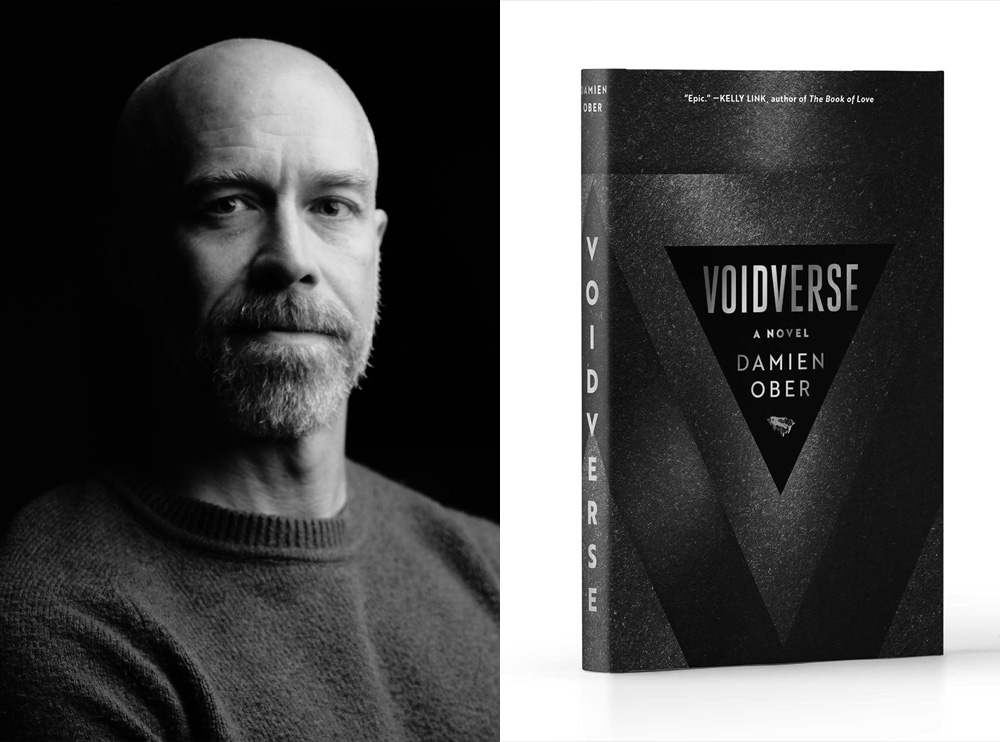
We chat with author Damien Ober about Voidverse, which is Dune meets Wool in this high-octane quest through the void, where two eternal forces are about to collide in an epic showdown.
Hi, Damien! Can you tell our readers a bit about yourself?
In the summer I spend a lot of time gardening and digging holes and building rock walls and staircases out of old railroad ties. My goal is making spaces that feel like outdoor rooms. When it’s too cold, I stay inside and paint tiny models, so tiny you have to wear a magnifying glass and a light attached to your forehead.
When did you first discover your love for writing and stories?
At a very early age, I fell in love with comic books and horror short stories and weird movies. I still remember my first reading of Poe’s The Murders in the Rue Morgue, so shocking and visceral, but also complicated and smart, like a living puzzle, with such a cool main character. The movie Saturn 3 stands out in my mind too, as a really scary blend of human and digital. By 11 or so I was trying to write my own stuff along these lines.
Quick lightning round! Tell us:
- The first book you ever remember reading: The Great and Secret Show by Clive Barker
- The one that made you want to become an author: V.A.L.I.S. by Philip K Dick
- The one that you can’t stop thinking about: Ducks Newburyport by Lucy Ellmann
Your latest novel, Voidverse, is out March 10th! If you could only describe it in five words, what would they be?
Existential; visceral; singular; thought-provoking; atmospheric
What can readers expect?
A very unconventional and rewarding science fantasy adventure…. While Voidverse is a bit of a throwback to old school sci-fi, it’s also something completely different. It blends big themes, political and social allegory, playful prose and a truly singular and unforgettable setting, bursting with metaphor and ontological questions. The characters are sharp and heightened, but also feel like regular people you’d want to hang out and have a drink with. Beyond all the cool characters, fun subtext and amazing settings, at its core Voidverse is just a really great, fast-paced adventure that builds to a mind-blowing conclusion you will be thinking about long after.
Where did the inspiration for Voidverse come from?
The Voidverse itself came to me in a dream. When I started fleshing it out, it was not as straight images, but more like the void being narrated to me, like someone telling me an old story or a dream they’d had. From that nugget the entire world built out, both the void setting and Emery’s voice. In terms of Voidverse, the novel, I always try to write the book I don’t think is out there, but it’s important for that to feel organic, and not like a mission, so I have to have fun while doing it. With this one I really wanted to bring a fresh take to all the things I love about sci-fi and fantasy and westerns and genre in general: liminal spaces, strange cults, conspiracies, legends, magical objects and plenty of bad-asses with cool weapons. Movies like Krull and Beastmaster blended in my mind with Metroid and Zelda (NES) and Feudal Japanese history and Russian novels and heady space operas like Rama and Ring World.
Were there any moments or characters you really enjoyed writing or exploring?
The sinker is my favorite character from across all of my work. She has a bit of a Toshiro Mifune or Clint Eastwood vibe, the quiet ronin or the wanderer with no name, but she has a moral compass she just can’t shake which drives her to help those who can’t be helped. When we meet the sinker, she is adrift after a life of running from her past. As she reengages with her own history, the mystery at the heart of her character becomes one of the central mysteries of the novel. I find her such a great character because of her dilemma: she has a mission of her own which drives her, but she is often compelled to stop and risk it all to help people she doesn’t even know.
Did you face any challenges whilst writing? How did you overcome them?
For me the actual writing of it is the place where you get to take the biggest and most rewarding risks. With a book like this the prose itself becomes such a big part of the setting and as a first person POV is also the voice of a character. That really was the most challenging part, getting the language of the book right so it becomes one with the character arc, the atmosphere and just the whole tactile feel of the void. I actually typed the first draft of this book on a typewriter, which helped a lot in the early stages of rendering the narrator’s voice and the relentless flow.

How did your experience with visual storytelling influence your approach to working on Voidverse?
In this book especially, I really wanted to reveal character through action, which is such a huge part of the western and samurai vibe. This is something you have to do well in a screenplay. Sans a voiceover, you don’t get to go directly into a character’s head, so you’re restricted to showing their development through choices and action. But in my writing overall, the influence goes much stronger the other way. Fiction doesn’t have to be so economical, so you have more space to play with style, tone, more freedom to develop the skills you can bring back to the tighter screenplay format. It’s also made me a really good editor and given me the invaluable skill of making a screenplay very easy to read. You should be able to read a screenplay almost by accident.
What’s next for you?
I’m working on the openings of two new novels, trying to decide which to pursue. One is a period political thriller with (of course) a big twist, and one a blue collar fairytale in a very distinct and magical future. With the screenwriting, I have a few really cool scripts floating around, some with directors attached, or producers and some brand new – in various stages that is to say. So I’m always hoping one of those becomes the next thing.
Lastly, what books are you looking forward to picking up this year?
I already picked up Ice by Janek Dukaj. I am about half way through and it’s really so awesome. Also: Exit Party by Emily St. John Martel; Kingdom of the Conqueror Worm, by Nathan Ballingrud; The Rush by Nathaniel Philbrick; and especially Phantom Limb, Brian Evenson’s much awaited sequel to Last Days.