


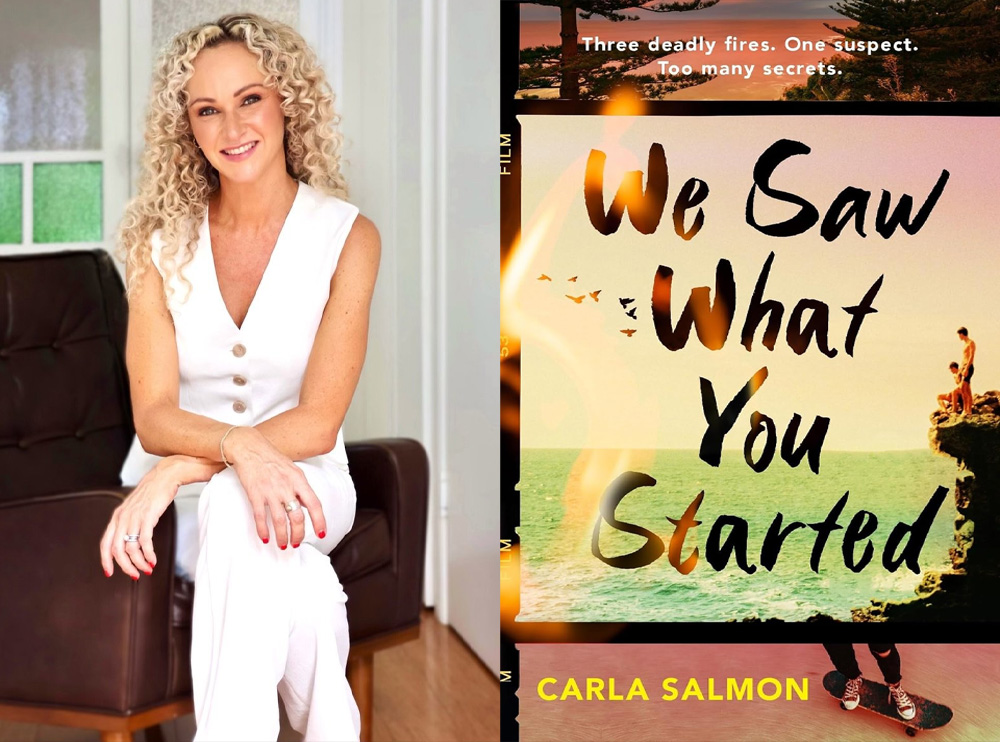
We chat with author Carla Salmon about We Saw What You Started, which is a suspenseful exploration of loyalty, family and friendship.
Hi, Carla! Why did you choose to set your book in a surf lifesaving club?
As a teen, I loved watching the Rainbow Beach kids arrive at my small country school – they’d pour out of the bus, sun-kissed, confident, and so connected. Their bond, shaped by their surf lifesaving club, stayed with me. Years later, my own kids joined one. It’s a perfect setting for stories about belonging and friendship.
What kind of research went into accurately portraying surfing and coastal town life?
I’ve spent a lot of time with my husband and kids at surf lifesaving clubs, skateparks and at the beach, watching them surf. So I knew the basics from their experiences and they provided initial information about the events in the book and patrol duties. But I also interviewed current families in surf lifesaving clubs as I wanted the characters’ experiences to be as accurate as possible. I also watched a lot of surfing and skating YouTube videos to really nail my characters’ voices. I wanted to get the technical language right, but also the everyday chat.
The book explores challenges of life in a tight-knit town – what was your experience of this?
Growing up in Gympie, a tight-knit town, was a mix of pride and pressure. The support is incredible – but if you mess up, there’s no hiding. I wanted to show how good kids can make bad choices, and how community and strong role models can help them find their way back.
Why did you choose to make Otto an American?
When I left Gympie and met American friends at university, I was fascinated by how they saw Aussie life – dangerous, strangely funny and full of surprises. Otto brings that fresh perspective, some laughs with his run-ins with native wildlife, and a reminder to be kind to people finding their place.
Milly thinks she needs to prove herself as an equal athlete to her brother. Do you think this is still relevant today for young girls in sport?
I really wanted to build on the momentum generated by inspiring female athletes such as Arisa Trew, the Matildas, AFLW and NRLW – and to position Milly as a strong, competitive female. Sport was really important to me as a teen, particularly field hockey – I was so inspired by the gutsy, driven girls and women who showed me that it was okay for girls to be tough and competitive on the sports field. And to just have a go – to show up. Now, I apply this mindset to other areas of my life.
My own children have both enjoyed playing sport, but we know participation rates drop off from 13-17 years – particularly for girls – and this can reduce opportunities to grow and develop skills. For example, when my daughter was 12 she started tennis lessons. She loved the game, but there were very few girls her age just beginning, so this made her experience less enjoyable. I’d love to encourage all young teens to keep playing and participating.
Which character was the most challenging for you to write, and why?
Otto was definitely the most challenging to write because I found myself wanting to protect him. You have to put your characters in really tough situations and they have to make mistakes, or the story will be very dull. But at the start, I felt vulnerable making Otto prickly. I wanted everyone to know immediately that he’s a good kid with a good heart who makes mistakes, which probably stems from experience as a teacher. Of course, I had to be brave and allow Otto to prove himself as the story unfolded.
Can you discuss a scene you found particularly impactful or enjoyable to write?
I had a lot of fun writing the scene in the surf club when the boys are sleeping over and sneak out for a night swim. Teen boys are hilarious. As a teacher and a mother, I spend a lot of my days laughing with them and enjoying their quick wit. But they also take risks, especially to save face with their friends. I really enjoyed exploring the line between fun and danger – and what kids do once it’s crossed.
What drew you to exploring themes of suspicion, loyalty, and family for a YA audience?
I’ve been in student wellbeing leadership roles at my school and these were all hot topics that impacted my students’ sense of belonging and connections. I wanted to remind kids that it’s okay to make mistakes – good kids sometimes make bad choices – and you always have options. Look for the people in your life who really believe in you and invest heavily in those relationships.
Were there particular authors or books that significantly influenced your writing?
As a child, I loved mystery stories like the Famous Five, Nancy Drew and the horrors of R.L. Stine. I was also addicted to the Babysitter’s Club – I had the whole collection. I was intrigued by the friendships and ‘grownup’ nature of kids running their own business. Once I hit high school, Looking for Alibrandi was the obvious standout. I craved coming of age stories that challenged stereotypes and opened windows into worlds beyond my small country town.
You talk about the need for more books specific to young teens. What do you see as the gap? How did you approach writing a story that bridges Middle Grade and Young Adult fiction?
My students are eager for books tailored specifically for readers aged 11 to 15. They want stories that feel mature – more complex friendships, boundary pushing, and real emotion with a crush or two – but still age-appropriate in terms of language and content. My own kids helped me shape something they’d be excited to read and that still feels right for their stage.

How did your teaching career shape the themes and characters in your novel?
The best part about being a teacher is learning that kids are inherently good. Our teens offer so much that we should be proud of and celebrate, even if it is sometimes hidden under protective layers of attitude and disruptive behaviour. Whenever I’m in the classroom, it is so easy to see the gold in every kid – even when they try their best to hide it. I wanted to share this in my book and tell teens that we see them. We understand that they make mistakes, but we’ll welcome them back with open arms until they’re comfortable. Everyone deserves the chance to belong.
Can you describe your journey from teaching into becoming a fiction author?
I thought I wanted to be a journalist. As a teen, I wrote for my local paper and completed work experience every year at Channel 7 on the Sunshine Coast. Then, I discovered public relations. I loved events. I loved networking. This was where my career in communications began and it was just as exciting as I’d hoped it would be. After university, I moved to London and joined a PR agency that specialised in design and fashion. I have plenty of stories from those years! When I returned to Australia, I moved into marketing, working for Bond University’s international marketing team. I travelled monthly for six years, visiting international schools throughout Asia and Latin America – which sparked my interest pivoting to education. I returned to university when my daughter was born to study teaching and was so fortunate to join Brisbane Grammar School, where I’ve enjoyed ten years in the Middle School. I love teaching but I needed another creative outlet – so I began writing. Now, I combine my experience from both industries as an author and a teacher.
Can you provide any teasers about your next book?
We return to Red Sands in Book 2 – but only briefly. This time, the teens head to their surf lifesaving camp on remote Talmar Island. The boys pick the wrong beach to set up camp – not just because there’s a spotlight, a speedboat and a sinkhole. But because someone else is coming. This one will have your heart racing from the very first page.
How do you envision your novels being utilised in educational settings?
As a teacher, I wrote with the classroom in mind. The novel includes extensive teaching notes mapped to the Year 7 and 8 curriculum, making it easy for educators to use the text for close reading, discussion and assessment. I was intentional with language and content – crafting a story that feels mature and relatable for students, while still being appropriate and purposeful for educational use. It’s designed to spark conversations around belonging, choices and resilience, with layered characters and themes that can be unpacked in meaningful ways.