
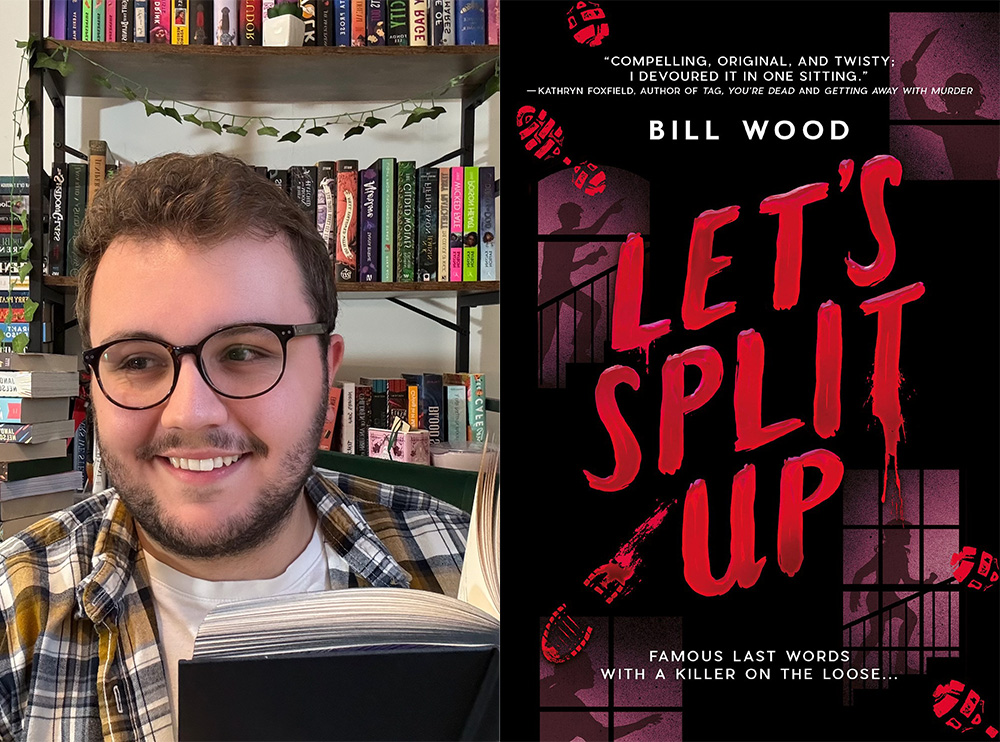
Guest post written by Let’s Split Up author Bill Wood
Bill Wood is a former Waterstones bookseller with a growing online platform. In less than three years, he has amassed a following of over 125,000 bookworms and 10.5 million likes on his TikTok. Bill has a BA with honors in film and screenwriting from Birmingham City University. He currently lives with his family and Staffordshire bull terrier, Macey. Let’s Split Up is his debut YA novel.
About Let’s Split Up: An electrifying tale of four friends determined to hunt the killer ravaging their idyllic small town that’s perfect for fans of I Know What You Did Last Summer. Check out our review here and interview with Bill here!
The horror genre has been long intertwined with queerness, serving as a space for subtext and coded representation. This is particularly apparent when overt depictions of LGBTQ+ identities were subject to censorship. Filmmakers and writers often danced around these limitations by inserting queer themes, coded characters, and more within the framework of horror, using its transgressiveness to explore identity and otherness. Here’s some of my favourite queer horror films, ranging from explicitly queer stories to unintended queer resonance.
Nightbreed, 1990 – dir. Clive Barker
Barker, the horror mastermind behind Hellraiser and Candyman, brought his dark expertise to Nightbreed, a film he wrote and directed based on his 1988 novella Cabal.
Released to middling reviews and box office returns, Nightbreed was initially marketed as a standard slasher. A man, manipulated by his doctor into believing he’s a serial killer, seeks sanctuary among a group of monsters and outcasts called the Nightbreed. But Nightbreed is far from typical slasher fare, especially of the early ‘90s.
While not explicitly queer, one cannot watch this film through a contemporary lens and miss the unmistakable queer undertones. Even with much of the queer subtext stripped from the theatrical release, its presence still lingers. Much like the X-Men franchise, Nightbreed functions as an allegory for societal rejection. As Trace Thurman noted in 2019, the film ‘serves as an allegory for intolerance.’ And as early as 1997, author Harry M. Benshoff recognised Nightbreed as ‘one of the first horror films to make an explicit connection between monsters and the activist politics of the queer community.’
Ultimately, Nightbreed is hellishly underrated—no pun intended—and a bold blend of horror and fantasy that deserves just as much recognition as Barker’s more commercial works.
A Nightmare on Elm Street 2: Freddy’s Revenge, 1985 – dir. Jack Sholder
When The Advocate dubbed A Nightmare on Elm Street 2: Freddy’s Revenge ‘the gayest horror film ever’ in 1985, it felt like both a bold claim and a very ‘80s one. But the film has since gained a reputation as a queer horror classic, not just for its subtext, but for its overt homoeroticism.
Mark Patton stars as Jesse, a high school student at the forefront of Freddy Krueger’s wrath. But Jesse isn’t the typical male protagonist. He plays the ‘final girl,’ a role typically reserved for a female character who survives the murder spree and ultimately takes the evil out. Jesse screams, cries, and runs in fear—often barely dressed.
The book Welcome to Our Nightmares dives deep into the film’s legacy, highlighting scenes that make the subtext impossible to ignore, ‘He and a tormenter have a sweaty wrestling match. His coach, clad in leather, basically hits on him in a gay bar, then gets killed by Freddy, including a bare-ass spanking.’
By now, it’s undeniable. Even Patton himself has said, “This is not subtext.’ He’s also revealed the queer undertones became more prominent during script rewrites—changes that were perhaps influenced by the political climate of the time. Released in 1985, Freddy’s Revenge drew an audience in the midst of the AIDS crisis when fear and stigma surrounding queer identity were at a boiling point.
Though originally marketed as straightforward horror and the sequel to an iconic film, A Nightmare on Elm Street 2 now stands as a relic of queer-coded cinema and a film with ‘subtext’ that barely pretends to be subtle.
Scream, 1996 – dir. Wes Craven
Scream was a huge inspiration for my writing. My book, Let’s Split Up wouldn’t exist without it. But it wasn’t until a few years ago, when I started digging deeper into the film, during a queer cinema module at university, that I realised just how much queerness people have recognised in it over the years. Looking back, I find it hard ot believe that I missed it.
**Spoiler alert for the ending of Scream**
When Billy and Stu are revealed as the masterminds behind the Woodsboro murders, it becomes quickly apparent that there might be something more than just bloodlust between them. Of course, this is not explicit said. But Stu, especially seems to follow every move. It’s not just out of loyalty, it’s almost like he’s desperate for Billy’s approval. He does what he’s told because…he wants Billy to like him?
Their dynamic calls back to the infamous Leopold and Loeb case from 1924 – two men, famously believed to be lovers, who murdered a boy in attempt to prove they’re smart to not get caught. That real life case has been adapted many times, notably in Hitchcock’s Rope, but it’s in Scream where the queer subtext really clicked for me, perhaps because it wasn’t so overt. And judging by the massive queer following the franchise has built of the year, I’m not alone.
Seed of Chucky, 2004 – dir. Don Mancini
Seed of Chucky is wild. But also, deeply, inherently queer. The Child’s Play franchise, created by Don Mancini, has always stood apart from its slasher peers. While Michael, Jason, and Freddy dominated the ‘80s horror scene, Chucky arrived a bit later, often seen as the underdog among the genre’s icons. But over time, Chucky carved out his own legacy.
Mancini, an openly gay filmmaker, began shaping the franchise during the height of the AIDS crisis. As the series evolved, so did the unapologetic embrace of queer themes and not-so-sub subtext. Seed of Chucky, an 87-minute, almost slapstick, horror comedy, was a turning point. It introduced audiences to Glen/Glenda, Chucky and Tiffany’s gender fluid kid, and leaned hard into the campiness of the genre.
Long before the explicitly queer Chucky TV series garnered both critical and commercial success, Seed of Chucky paved the way. It didn’t just bend the genre norms of the time, it obliterated them. The film’s unhinged tone, satirical nature, and cameo by queer icon John Waters all highlight its place as a queer cult classic.

The Child’s Play franchise has never shied away from tonal experimentations, but Seed of Chucky took that title to new heights. It’s messy, self-aware, and decades ahead of its time.
Haute tension/High Tension, 2003 – dir. Alexandre Aja
Haute tension is a French slasher film I first encountered during a queer horror cinema module at university. I even created a video essay on it. When it came up on the recommended watching list, I was intrigued. This was a film often associated with New French Extremity, a movement known for pushing boundaries. It had slasher tropes, home invasion horror (something I think truly terrifying), and a director whose work I’d previously enjoyed. Everything seem to be lining up.
And Haute tension is definitely interesting. Before diving into it, a huge spoiler warning. The film’s twist ending is polarising, to say the least, and for many, it either makes or breaks the experience.
The film follows two best friends, Marie and Alex, who are staying at Alex’s family home. One night, a serial killer breaks in and murders Alex’s entire family. As the chaos unfolds, Marie and Alex escape, and spend the film trying to stay alive.
But then the twist hits. It’s revealed that Marie is the killer. The entire home invasion scene was a delusion, and she’s been holding Alex hostage the entire time. The final scenes depict a disturbing confrontation where Marie demands Alex tell her she loves her, then she kisses her.
It’s a controversial ending—for good reason. On one hand, the film is gripping—the home invasion scene is a masterclass in frights and tension. But the twist frames that narrative in ways that many find troubling, particularly in its portrayal of queer people as dangerous and violent.
As someone who has engaged with queer horror in a broader sense, Haute tension is a valuable piece of media. Not because it offers ‘good’ queer representation, but because it opens the space for a discussion. I’ve read and watched reviews from lesbian creators who argue that not all representation needs to be positive. There’s something to be said about complex and villainous queer characters, though the level of nuance in their portrayal is important too. Without it, it’s understandable that some viewers find the representation harder to digest.
In conclusion, queer horror has always been present, whether through subtext or explicit representation. The idea that horror is somehow ‘going woke’ misses the point entirely. Queerness and horror have always been intrinsically linked—thematically, politically, and culturally. That connection isn’t new. And it’s not going anywhere.