


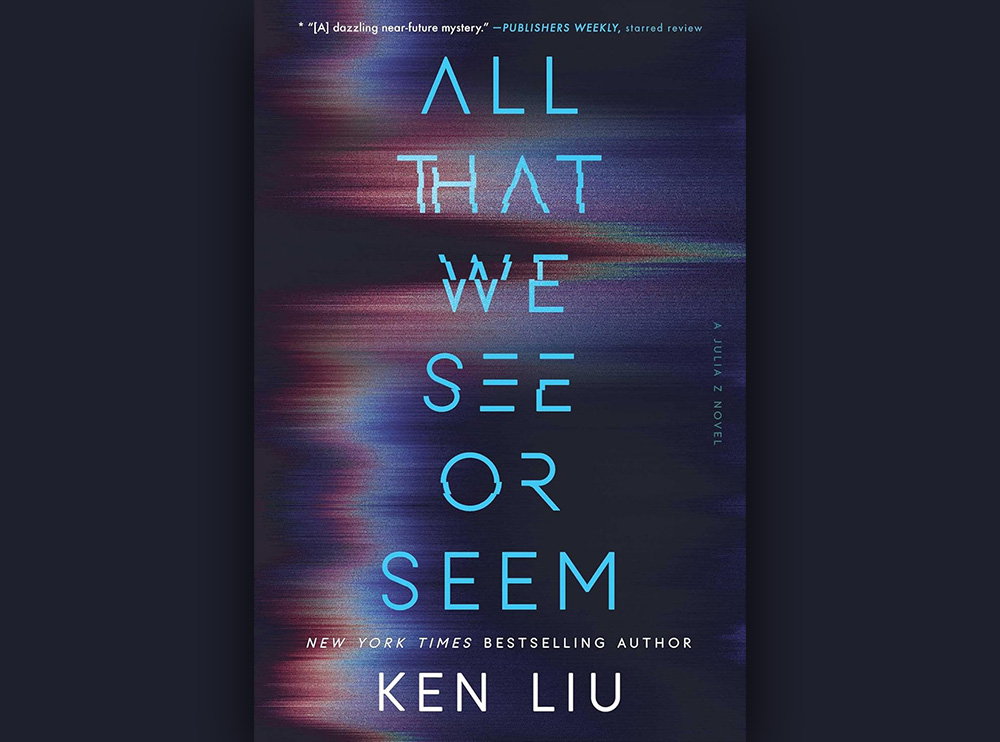
Award-winning author Ken Liu returns with his first scifi thriller in a brand-new series following former “orphan hacker” Julia Z as she is thrust into a high-stakes adventure where she must use her AI-whispering skills to unravel a virtual reality mystery, rescue a kidnapped dream artist, and confront the blurred lines between technology, selfhood, and the power of shared dreams.
Intrigued? Well read on to discover the synopsis and an excerpt from Ken Liu’s All That We See or Seem, which releases on October 14th 2025.
Julia Z, a young woman who gained notoriety at fourteen as the “orphan hacker,” is trying to live a life of digital obscurity in a quiet Boston suburb.
But when a lawyer named Piers—whose famous artist wife, Elli, has been kidnapped by dangerous criminals—barges into her life, Julia decides to put the solitary life she has painstakingly created at risk as she can’t walk away from helping Piers and Elli, nor step away from the challenge of this digital puzzle. Elli is an oneirofex, a dream artist, who can weave the dreams of an audience together through a shared virtual landscape, live, in a concert-like experience by tapping into each attendee’s memories and providing an emotionally resonant narrative experience. While these collective dreams are anonymous, Julia discovers that Elli was also dreaming one-on-one with the head of an international criminal enterprise, and he’s demanding the return of his dreams in exchange for Elli.
Unraveling the real and unreal leads Julia on an adventure that takes her across the country and deep into the shadows of her psyche.
One step. Another. Pause.
She waits until Piers’s snoring resumes its steady pace. One more step. She’s out of the bedroom.
Turning around, she whispers her goodbye. The curtains are tightly shut so that not even the moon can peek in, and Piers is just an indistinct lump in the bed. They’ve had a good life together. Better than most. She’s sorry that he’ll be devastated. He loves her and she loves him, but love isn’t enough.
It’s not enough to save her from this story about herself, this wak- ing dream that has turned into a nightmare. She’s a Shahrazad tired of telling lies to delay the inevitable, night after night. True, it’s her own fault that she ended up here. At least she’s now doing something about it.
She pulls the bedroom door shut, turning the knob so that it latches silently. Usually, the hinge would creak like a cartoon witch, but she had the foresight to oil it earlier that day. Good planning—the corner of her mouth curls ironically at the thought—if only she had always seen ahead.
Every step leads to another. Closer to the edge. At some point, you run out of steps.
She slips into her studio—what would otherwise be a kids’ bed- room in the suburban colonial two-story—and ties up the loose ends. She doesn’t turn on any lights; the glow from all the screens and LEDs is enough. It only takes her about ten minutes to reassure herself that she had cleaned up after herself and to erase anything that had to be left till the last minute.
She thinks about erasing more: all the practice session recordings; her own encrypted cephaloscripts; the dream-guide neuromesh of her personal AI; the interviews, fan messages, reviews—food for her vanity, training data for her egolets. Her fingers hover over the keys for a long moment.
In the end, she pulls back. She tells herself it doesn’t matter; eras- ing all this stuff won’t make Piers safer. In fact, keeping them around may be helpful, something to remember her by and something to bar- gain with. There will be darkness, shadows, danger, terror. It’s the least she can do to help him.
But deep down, she knows that she can’t go through with it be- cause she can’t kill herself. She has painstakingly built this idea of her, of Elli Krantz, over more than a decade.
Or maybe this has never been her self. That is the question and the reason and the entire point, isn’t it?

Maybe she can’t get away. Faustus tried and failed. But she has to try.
Slowly creeping over the floorboards to suppress any creaks, she finally steps into her soft boots, pulls on her long wool coat (March nights in Massachusetts are still very cold), and picks up her water- proof backpack. Holding her breath, she twists the handle and slowly opens the front door, listening for noise from upstairs.
The frosty air makes her shiver. The waning moon hangs from the maple on the east lawn like a question mark. If Piers wakes up now, she thinks, it will be a sign. I won’t do it.
There is no noise.
She lets out the held breath. That’s also a sign.
The darkness beckons. She steps out, slowly closing the door be- hind her and latching it with the softest click.
She’s gone.