


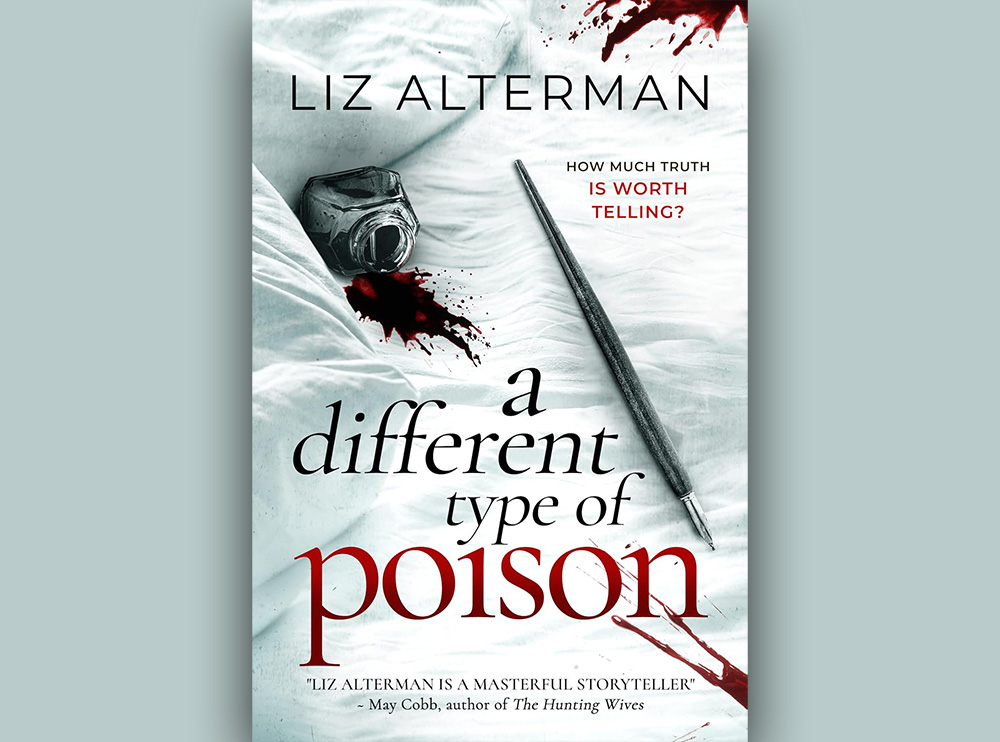
The Plot meets Disclaimer in a simmering, slow-burn domestic thriller and psychological suspense novel that explores the stories we tell, the secrets we bury, and the price we pay for both, perfect for fans of Sally Hepworth, Liane Moriarty, and Lisa Jewell.
Intrigued? Well read on to discover the synopsis and an excerpt from Liz Alterman’s A Different Type of Poison, which releases on November 25th 2025.
When a bestselling author receives an invitation to return to her hometown to discuss her dark campus thriller, she never suspects she may be walking into the most unsettling plot twist of her life.
After her first two books flatlined, author Molly Archer is thrilled that her latest, Birds at Night, is an instant hit. Newly divorced and raising two children in an upscale community north of Manhattan, Molly will do whatever it takes to sustain her novel’s momentum and support the lifestyle she’s worked so hard to achieve.
When an enthusiastic book club organizer from her hometown reaches out, Molly welcomes the opportunity to meet her readers. Traveling back to Ohio offers the perfect excuse to check on her widowed mom, whose health—and memory—appear to be unraveling.
As much as she looks forward to the trip, one thing troubles Molly: She can’t remember Anna Fox, the woman who extended the invitation and seems all too eager to reconnect. Will Molly’s visit introduce her to a new group of adoring fans or is she stepping into her deadliest chapter yet?
A taut literary thriller with shocking twists, A Different Type of Poison explores the line between where fiction ends and truth begins.
Prologue
I step onto the wide front porch. Its worn wood planks creak beneath me. The welcome mat lies crooked, its cheerful cherries faded. Flowers, browned and hunchbacked, wither inside the planters that flank the double doors. Petunias? Begonias? They were probably lovely. When they were alive.
It’s dusk. A full moon rises behind me. No light inside. Still, it’s bright enough that when I press my face to the glass I can see an entry table, mail stacked, shoes jumbled in a pile, a couch and a pair of armchairs to the left.
Once I had the address, I scanned the old listing photos. I wanted to get the lay of the land, a feel for the house, its exits. That’s the right thing, the smart thing, to do.
It looked nicer online. Doesn’t everything?
My right hand hovers above the doorbell. In my left is a bouquet of lilies. Peonies felt too on the nose. The book is tucked beneath my arm. Its weight steadies me. That’s all I need, really, but, of course, I brought other things too.
It’s time.
I take a deep breath, let the clean country air fill my lungs. Nearby, someone has cut the grass. My nose twitches at the sweetness of it.
I press the bell, its chime dulled, muted, either by the window panes or the ringing in my ears as I wait, wondering how this will go, what will happen from here.
Shadows shift behind the glass, movement. A figure comes toward me.
When I see her face, I nearly step back. She’s aged quite a bit, like someone who’s been through it. Haven’t we all, each in our own way?
Still, it’s been a particularly rough time for her. It’s about to get a lot worse.
Chapter 1
Molly
Enjoy the moment, I remind myself and smile at the audience. My audience. I took half a Xanax before I left the house. It’s starting to work its magic, the butterflies in my stomach slowly settling.
My other novels never drew a crowd like this. Of course, they were “quiet fiction” as Denise, my former agent, loved to call them. Tales of dysfunctional families in sleepy towns leading small, sad lives. Nothing like my latest, a thriller, that has rocketed to the top of bestseller lists and remained there for weeks.
I’m seated, legs crossed beneath a flowy floral dress that cost more than my monthly car payment. Perched atop a navy velvet chair to my left is the reigning queen of suspense, Selena Sandborn. It’s a pinch-me moment. I can’t believe she’s here—this brilliant author with the cascading silver hair and shock of red lipstick. As a teen, I read her twisty epics—filled with strong-willed, wily women—by flashlight beneath a fraying quilt so my mother wouldn’t catch me wide awake well past my bedtime. Now her novels line my office shelves.
Selena lobs softball questions my way, yet it’s obvious she’s read my words and that alone is as unexpected and magical as a lottery win. She lives a few towns away and has a new book out in September so this event benefits her too. Still, she’s here to interview me. Me.
What a change from the days when I’d lug a box of my books to a signing because Bonnie, the local bookshop owner, was reluctant to stock more than a half-dozen for fear she’d have to return them.
Inside the corner of that musty store, I sat surrounded by classics and bestselling debuts, trying not to sulk, pen in hand, writing nothing more than grocery and to-do lists.
I’d end up dragging home all but one copy, a sales associate making the lone pity purchase with a smile, a shrug, and the kindly, “If it hadn’t rained, I’m sure you’d have had a great turnout!”
Tonight, I didn’t have to bring so much as a water bottle. Everything has been handled for me. It’s a ticketed event. Sold out for weeks, Georgia, my new agent, reminded me this afternoon in her “enjoy the moment” email. Bonnie had to move the reading from the bookstore to this theater nestled among the rolling hills of a small Hudson Valley college. Of course, most people are probably here for Selena, but Georgia had the grace not to mention that.
Pink peonies, soft as cotton candy, bloom in a pale green vase set on the low table between Selena and me. It’s a nice touch as this particular flower plays a role in my novel.
Book covers larger than movie posters stand on easels flanking us. Against a ruby and gold backdrop, blackbirds hover above the silhouettes of two young women, their hair blown wild in the implied breeze. Tree branches, bare and menacing, arch and twist to create the title: Birds at Night.
Seeing my name, M.J. Archer—even though it’s just my initials followed by my ex-husband’s surname—makes my breath catch every time.
It doesn’t seem real. But it is, and I need to focus because Bonnie is striding purposefully through the aisle, saying, “Next question! Yes, you with the ponytail.”
As a young woman stands, a hush falls over the room, the only sound the soft rustling as the microphone changes hands.
I brace myself. This is the scariest part. The not knowing. The seconds when I wait, wondering: What will this person ask?
Over the past few months, I’ve fielded dozens of questions about my writing process. My answer never changes.
“With two young children, I always keep a notebook in my bag so I’m able to write wherever and whenever I have an idea,” I say. “Sometimes it’s not even writing. I’ve been known to leave myself a voice memo—or, in the old days—a message on my answering machine.”
The implication: I’ve been at this for ages! garners a few chuckles. People swoon at an overnight success story but who do they really love? An underdog. They want to hear about the struggle, the muddy boot prints on your once-pure and hope-filled heart. They want to know how you found the strength to rise when the world tried to hold you down.
“What made you shift away from literary fiction?” is another popular question. It feels like an insult but whatever. Each time, I fight the urge to say, “Money. Duh.”
That’s not entirely true. This project has been a demon inside me, clawing and screaming its way to the surface for years, but rather than get into that, I opt for a simpler response. “I tend to pursue the project I’m most passionate about at that point in time. If you’re going to spend years writing, revising, and rereading, you need to love your story, whichever genre it may be.”
This is typically met with affirming nods all around, the audience transformed into a sea of bobbleheads. It’s the truth yet it feels like I’m lying. This novel didn’t take years. It flew out of me, as dark and fierce as one of the blackbirds on its eye-catching cover.
There’s only one question I refuse to answer directly.
I draw a deep breath as the woman begins. “Um, hi.” Her voice wavers. “These characters feel so real to me. Did you base them on people you know?”
There it is. I’ve rehearsed my answer at home in the bathroom mirror. I like to think I’ve mastered this response but my nerves betray me. Heat spreads across my chest and rushes up my neck to my face. Beside the vase of peonies sit two glasses beaded with condensation. I reach for mine, wishing it were filled with wine instead of water.
I take a small sip and pause for effect, remembering a line from the novel: When in doubt, answer a question with a question.
“Oh goodness, I think we all know people like these characters, don’t we?” With a throaty laugh and a head toss, I lean into the witty artist persona I’m attempting to cultivate on this tour. Selena joins in and soon hoots and howls ripple through the theater, bouncing back to me, a gift from the generous acoustics.
I could say more but I don’t. There’s power in silence. The levity subsides, shifting to a lull that gives way to another swell of applause. When it does, I smile. This time genuinely. I’ve been promoting this book for six weeks and it never gets old, this feeling of adoration, of people cheering just for me. It’s foreign and fantastic. Heady. A drug without side effects.
Still, pain stretches from my left eye to my hairline, signaling the start of a migraine. Storm clouds loomed on the drive here, flashes of lightning electrifying the late spring sky.
Now raindrops patter against the roof, puddling and pooling on the skylights. My mind shifts to Ingrid’s tears. I picture my daughter sobbing an hour earlier while I raced from room to room trying to locate a missing earring.
“What is it now, love?” My voice was strained, my patience waning as I dumped makeup bags and rooted through the hamper.
I’d returned from my three-city tour nearly a week ago but hadn’t fully unpacked.
“I can’t find my raspberry tights,” Ingrid whimpered. Her “r”s came out more like “w”s.
“Shoot!” I muttered. Once again, I’d forgotten to respond to emails from the speech therapist Ingrid’s kindergarten teacher recommended.

“I need them for tomorrow,” my daughter whined, “for the concert.”
The concert. When was it? 10 a.m.? I had a radio interview scheduled. What time was that? Ten-thirty? No. Eleven. My chest tightened.
“Help me look!” Ingrid begged.
“I can’t right now, pumpkin. I’m already late.” I didn’t need to see my five-year-old’s face to know it was crumpling. “Did you leave the tights at your dad’s?”
Dan and I separated two years ago yet somehow our daughter still hasn’t grasped that her belongings, like her holidays, her home, and her heart, will be forever divided—something always missing, invariably left behind. Because of us, she’s become tortoise-like, carrying what she needs, what makes her feel safe, on her back in an endless shuttling.
“Isaac,” I handed my phone to my son, who, at eight, is already as tech savvy as any personal assistant I could’ve hired, “text your father, please. Ask if he’s seen your sister’s raspberry tights.”
“My lucky tights!” Ingrid corrected.
“One sec.” Isaac’s brown eyes remained fixed on my iPad where he played yet another game of Subway Surfers. When his avatar failed to land on the next train, he swapped devices, sent the text, then toggled between apps.
“Hey!” He smiled, revealing the tooth he’d lost at lunch. “You got invited to something!”
“To what?” I moaned, envisioning an end-of-the-school-year Mothers’ Tea or an “invitation” to co-chair next year’s Field Day committee.
“A book club,” Isaac said. “It’s from someone named Anna Fox. She says she’s obsessed with Birds at Night and wants to know if you can come to her book club.”
A giddy rush surged through me, that same welcome dizziness I felt when I stood after finishing a martini.
When my last two books came out, a few kind-hearted local friends—mostly moms from Isaac’s school and Ingrid’s daycare—invited me to their book clubs, especially once word of my divorce started to spread.
“We want to support you!” these women said, rubbing my arms as if I’d received a devastating diagnosis. In their eyes, I imagined, a failed marriage and the pursuit of a career as a novelist were as dire as any illness.
I appreciated their thoughtfulness but it hit differently when strangers reached out. Their interest seemed pure and, therefore, more valuable.
At the bottom of my author website I’d written a few lines:
I love to meet readers virtually or in-person. I promise not to drink all your chardonnay!
I hadn’t gotten many inquiries in the past, perhaps a handful of requests from librarians for virtual visits. But now with buzz building around Birds at Night, I needed to delete that paragraph or I’d never have time to finish the sequel.
“Did Anna Fox say where she lives?” I finger-combed the back of my hair as I waited for Isaac to blurt “Alaska!” or some far-flung place nowhere near our home in New York.
“Milltown, Ohio,” my son said. “That’s where Nana lives, right?”
“It is.” I abandoned my earring search, settled on silver hoops, and reached for the phone.
I skimmed the message. Anna Fox? Did we go to high school together? Anna Fox?
Ingrid’s chaotic ransacking of the house made it impossible to focus so I tossed the phone in my purse, grabbed an umbrella, and hurried out the door as soon as Heather, my tenant-slash-babysitter, arrived to stay with the children.
On the drive to the theater, I assured myself that once I had a few quiet moments to think, Anna’s face, and whatever connection we shared, would swim back to me.
Anna Fox. The name floats through my mind now as I sit on the stage shifting in my chair. Her words “It would be wild to see you again!” imply that we know one another. I should remember her, it suggests. Why don’t I?