


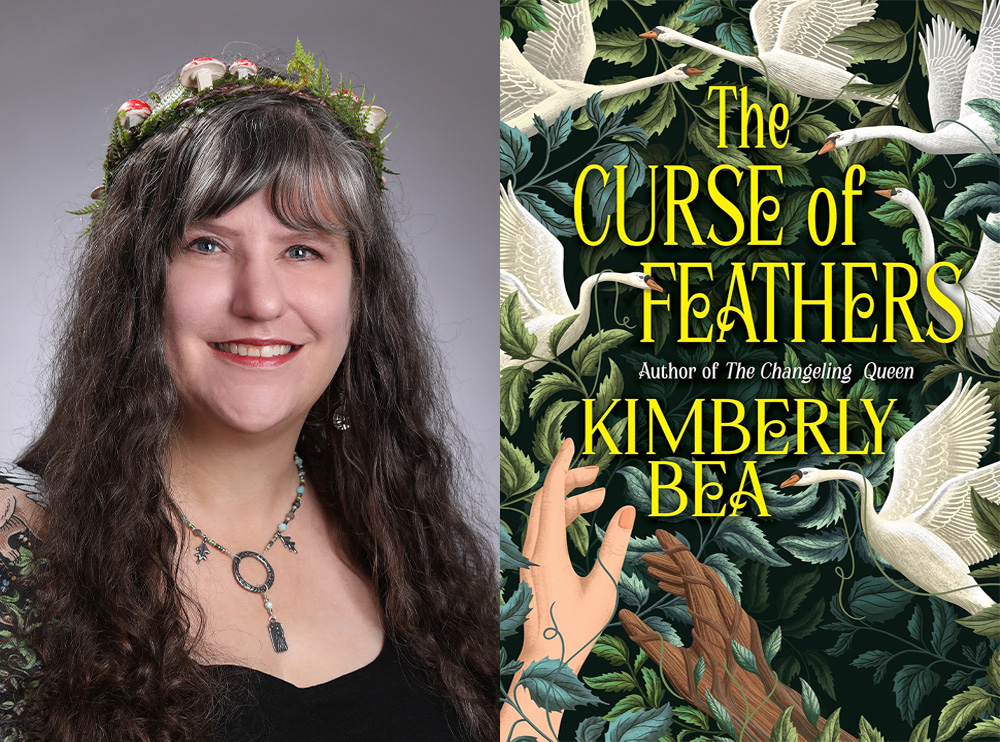
We chat with author Kimberly Bea about The Curse of Feathers, which is an enchanting, feminist fantasy retelling of the Brothers Grimm tale “The Wild Swans”: a young woman’s handiwork and determination is tested to the limits to save her six brothers, cursed to become swans.
Hi, Kimberly! Can you tell our readers a bit about yourself?
Hi there! I am a former academic, current educator and writer who moved from California to Minneapolis then back again after 25 years. I studied ancient history for many years, have been obsessed with Greek mythology since fifth grade, and love anything folklore and fairy tale. Besides reading and writing, my hobbies include knitting/crocheting, making jewelry, and belly dance!
When did you first discover your love for writing and stories?
Third grade is when I first realized you could write stories even if the teacher didn’t assign you to in class! But before then, I loved to draw and to make up stories about the characters I was drawing. I was telling those stories before I even knew how to read and write!
Quick lightning round! Tell us:
- The first book you ever remember reading: That’s a hard one! But I remember loving In the Night Kitchen by Maurice Sendak when my parents still read to me.
- The one that made you want to become an author: Probably A Room Made of Windows by Eleanor Cameron.
- The one that you can’t stop thinking about: The Last Tale of the Flower Bride by Roshani Chokshi.
Your latest novel, The Curse of Feathers, is out now! If you could only describe it in five words, what would they be?
historical fantasy feminist fairy tale
What can readers expect?
I really hope they will find an atmospheric tale of dark curses, witch hunts, and forest magic, with an engaging, determined, and devoted heroine and a deeply rooted (pun intended!) female friendship at its heart!
Where did the inspiration for The Curse of Feathers come from?
To be honest, I love the fairy tale “The Wild Swans” because it is the sister who gets to save all her brothers, but I wasn’t entirely happy with the ending. It always disappoints me at the end of the fairy tale when the magic seems to be over at the end of the fairy tale; it’s the best part! So I wrote a short story detailing what happens after the Happily Ever After, then expanded it into a full novel!
Were there any moments or characters you really enjoyed writing or exploring?
My favorite character to write might have been Nuve (pronounced Nu-veh), the askefrue, which is the spirit of the ash tree. Something I love about writing fantasy is getting to play around with magical creature who might somewhat resemble humans but don’t think like them at all. Nuve surprised me a lot, too.

Did you face any challenges whilst writing? How did you overcome them?
The research was a challenge, in part because I love it too much, and often fall down rabbit holes thatdistract me from writing. You can really procrastinate very badly that way! Limiting myself by setting a timer, making some days writing days and others research days, and having a critique group whose eyes glaze over when I am showing my work too much helps.
What’s next for you?
I am working on two different projects right now, which I am not sure I can share much about, both of which, in very different ways, will allow me to draw on my graduate studies in ancient Rome. Once is a secondary world fantasy, which I haven’t attempted in many years, so wish me luck!
Lastly, what books are you looking forward to picking up soon? Any you’ve got your eye on that are releasing in 2027?
I am eager to get my hands on Molly O’Neil’s Nightshade and Oak, and Holly Black’s A Conspiracy of Charming Monsters. In 2027, I’m super excited to read Emily Wilde’s History of Dark Faerie by Heather Fawcett and Dhonielle Clayton’s adult debut, Conjure the Bones.


