


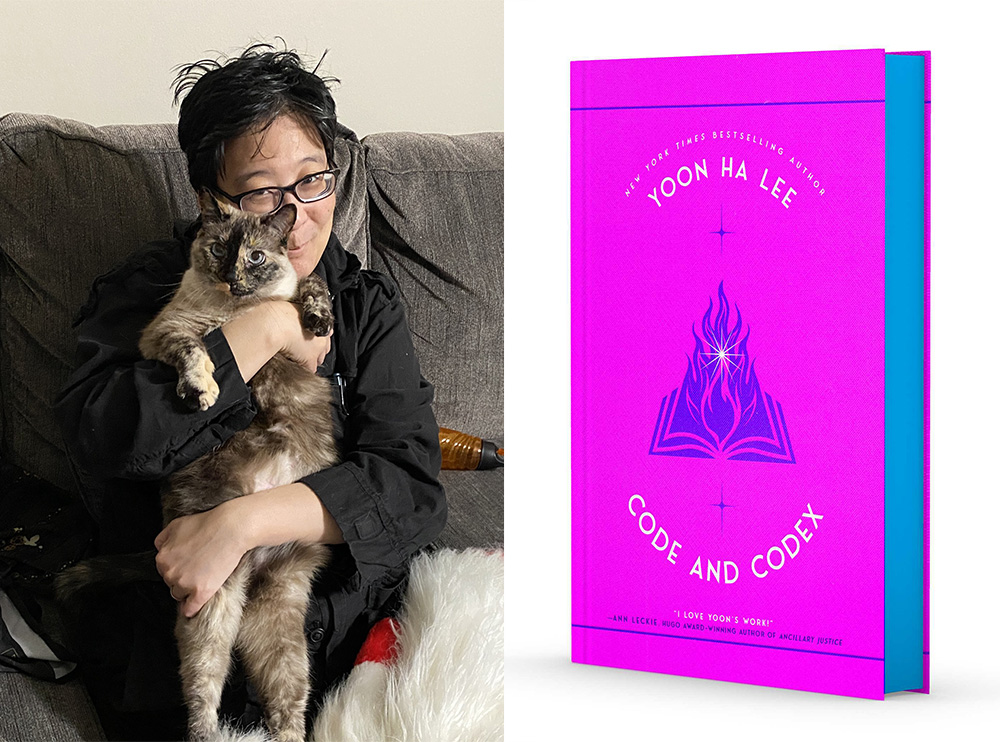
We chat with author Yoon Ha Lee about Code and Codex, which is a swashbuckling space opera about fighting against an evil empire trying to erase history.
Hi, Yoon! Can you tell our readers a bit about yourself?
Howdy! I’m a Korean-American sci-fi writer running around with a B.A. in math from Cornell University. My previous books have included Ninefox Gambit (explodey military science fantasy), Dragon Pearl (less explodey science fantasy, for younger readers), and Phoenix Extravagant (fantasy set on a Korean peninsula that never was). I live in Louisiana with my husband and a flopsy catten. My hobbies include handweaving, off-label uses of musical instruments, and destroying readers.
When did you first discover your love for writing and stories?
After my 3rd grade teacher imparted to our class that people wrote stories and we were people so we could write stories too (!), my sister and I went on a tear of making “book catalogs” for each other and “ordering books” from each other that sounded appealing. By “book” I mean “four sheets of typing paper folded in half and stapled” and the text was usually 2-3 sentences handwritten badly in pencil, with equally terrible “illustrations.” (That was my work, anyway. I’m sure my sister’s were much better!) Fast forward to 5th grade, where I’d write stories to share with my friends, some of whom would read over my shoulder as I wrote.
Quick lightning round! Tell us:
- The first book you ever remember reading: The first one I remember clearly reading on my own may have been Flutterby Fly. My kindergarten had a bunch of Serendipity Books and I was drawn to the beautiful illustrations and magical creatures. I sometimes read children’s picture books because I love the visuals, and I miss when adult fiction sometimes had chapter illustrations. That said, my mom says when I was very small, one time when we were preparing to move, she caught me reading the phone book…
- The one that made you want to become an author: I can’t remember clearly whether it was Walter Farley’s The Black Stallion or Madeleine L’Engle’s A Wrinkle in Time, both first books of series I was addicted to in 3rd grade. I wrote terribad eight-page knock-offs of both (where by “page” I mean “a couple sentences handwritten in pencil in a folded-in-half stapled ‘book’”), which have fortunately been lost to humanity.
- The one that you can’t stop thinking about: Perhaps a bit off the beaten path, but lately I’m obsessed with Anna Blackwell’s solo/co-op sci-fi roleplaying game For Small Creatures Such as We. I’m normally not a cozy gamer – I usually go for the grimdarkness of the darkgrim murderdice or explodey aggro mecha intrigue, you know? – but paging through this gives me so much joy. I might gather enough brain cells to attempt a playthrough! (I’m a slow reader and I like to read TTRPG books to study the systems.) Blackwell cites Becky Chambers’ terrific novels and Star Trek and Mass Effect as influences (among others), but has alchemized something wondrous and new in itself.
Your latest novel, Code and Codex, is out now! If you could only describe it in five words, what would they be?
Linguistics, genocide, duels, dysfunctional lovers.
What can readers expect?
This is a story about two oath-sisters; it’s a story about whose language we speak, and when and why; it’s a story about the people who aren’t seen as people. It also has unhinged math and linguistics references, plot-relevant shrimp forks, and survival in abusive relationships – some readers will want to nope out of this book on that last count.
Where did the inspiration for Code and Codex come from?
This was the “weekend project” book I noodled at in fits and starts and fragments while working on my YA trilogy. Sometimes the seed of the story doesn’t make it into the published book, which was the case here. I thought of this, initially, as an extremely cursed TTRPG session with larger-than-life players and characters in an aggressively baroque, bizarre world. My editor gently, lovingly asked me to take out the metatextual Dungeons & Dragons TTRPG gamemaster narrative frame. It was necessary for me to conceive the story, but it didn’t add enough to justify keeping, so I gladly cut it.
Also, what I chanted to myself over and over as I wrote this was the wish that everyone who asked for more math in Ninefox Gambit (which has very little overt math) would read this and realize the wisdom of be careful what you wish for, because I am a troll.
Can you share some insight into your worldbuilding process for Code and Codex?
Because this started as a weekend project, I ended up shoveling in everything that interested me in the moment; but some of those interests go back to when I was a small child. The world expanded fractally, inward and outward. I researched, or already knew (something) about: Byzantium’s judicial punishments, falconry as a discipline, Gödel’s incompleteness theorems. I think the entire enterprise of “immersive realism” in narrative fiction, if that’s a desired aesthetic ideal, has to proceed by chicanery and illusion and mirage because the world is too big to fit into several hundred pages. I can find you a textbook of a hundred-plus pages on damask structure and weaving techniques alone, and it’s not the only one. Now multiply that by everything that appears in a book. At a certain point, you have to pick what to include, what gets gestured at, what is omitted entirely.
Were there any moments or characters you really enjoyed writing or exploring?
Truthfully, I enjoyed writing all the characters, even the villainous ones, or the ones in their villainous moments. I often think the relationship between a writer and characters may be different from the reader’s relationship to the characters. Writers’ processes vary so much but for myself, even the most wicked villain is only doing their job, the job that I have constructed them for and instructed them to carry out. They’re a character, they don’t have any free will!
That being said, toss-up between my personal faves to write being Melisande with her combination of flashy beauty and pragmatism, and the Basilisk, who is So Very Done with everything but is too polite to say so. I do not usually write polite characters. It was a challenge!
Did you face any challenges whilst writing? How did you overcome them?
This is boring to describe, but: health. Dealing with various medical things as they came up, both myself and those close to me. We got through the worst of it together.

On a more cheerful note, what helped me was taking time away, with the love and help of my family and friends – away from writing in general, to give my brain a chance to rest, but also away from my computer-based writing setup! I’m very tactile and something about computerized writing stifles that process. I returned to a couple manual typewriters, which is how I originally learned touch-typing as a child. I took up handweaving and handspinning to remember what it’s like to interact with the physical world rather than being stuck in my head. (Pro tip: hand spindles are absolutely the most economical way to start handspinning, teach the mechanics, produce just as beautiful yarn when you learn the technique; I switched to treadle wheels because ironically, they’re kinder to my hands with their arthritis and nerve damage issues, but I like using my Turkish spindles when I’m able to.)
What’s next for you?
In the short term, back to focusing on schoolwork; I’m in the middle of a part-time MFA in media composition and orchestration. I’m neck-deep in Orchestration 1 and Session Preparation and having the time of my life because I like engraving nitpickery (well, within reason), as well as working on a short 2D animation film as a student project – time-consuming but so rewarding!
Writing-wise, I’m noodling at two WIPs on spec (a sci-fi thriller and a hard military sf reboot for fun, NINEFOX: CRASHHAWKS). We’ll see how they go!
Lastly, what books are you looking forward to picking up? Any you’ve read so far this year that you’ve enjoyed?
Between school and family, I haven’t had as much time to read as I’d like, but so far the standout fantasy read for me was Gracie Marsden’s Bones of Jade, Flesh Like Ice, which I was fortunate enough to read in ARC – reincarnation, star-crossed lovers, and generational damage in mythic Taiwan, and the blessed/cursed ties of two sisters. This would have knocked my socks off any year no matter how many books I read. One of my favorite reading experiences, inherently unpredictable, is when I pick out a book for myself and it’s by an author I don’t know anything about (I live under a rock) and it absolutely blows me away right to the tension of Is the author gonna stick the landing? The last time a book made me cry this hard was a very secondhand copy of Gordon R. Dickson’s Soldier, Ask Not. A++, would cry again!
I’m also on a romantasy kick and on tenterhooks for my copy of Bel Banta’s The Venus Court. Rivals-to-lovers and astrology magic and intrigue? I keep watching my mailbox hoping it’ll show up soon…