


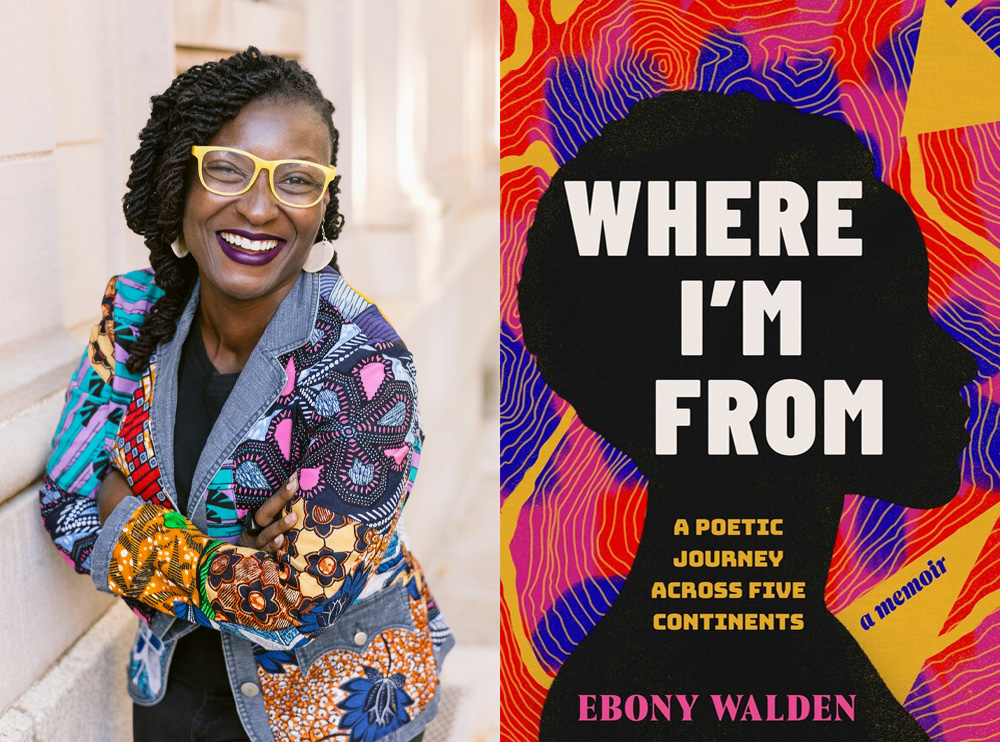
Guest post written by Where I’m From: A Poetic Journey Across Five Continents author Ebony Walden
Ebony Walden is an author, filmmaker, and speaker who has traveled to nearly fifty countries and all fifty US states. She is the founder of Ebony Walden Consulting, a racial equity–focused consulting firm, and the creator of Black Beyond Borders, a documentary series and podcast exploring culture, creativity, connection, and cuisine across the African diaspora. Ebony also writes Beyond Borders, a weekly Substack newsletter on travel and transformation. She lives in Richmond, Virginia.
About Where I’m From: A Poetic Journey Across Five Continents: Perfect for fans of Eat, Pray, Love, this soulful travel memoir blends poetry, global adventure, cultural connection and personal transformation with reflections on race, identity, and belonging. Released September 8th 2026.
Mirror in Salvador, Bahia
She wore white from head to toe. A layered lace skirt and a head wrap that felt like architecture. Gold bangles stacked high against her deep brown wrists. She was my kind of brown and unmistakably Black.
She stood on a cobblestone corner selling acarajé, the city’s local delicacy. As I looked at her, I saw my grandmother. Or my mother, years younger. Or even my sister, decades ahead. She was a Baiana, representing Candomblé and Afro-Brazilian culture. But, in that moment, she felt like me, years and continents removed.
She met my stare with steady jet black eyes and spoke to me in Portuguese. I spoke back in English. We were separated by language, centuries, and a different route across the Atlantic.
Brazil was the first country abroad where I saw my Blackness mirrored so clearly.
It holds one of the largest populations of Afro-descendant people outside of Africa, and standing there, I felt that history in a way that was physical. But what I felt went beyond pain. It was the triumph of a people who refused to disappear.
In Salvador, Black culture lives in food, religion, and movement. The Baianas de Acarajé, dressed in white, are connected to Candomblé, an Afro-Brazilian religion rooted in African spiritual systems that survived enslavement by synchronizing with Catholic saints. The acarajé she was selling traces back to West Africa. Black-eyed peas ground into paste, fried in red palm oil, filled with shrimp, deliciousness, and heat. It is edible history.
I watched capoeira in public squares, a martial art of resistance disguised as dance. I went to church services where embodied praise felt familiar, rhythm rising as call and response echoed across pews.
Salvador made me realize how much of the African diaspora exists outside of the American narrative, and how limited my understanding had been before I stood in that space.
Spirituality in Guanabacoa, Cuba
Years later, I would feel that same thread again.
I am on my knees in a room that is quiet in the way sacred spaces often are. It is still and open. Babalawo, a high priest of Santería, stands before me, dressed in white. Shelves around us hold sacred figurines, and offerings honoring the Orishas. These objects carry ancestral memory and spiritual power.
He lifts a feather and brushes it over my hands and my head as a cleansing. I don’t fully understand the words spoken, but my body does. This is exactly why I came to Cuba. Guanabacoa, just across the bay from Havana, is a center of Afro-Cuban spiritual traditions, a blending of Yoruba beliefs with Roman Catholicism. I am here for something I might have once feared. Growing up, anything tied to African spirituality was often framed as demonic. But kneeling there felt grounding. There was a familiarity to it, even though it was wrapped in newness.
Cuba taught me that African spirituality is not something to fear. It is a way of honoring ancestors, spirit, and energy. Its survival in the Americas is a form of resistance. It is something that has sustained people for generations.
Kneeling there, I realized that reclaiming that connection is part of reclaiming ourselves. It is radical and revolutionary.
Palenque and Liberation
I am in San Basilio de Palenque in Colombia. The air is thick with heat and music. Women in colorful dresses move with purpose. The pride is visible in the way people carry themselves, in the rhythm of the street, in the way history is spoken and lived.
Palenque was founded in 1603 by self-emancipated Africans. It is the first free Black town in the Americas. Being there felt like stepping into a living legacy of liberation.
Walls are painted with murals that read Black Lives Matter and I love being Black. A statue of the founder, Benkos Biohó, stands at the center with his fist in the air. Coconut rice and fried fish taste like a merging of coasts, Caribbean and South American.
What I felt in Palenque was resistance, born out of necessity but expressed through creativity. Building culture, community, and identity on your own terms. It reminded me that Black liberation has always existed alongside oppression. That even in the harshest conditions, people found ways to create beauty, to build, and to live fully.
Dakar and Creativity
In Dakar, Senegal, I am walking through the Ancient Palace of Justice at the Biennale, the country’s contemporary African art festival, surrounded by artists from across Africa and the diaspora. Paintings, sculptures, and installations fill the space, bold and unapologetic. One installation is made of shredded colonial maps, a critique of colonialism. Another is made of whips shaped like a Black body, protesting police brutality in South Africa.
I move from room to room, taking it in, feeling both inspired and challenged. This is not art that is trying to explain itself. It is art that makes a declaration of independence.

Dakar taught me about the expansiveness of Black creativity. It is limitless and ever-evolving. Being there felt like witnessing a conversation across continents and generations. Black artists telling their own stories, on their own terms.
Threads Across the Diaspora
And then there are the places in between. Sitting in Garífuna communities in Honduras, Guatemala, and Costa Rica, tasting soup thick with seafood, coconut milk, and history. Hearing the Gullah Geechee accent on the South Carolina coast while they braid sweetgrass, a practice carried from West Africa. Listening to Grupo Niche in Cali, Colombia blend salsa, jazz, horns, and Afro-Caribbean rhythms. Traditions crossing oceans and reappearing in new forms.
In these spaces, I feel both foreign and familiar at the same time. The locations, language, and cultures shift, but a common thread is always present.
Black Women Everywhere
What has remained constant is Black women. No matter where I go, I find them. In cafés, in Facebook groups, at events, in conversations that turn into traveling companions. These women are living abroad, building lives, creating community, navigating transitions and the vicissitudes of being Black in the world.
We share an understanding. We laugh, share stories, and hold space for each other in ways that feel immediate and real. We talk about entrepreneurship, identity and what it means to seek freedom and ease.
In these moments, I realize that being a Black woman across the diaspora comes with a duality. You can feel at home in Black spaces and still know you are a visitor. You can be understood and still carry parts of yourself that remain unknown.
Black Beyond Borders
Across cities, countries, and continents, there was always a connection. That is what I carry most from these places. Not just the history or the art or the culture, but the relationships. The small moments of connection that reminded me that even in a world that can feel divided, there are still ways we find each other.
Being a Black woman everywhere is not a single story. It is a collection of moments, of places, and of people.It is the reality that Black people have forged languages, cuisines, rhythms, and spiritual systems out of constraint. We synchronized. We stewed. We shimmied. We survived.
This is the beauty of Blackness. It is diverse, dynamic, and diasporic. And in all of it, I always felt like I belonged.