


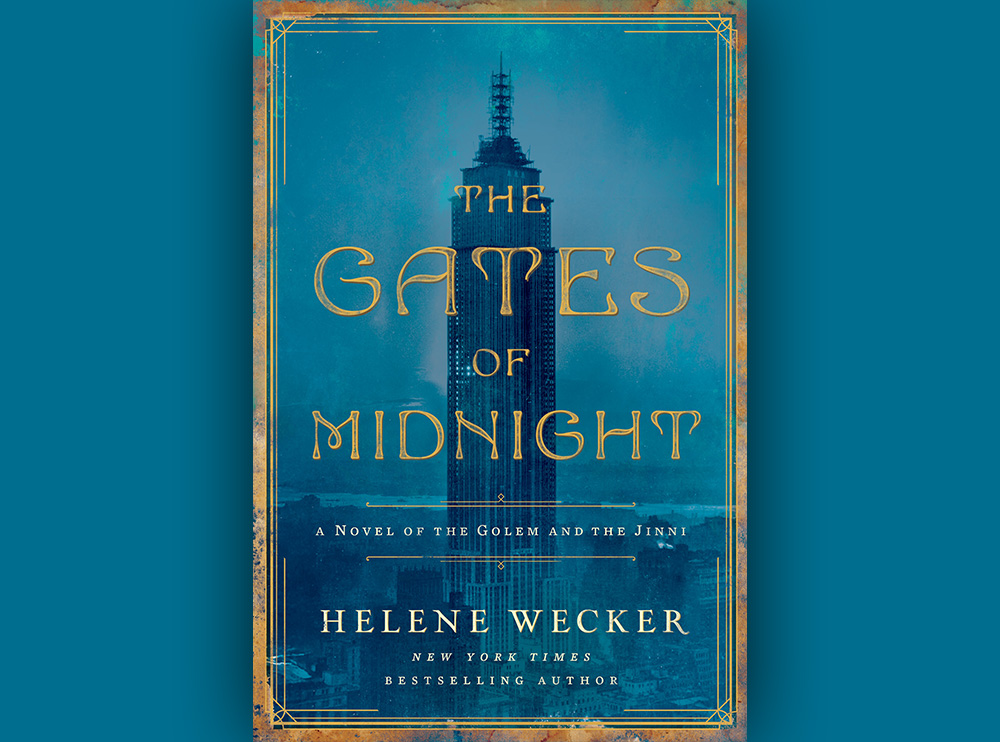
The long-awaited final installment in the award-winning, bestselling Golem and the Jinni trilogy.
Intrigued? Read on to discover the synopsis and an excerpt from The Gates of Midnight by Helene Wecker, which releases on September 15th 2026.
At the beginning of The Hidden Palace, the second book in Helene Wecker’s Golem and Jinni trilogy, Ahmad the jinni travels to Syria with the copper flask that holds the captured wizard Yehudah Schaalman. There in the desert he buries the flask for all time… or so he thinks.
In The Gates of Midnight, the riveting conclusion to the saga of the Golem and the Jinni, it’s 1930 and three decades have passed since Schaalman’s defeat. Chava the golem quietly tends to her house and garden in Brooklyn, hoping to create a refuge for other magical beings. Meanwhile, Ahmad has found employment as an architect in Chicago, helping to build its towering skyline above the prairie.
But all is not well in the desert. Schaalman has managed to trick an unsuspecting passerby into digging up the flask, and now it passes from hand to hand as the wizard possesses his victims — first a French soldier traveling to New York, then a small-time mobster — all in an effort to get to Chava, the only one who can release him from his prison.
Meanwhile others are gravitating to New York as well: Ahmad, who has lost his job following the 1929 stock market crash; the mysterious Thomas Beshara, a riveter on the rising Empire State Building, who also has hidden ties to Chava and Ahmad; and Kreindel Altschul, who still grieves her own destroyed golem Yossele. Does the reluctant Kreindel hold the key to saving Chava from Schaalman’s revenge? Will Schaalman succeed in escaping the flask, binding Chava to his will, and re-enslaving Ahmad? Or can they find a way to finally defeat him and free themselves from his power? An earth-shaking finale to the brilliant trilogy.
EXCERPT
The airplane was a modified two-seater, a Potez 25. In the rear cockpit, in place of a machine gun, an enormous steel-framed camera had been bolted to the fuselage. A man peered into its viewfinder as the landscape scrolled past below, his white silk scarf whipping about in the wind.
The man’s name was François Dellarme, and he was a pioneer in the field of aerial archaeology. Gone, according to Dellarme, were the days of long and dangerous treks to one’s survey site, with little idea of what one might find when one arrived—for archaeology, like war, had been given the gift of flight. Now, with an airplane at his disposal, he might take off at dawn, survey half a dozen ancient sites, and be home again in time for supper and a cognac. His techniques had proved so successful that even the High Commissioner’s office in Beirut had taken notice. After all, the ancient Romans had occupied Syria for centuries through the careful placement of troops and outposts. With men like Dellarme to map and study their methods, surely France could do the same.
Dellarme swung his camera, searching. There: a minor ruin, probably the remnants of a Roman garrison. He adjusted the focus, snapped the shutter, then tapped the pilot’s shoulder to signal that he wanted another approach. The pilot tilted the yoke. The wing dipped—and a deep valley appeared beneath them, framed by a ridge to either side. In the center of the valley stood a solitary cairn of stones.
Dellarme peered at the cairn as the plane continued its circle. It seemed to loom enormous in the camera’s eye, each rough stone a wealth of detail. Gooseflesh raised on Dellarme’s arms. For a long moment he felt certain the cairn was staring back at him.
He tapped the pilot’s shoulder again and gave the signal to land.
The jinn scattered in terror as the winged monster descended.
It touched down in the middle of the valley and rolled toward the cairn, wheels bumping over rocks and furrows, then came at last to a stop. The pilot cut the engine; the propeller stilled. Silence fell.
Dellarme climbed down the wing and strode off, silk scarf flapping over his shoulder. The watching pilot sneered at Dellarme’s retreating back. The scarf irked the pilot to no end; he considered it an unearned affectation, not to mention a menace in the open cockpit. He was growing sick of Dellarme’s imperious taps upon his shoulder, sick of sand and rocks, sick of Syria. He’d earned the Croix de Guerre for heroism at Saint-Mihiel, and now here he was, chauffeuring an insufferable peacock around an interminable desert.
At last, with nothing else to do, the pilot climbed down and followed after Dellarme. He found the man standing over a small cairn, perhaps four feet across and two high, made of tightly fitted stones.
“It seemed larger from the air,” Dellarme muttered.
The pilot glanced up at the ridges that framed the valley. His skin had begun to prickle as it had at Saint-Mihiel, in the moments before the enemy had hurtled down from above. Dellarme, meanwhile, had pulled out his pocket notebook and pencil and was now pacing out the cairn’s dimensions with the air of a man attempting to salvage a blunder.
“Perhaps it’s Bedouins,” said the pilot. “A food cache, or a marker of some kind.”
Dellarme shot him a withering look. “You know little of these things.”
“Then what is it? Ali Baba’s buried treasure?” The prickling was growing worse. The pilot glanced over his shoulder again, saw only the empty ridges, the lowering sun. And then, in the whistle of the breeze, he heard something. A voice, muffled and unclear, but desperate. A man calling for help.
“Listen,” he said. “Do you hear that?” “Hear what?” said Dellarme.
“Where is he?” the pilot said, confused—and then stared down at the cairn. “My God, is someone buried in there?”
“What do you mean, buried?”
But the pilot was already on his hands and knees, hauling at the stones, his mind filled with a sudden frenzy. He had to find the man, there wasn’t much time—
“What’s the matter with you?” said Dellarme. “Leave it alone, there’s no one there!”
“Shut up, you windbag,” the pilot muttered. The shouting was now so close at hand that it seemed to be inside him. He broke through the rocks to the sandy soil and began scooping it away.
“Stop, you idiot!” Dellarme grabbed him by the arm.
A red haze descended over the pilot’s vision. He wrenched away from Dellarme. His hand, unbidden, landed upon the service pistol at his waist.
The report of a single gunshot sounded up and down the length of the valley.
For a long moment the pilot only stood, breathing hard. Dellarme lay a few feet from the cairn, his blood soaking into the ground. The dead man’s expression was one of open-mouthed surprise.
Some part of the pilot was horrified at what he’d done, but the buried man’s shouting was like a blanket that smothered all else. He holstered his pistol and resumed his digging. His leather gloves were soon in shreds, and one fingernail tore to the quick, but in his agitation he hardly noticed.
There was a sudden crackle of paper, and then a reddish, metallic glint.
From their hiding places the jinn peered out as the pilot lifted the flask out of the hole in the ground and wiped the dirt away.
Thirty years of internment had changed the flask not at all. The copper was free of tarnish, the knotted engravings clear to the last detail. As the jinn watched, the pilot reached inside again and lifted out the papers—likewise no worse for the wear, though surely they ought to have crumbled to fragments by now. The pilot set his spoils upon the ground, hesitated a moment, then roughly tugged the scarf from the dead man’s neck and wrapped the flask and papers in its length. He tied the ends to make a bundle and carried it back to the airplane.
There was still time for the jinn to keep their promise. They could have stirred a powerful wind in the valley to destroy the Potez, or sent a mirage to trick the pilot’s eyes. But none of them moved to interfere. The enormous winged machine, the pilot’s deafening steel weapon: these were abominations far more terrifying than the cairn had ever been. And so they only watched in relief as the pilot climbed into the cockpit and flew away.

The pilot set the altitude, trimmed the wings, and tried to think.
What had just happened? He’d landed the plane, he’d heard screaming, and then . . . His mind skittered past the gunshot, the body. He’d saved a life; that was the important part. An old man had been trapped in a hole in the earth, and the pilot had pulled him free and carried him to the Potez. The old man was now in Dellarme’s seat behind the pilot, an unseen presence, his ancient eyes seeming to burn into the back of his rescuer’s neck . . . and yet a small part of the pilot’s mind insisted there was no man in Dellarme’s seat, only a small bundle of copper, paper, and silk. You killed Dellarme, his mind whispered. You shot him.
No matter, said the old man. In a voice surprisingly strong and deep for one so weak he told a story of a faraway city, a woman they must find. New York. Chava Levy.
The pilot tried to explain that this was impossible. Already it was growing late. If they didn’t return to the airstrip outside Damascus within the hour, the ground crew would report them missing. Perhaps they could reach Beirut . . . but no, there wasn’t enough fuel left for an evening flight over the mountains. Besides, thanks to Dellarme’s camera, every aviator in the Levant knew the Potez on sight. They’d be recognized no matter where they went.
The enormity of the pilot’s situation began to settle over him. He’d shot François Dellarme. He was a murderer, a fugitive. A traitor to France.
Forget Dellarme, said the old man. Forget France. I can protect you from capture. But first you must take me to New York, and find Chava Levy.
A strange, aching pressure had begun to build in the pilot’s mind, as though something was trying to push its way inside. What on earth was the old man saying? Forget France? He was a war hero! God in heaven, what had he done?
I’ll reward you, the old man insisted. Power, fame, whatever you desire—
Shut up, the pilot thought. The pain in his head was making it difficult to concentrate. He’d turn himself in; he’d say there’d been a terrible accident, that the desert had maddened him, that he’d heard whispers in the wind telling him to do the unthinkable. He pictured the Croix de Guerre in its presentation box, his mother’s proud smile as the medal was pinned to his chest. What would she think of him now? Blinking back tears, he turned the Potez toward Damascus.
No! the old man shouted. New York! Chava Levy!
Pain and pressure surged—and the pilot’s mind burst like a grenade. He slumped sideways, jaw slack, eyes unseeing.
The Potez flew on, buoyed by the currents that rose from the desert floor. It began to drift lower as it approached the outskirts of the Ghouta, the river-fed oasis east of Damascus. One wing dipped lazily above a farmer’s field. The plane banked, the bank steepened into a dive; and in a bloom of fire the airplane buried itself in the wheat.
In the flask, Schaalman cursed bitterly.
A dry chuckle rose from beneath him. Schaalman glared down to where ibn Malik still dangled from his golden fetters. Thirty years of waiting, ibn Malik said, and then when opportunity strikes at last you cannot be patient for longer than an hour.
Schaalman, irritated, made no reply. Yes, he’d been impatient; next time he’d go more slowly, be more careful. But he was a step closer to his freedom now, and not even ibn Malik could deny it.
THE GATES OF MIDNIGHT. Copyright © 2026 by Helene Wecker. Reprinted here with permission from Harper, an imprint of HarperCollins Publishers