


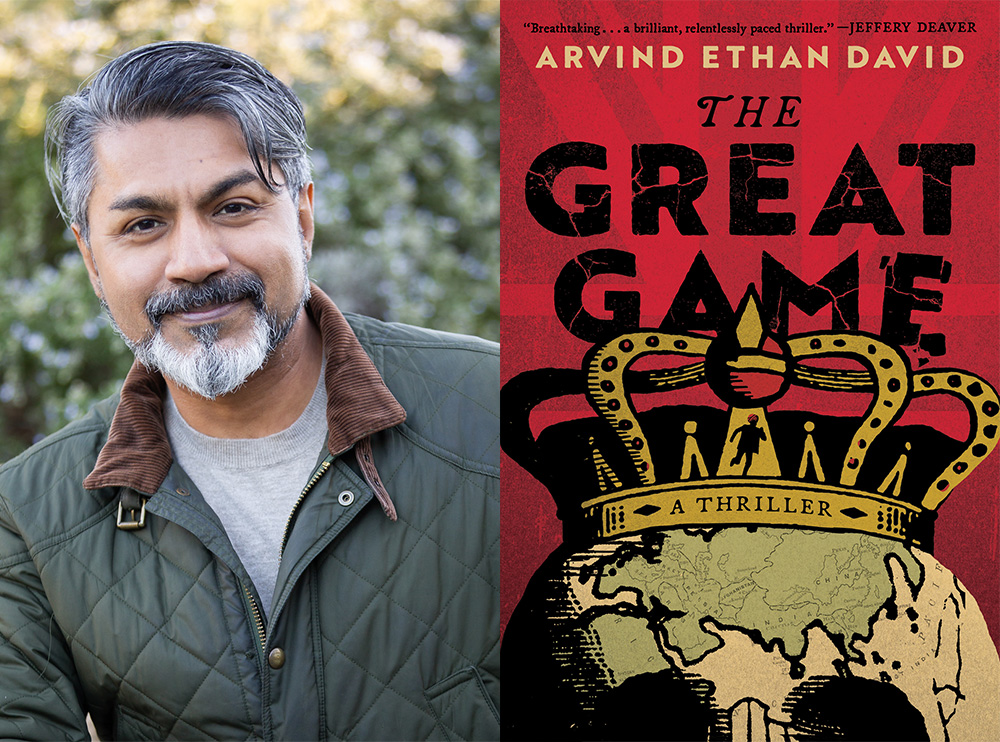
We chat with author Arvind Ethan David about The Great Game, which follows an outsider in London who investigates a series of brutal murders targeting English aristocrats in this timely and provocative historical novel brimming with intrigue, wit, and rage.
Hi Arvind! Can you tell readers a little bit about yourself?
Long-time reader, first-time novelist… Well, that’s technically true, but I am a long-time writer in other mediums. I’m a playwright whose recent work includes the family musical The Boy With Wings (which was lucky enough to be nominated for an Olivier Award), a big immersive adaptation of Douglas Adams’ The Hitchhiker’s Guide to the Galaxy, and I’m currently working on an original play about the life of Richard Potter, America’s first magician. I’m also a television writer-producer, probably best known for my work on Dirk Gently’s Holistic Detective Agency on Netflix, and occasionally I produce musical theatre, which is, I think, how we first met when I opened Jagged Little Pill in Sydney.
Amidst all of that, I’m a father to a gorgeous, vivacious, brilliant, brave 8-year-old named Odetta and an assistant zookeeper to two cats, an Alaskan Malamute called Quiet Before the Storm and a bearded dragon, fka Nora Jones.
When did you first discover your love of writing?
In high school, I wrote a short story which won the English prize. It was less the writing of the story and more that the prize was Salman Rushdie’s Imaginary Homelands, a collection of his criticism and essays. The fact that someone who looked rather like my dad was a famous and brilliant writer alerted me to the possibility that it might be a viable career.
Shortly after, I co-wrote a play and put it on at school. The play happened to be an adaptation of Douglas Adams’ Dirk Gently’s Holistic Detective Agency. Its initial production was a transformational moment in my life. For the first time, I felt like I knew what I was doing, and I felt confident amongst my peers. I had been somewhat shy and awkward until then. I probably still am somewhat shy and awkward, but when I am writing, when I am telling stories, I know exactly what I am for.
If you could describe your upcoming novel, The Great Game, in only five words, what would they be?
I’ll defer to the great Jeffery Deaver, best-selling author of The Bone Collector, the Lincoln Rhyme and the Colter Shaw novels, who described my book as, “Breathtaking! Nothing short of transcendent.”
I cried a little when I read that.
Where did the inspiration for The Great Game come from?
The book is both a love letter to the Edwardian adventure and mystery stories I grew up reading (Conan Doyle, H. G. Wells, Rudyard Kipling, J. M. Barrie, and Edgar Rice Burroughs), but it’s also an interrogation of those characters and the world and the fictional and historical worlds they inhabit. I loved those books as a child, but even as a child I was aware that I and people who looked like me were strangely either absent or relegated to the margins of the stories.
Nobody wants to be in the margin of their own story, so in the character of Balvinder Dev Singh I’ve created a brown protagonist who demands to be a hero.

This is your prose novel debut. Did you approach writing your novel differently than the way you write a script or play?
Yes, it took many, many more words.
Can you tell us about any challenges you faced while writing the book?See above answer. So many words.
Were there any favorite moments or characters you really enjoyed writing or exploring?
The biggest thrill, and in some ways the riskiest moments of the book, are where I bring in existing legends to interact with my story. Some of these legends are historical figures, the young Winston Churchill for example. Others are fictional but seem real to us: Sherlock and Watson. The hard thing was to make sure they were fully themselves, not caricatures, not me puppeting these great men for my own purposes, but allowing them the agency that they have in the books and events in which they were the unquestioned heroes. Readers will have to decide if I pulled it off or not, but it was definitely the most fun and the most terrifying bits of writing in this book.
What’s the best and the worst writing advice you’ve ever received?
I was lucky to have dinner with Guillermo del Toro once, and he said a thing that has always stayed with me. I’m going to have to quote him exactly, and bear in mind he was talking about the process of getting notes from studio executives: “You can let the motherfuckers tell you what syntax to use, but never let the motherfuckers tell you what story to tell.” Those are words to live by. Though I would say, as a novelist, I’m not even going to let them tell me what syntax to use. Those choices are mine.
What can readers expect next from you?
There’s a discussion about Balvinder’s further adventures… but I’m also working on something altogether new. A portal fantasy novel in which a group of dispirited Gen Zs find themselves in a world ruined by the decisions of their parents. A really wild, far-out premise. Not at all inspired by the real world.