


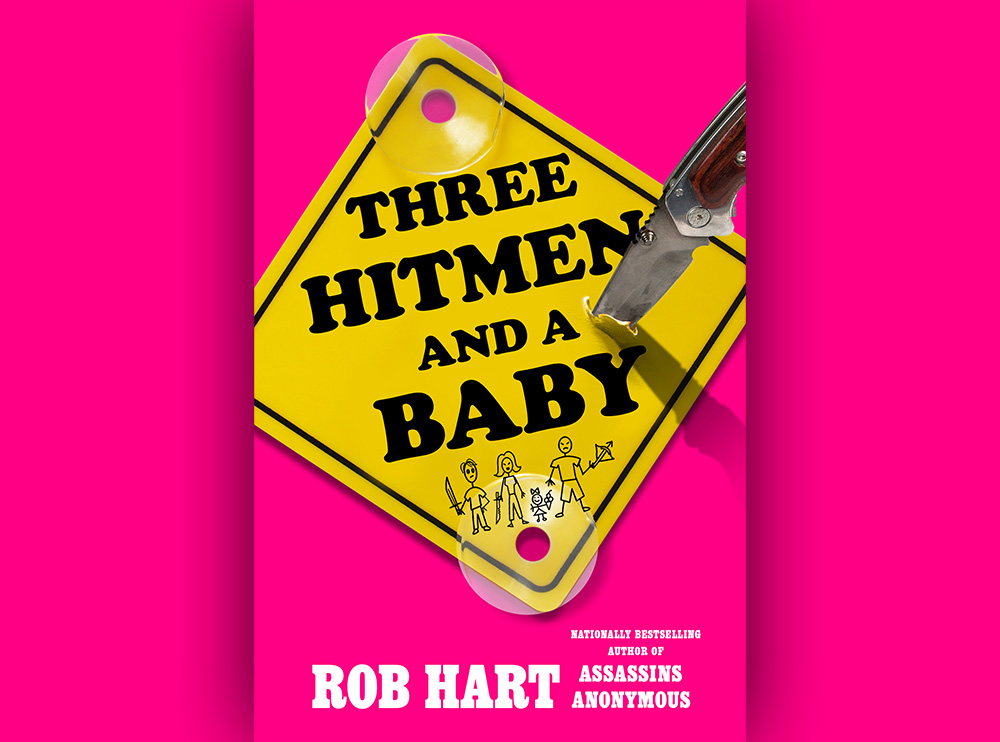
Welcome back to Assassins Anonymous, where family is everything and danger lurks around every corner.
Intrigued? Read on to discover the synopsis and an excerpt from Three Hitmen and a Baby, which releases on June 16th 2026.
Assassins Anonymous isn’t just a weekly recovery meeting for reformed killers—it’s also a family.
When Valencia receives troubling news that her brother has gone missing, she wants rush off to LA to find him. But she can’t bring her baby girl, Lucia. Enter the other members of Assassins Anonymous—Mark, Astrid, and Booker, who offer to watch the toddler while she’s gone. After all, they’re three of the deadliest, most highly skilled people on the planet; what could go wrong?
Turns out, a lot. Shortly after Valencia leaves, Mark is summoned to the lair of Zmeya, a Russian mob boss calling in a deadly favor—she wants him to kill Astrid, his protege and friend. Mark refuses, but Zmeya reveals that she knows the identity of Mark’s ex-girlfriend . . . and his son. Either Astrid goes, or they do.
Meanwhile, Lucia spikes a dangerously high fever, and when Booker and Astrid take her to urgent care, they realize too late, that their fabricated identities are a real liability. Also, they don’t know Valencia’s last name, let alone Lucia’s. They can hardly blame the staff for calling the NYPD.
Suddenly the splintered group is on the run from both the Russian mob and the police, dodging bad guys and do-gooders while trying to find refuge in a city full of surveillance cameras—all without killing anyone. That is, until Zmeya captures Sara and Bennett, and Mark is ready to throw his sobriety out the window.
EXCERPT
MARK
Financial District
A bullet slams into the facade of the building next to me, narrowly missing my head. It spits out a hail of dust and stone fragments. I skip to the side and nearly stumble trying to
avoid it, but still manage to suck some of it into my lungs as I regain my footing.
Running, not for my life, but for the lives of everyone I know.
Wall Street is a ghost town at three in the morning, the sidewalks clear and the shutters drawn. Bullshit, this city never sleeps. It’s so quiet it feels like it’s been roofied. Still, we’re in the heart of the city’s surveillance network.
The sheer edge of Manhattan looms in the distance: South Street, running along the shoreline and underneath the FDR
Drive. The East River surges and swells just beyond that, frigid and dark. I’m close enough I can smell the brackish mix of salt and trash.
With the way the February air is slicing my exposed skin, that water is not going to feel good. But two more gunshots whiz over my head, so it’s the safest bet. I pump my legs harder, coughing the dust from my lungs.
This is it then.
When you’ve lived the kind of life I have, you wonder what it’s going to look like at the end. People like me don’t tend to pass quietly in our sleep. The best we can hope for is a bullet to
the head, because at least that’s quick.
To me, a bullet was always the kindest death I could grant someone. Knife wounds take time to bleed out. They hurt. Throwing someone off a roof, they have time to think about
the impact. A well-placed bullet just turns the lights off, quick as flipping a switch.
Considering my collection of sins, a bullet is probably too kind.
Not that I didn’t try to be a better person.
Not that it worked.
Five years sober. I held on to the bumper of that goddamn wagon with my fingernails, knuckles white, struggling at every turn. And there were a lot of them.
Then I lost my grip.
Davit Nozadze, dead in the middle of the street.
Did I ever stand a chance?
I make it to South Street, keeping the FDR’s support pillars between me and my pursuer so they can’t get a clear shot, buying me enough time to reach the water’s edge.
Just as I’m about to grasp the railing, a voice behind me calls
out, “Stop!”
I put my hands in the air and turn to find a slight figure in dark clothing, a balaclava wrapped around their face, only their eyes visible. I lean against the railing and breathe air into my ragged lungs.
“Go on then,” I say. “It’s late, and I’m tired.”
The figure pauses, cocking their head to the side like they want to ask a question, or share a thought. Then they raise a gun.
I’m too far away and it’s too dark for me to tell the make and model. Which upsets me a little. I feel like that would be a nice thing to know—what kind of gun, exactly, is going to take out the Pale Horse.
It ll probably end up a collector’s item.
Fifty yards away. A monkey could make that shot. In the interest of moving things along, I pull my own gun, my trusty Sig Sauer P365, from the holster on my hip. If I’m going to go,
it ought to be with a full hand.
I think about Lucia and Astrid and Valencia and Booker and Ms. Nguyen and Quraishi. Sara and Bennett and Lulu and Kittie Smalls. The tiny constellation of a life I built, and what it’s going to look like with me gone.
The self-pitying part of me says they’ll be better off.
That’s probably not the way theyre going to see it.
Grant me the serenity to accept the things I cannot cha—
God comes down from the heavens on high and flicks me in the center of my chest with an almighty finger.
Wait, no, that’s a bullet.
The sharp crack of the gun seems to hit my ear a millisecond later. My gun flies from my hand as I’m jerked back. I hear a splash. The world has erupted into a cacophony of sensation and adrenaline that overwhelms me. I try to pull air into my lungs, but they don’t seem to be working correctly.
My body wants to fold forward to protect itself, and it takes every ounce of strength I have to push myself back, over the railing, and I tumble into the freezing embrace of the river, cold like I’ve never known cold, and my vision blurs and everything slows… slows…
ONE WEEK AGO
TUESDAY
I am terrified by this dark thing
That sleeps in me;
All day I feel its soft, feathery turnings, its
malignity.
—SYLVIA PLATH, “ELM”
ASTRID
Church of St. Jude, Chelsea
*m the second to arrive. I’ll never be first, because Mark is always first. He’s here now, hunched in a folding chair, his sandy hair hanging in his eyes, tapping away at a laptop perched on another chair in front of him. He glances up at me and offers a half-hearted salute before going back to the computer.
I hang my jacket on a hook by the door and head to the kitchenette, taking the brown paper bag out of my purse. A new coffee place opened around the corner from me, and they
sell ground beans by the pound. Flavored coffees taste funny to me, but this place uses some sort of natural roasting method, so the hazelnut tastes like hazelnut, not a chemical spill.
I fill the reservoir of the coffee maker, once again glad we’ve finally stopped using the stupid pod brewer. It was wasteful and the flavors were gross. Mark loved it for ease of use, but also because he has the palette of a toddler, and he liked the birthday-cake-flavored pods.
So one day when no one was looking I popped off the back, snapped something that looked important, feigned ignorance, and replaced it with this: a sixty-ounce Technivorm Moccamaster. It cost four hundred bucks and looks like a rocket ship, but damn if it doesn’t make good coffee.
“Stupid piece of…” Mark mutters from the corner.
“What’s wrong?” I ask.
“Hmm.” He looks up at me, like he forgot he just saw me walk in. “Ms. Nguyen and Quraishi were going to patch in, but Zoom doesn’t seem to be working.”
“Where are they now?” I ask, placing a filter in the basket and filling it with grounds.
“Hanoi.”
A smile spreads across my face. The older members of our group: Ms. Nguyen, a former covert intelligence operative, and Quraishi, a reformed terrorist.
When we brought Quraishi in almost three years ago, they formed a quick friendship. Last month they decided to take a trip together; Ms. Nguyen was born stateside and had never been to Vietnam, where her parents emigrated from.
“I wonder how long their little Eat Pray Love thing is going to last,” Mark says, closing the laptop and leaning back in his chair.
I put the basket in place, click the button to start the coffee brewing, and catch a glimpse of the purple hair tie wrapped around my wrist. My heart twists into a knot. I pull the elastic taut and snap it against my skin, savoring the sting of it. Then I join him in the circle of chairs. “I hope they’re having fun. They deserve it.”
Mark’s eyes narrow. “You don’t think theyre. . .”
“First off,” I tell him, “that’s not our business. Second off, probably yes.”
Mark laughs and looks around the room. “Meetings just feel a little empty without them here, right?”
As if on cue, there’s a soft chime, meaning someone has keyed in the code on the security door. Valencia strides in with Lucia and Booker, all of them layered in jackets and scarves for the brisk weather.
Lucia looks like a cartoon character in her pink puffy jacket, earmuffs, and huge fuzzy mittens. The second she sees us she breaks into a run, heading first to Mark, climbing into his lap and giving him a hug.
“Unca Mark,” she says.
Mark kisses the top of her head, his face plastered with a massive, goofy smile. “Hey there, sweetpea.”
She comes over to me next, wrapping her tiny arms around my legs. “Unca Astid!”
I poke the tip of her little red nose. “Aunt Astrid.”
“Mark said to call you ‘unca, like him and Unca Booker.”
I hold her tight and tell her, “You can call me anything you want, little love.” I look up at Mark, who is holding in a laugh, and mouth the word, Prick.
He shrugs, then gets up to greet Booker and Valencia, who are squaring their coats away on the rack. Booker is growing out his beard, and it’s coming in thick with flecks of gray. Any-
one else might look like the Unabomber, but on him it looks distinguished. Valencia, meanwhile, pulls off her wool hat to reveal a freshly shaved head.
“V, what’s with the cue ball look?” Mark calls out.
Valencia rubs her hand over the stubble. “One less thing to worry about.”
Lucia joins them, and Valencia lowers herself to one knee, undoing the girl’s winter gear. When she’s done, Booker scoops her up and says, “Time for donuts and Bluey. How does that sound?”
“One donut,” Valencia says, raising a sharp eyebrow.
Booker nods. “I know, I know.” He plops Lucia on the brown leather couch in the corner with her iPad and noise-canceling headphones, then steps to the box of donuts next to the coffee maker. He turns his back so he can place two on a plate—both strawberry-frosted with sprinkles—and sets them down next to her. Lucia looks up at him and Booker puts a finger to his lips.
Valencia sees this and rolls her eyes, then betrays the slightest hint of a smile.
Our weird little family.
Booker, former mercenary.
Valencia, former covert CIA operative.
Mark, formerly the Pale Horse, the world’s deadliest assassin, employed by a clandestine group called the Agency.
I worked for them, too, and I was known as Azrael. The Angel of Death. Mark was the organization’s top hitter. I was second, though I think that had more to do with gender politics than relative skill. Because twice me and Mark nearly threw down, and both times I’m pretty sure I could have taken him.
But those ego-drenched days are gone. Still, there’s something sweet about watching four former killers melt like ice cream in the sun around this little girl.

Valencia and Booker sit with Mark in the circle. I go to the coffee maker, now finished with its task, and pour out four mugs. Soy creamer and Splenda for Mark, black for the rest of us. Valencia appears at my side and grabs two of them, helping me carry them over.
There are three empty chairs. A ritual for our meetings—leaving a chair out for missing or deceased comrades.
One each for Ms. Nguyen and Quraishi.
One for Kenji, the former leader of the group—a reformed Yakuza hitter who sacrificed his life for Mark. I never got to know him, and I wish I did, given the reverence in everyone’s
voices when they speak about him.
“So…” Mark says, taking a sip of the coffee, and his eyebrows shoot up. “Damn, Astrid, this is good.”
“Told you,” I say. “Not everything needs to taste like candy.”
“But life is a little better when it does.” Mark places the cup on the floor next to him, then picks up the remote and hits a button. It engages a white-noise device that’ll prevent anything we say from being recorded, and keep anyone from eavesdropping on us. One of the security upgrades Mark added to the space after he bought it.
After our last space was blown up by a bunch of mercenaries.
I miss St. Dymphna’s. I think we all do. It was the first place we came together. The first place I realized I could forgive myself for the things I’ve done—or some of them, at least. The road hasn’t been easy. It took me getting kidnapped, thrown in a black site prison, and forced to face my accumulated traumas, just to feel comfortable enough to share during the meetings.
But when I did, it was like a floodgate.
This place, the Church of St. Jude, is where the dam broke, and it’ll always be special to me. Mark has spent a considerable amount of time and money setting the space up for us. Security, comfort, everything we need. And the exact same shade of robin’s-egg blue painted on the walls.
Because blue is calming, and we can all use a little of that. Especially when you’ve spent most of your life riding shotgun with the Grim Reaper.
“Before we begin,” Mark says, “any announcements or anniversaries?”
Shaking heads, all around the circle.
“Okay,” Mark says, glancing at Lucia to confirm the headphones are on. “Assassins Anonymous is a fellowship of men and women who share their experience, strength, and hope with each other, that they may solve their common problem and help each other to recover. The only requirement for membership is a desire to stop. We are not allied with any sect, denomination, politics, organization, or institution; our primary purpose is to stop killing and help others to achieve the same.
“We do not bring weapons into Assassins Anonymous, nor prior political affiliations. If any of us were known by any particular handle or nickname, we do not use it here. We share our
stories, but we obscure details as best we can. If any of us seek to bring in new fellows, we agree to have them properly vetted. This is to protect us, not just from prying ears, but from each other.”
We take a moment of silence for fallen friends.
“Valencia,” Mark says, “could you read the steps?”
Valencia nods. In a regular AA meeting, you’d read from a handout, but we like to avoid putting things in writing.
“Every time…” Booker says.
Mark smacks Booker’s knee with the back of his hand.
“That’s right. Every time.”
Valencia begins:
“One, we admitted we were powerless—that our lives had become unmanageable.
“Two, we came to believe that a power greater than ourselves could restore us to sanity.
“Three, we made a decision to turn our will over to the care of a higher power, as we understood it.
“Four, we made a searching and fearless moral inventory of ourselves.
“Five, we admitted to our higher power, to ourselves, and to another human being the exact nature of our wrongs.
“Six, we were ready to have our higher power remove all these defects of character.
“Seven, we humbly asked it to remove our shortcomings.
“Eight, we made a list of all persons we had harmed, and became willing to make amends to them all.
“Nine, we made direct amends to such people wherever possible, except when to do so would injure them or others.
“Ten, we continued to take personal inventory, and when we were wrong promptly admitted it.
“Eleven, we sought through prayer and meditation to improve our conscious contact with our higher power as we understood it, praying only for knowledge of its will for us and
the power to carry that out.
“Twelve, having had a spiritual awakening as the result of these steps, we tried to carry this message to others like us, and to practice these principles in all our affairs.
“No one among us has been able to maintain anything like perfect adherence to these principles. We are not saints…”
Booker and Mark chuckle because, traditions.
“The point is that we are willing to grow along spiritual
lines,” Valencia says.
Mark claps his hands. “Excellent. Who wants to go first?”
I raise my hand, and everyone turns to me.
“Tm Astrid, and it’s been almost three years since I killed someone,” I tell them.
From THREE HITMEN AND A BABY by Rob Hart, published by G.P. Putnam’s Sons, an imprint of Penguin Publishing Group, a division of Penguin Random House, LLC. Copyright © 2026 by Rob Hart.