


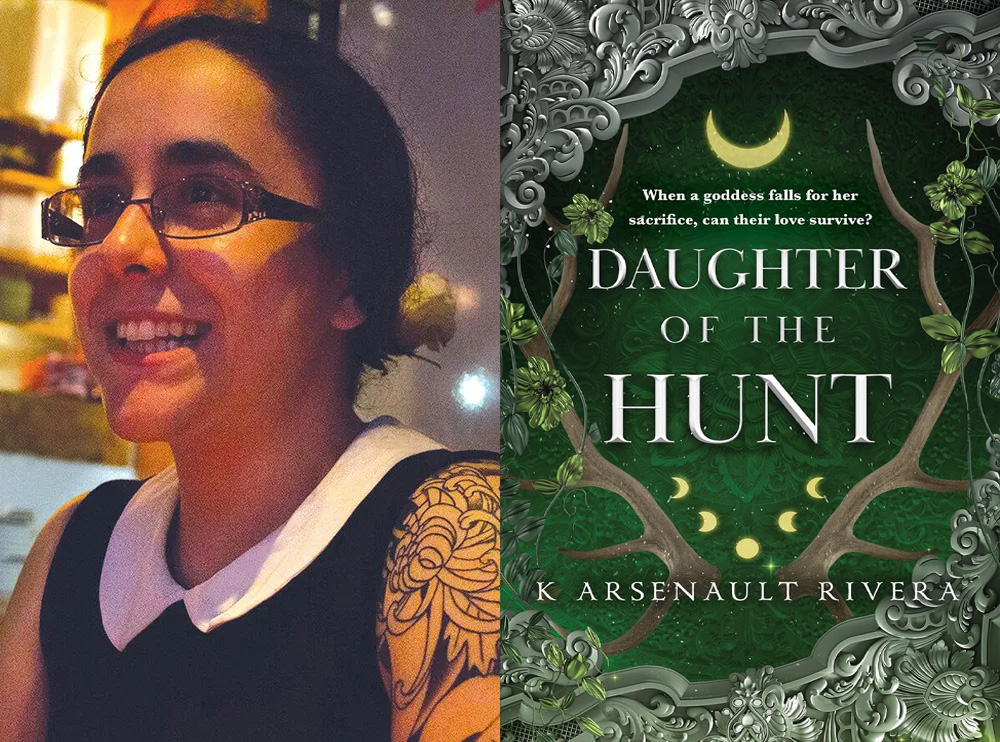
We chat with K. Arsenault Rivera about Daughter of the Hunt, which is a lush, haunting reimagining of the myth of Iphigenia and Artemis, sure to enchant readers of Katee Robert and Rebecca Kinney.
Hello and welcome back! How have you been since we last spoke for the release of Oath of Fire?
It’s been an exciting time! Since then I’ve changed jobs and moved all the way across the country. In a lot of ways it feels like I’m in a new era of my life—one I really like.
Daughter of the Hunt is the second installment in your Oath of Fire and it’s out March 17th! If you could only describe it in five words, what would they be?
Sapphic survivalist story, ropes involved.
For those who haven’t picked up Oath of Fire, what can readers expect?
This one is fairly standalone! It ties in only at the beginning at end, so you’re totally cool to pick this one up if you haven’t read Oath. In this setting, gods exist in a kind of parallel world to ours. A god exists in both their humanoid form and in the court they rule—a kind of pocket dimension tied to whatever they rule over.
Daughter of the Hunt retells the myth of Artemis and Iphigenia: a girl is sacrificed so that her family can win a war, and Artemis trains her as a handmaiden. It’s a book about learning to stand on your own, finding things to live for, and the healing power of the wilderness. It’s also about kink.
And for those who have, what’s to come in Daughter of the Hunt?
There are plenty of new gods to meet—we get to see Ares in this one, along with Hermes and some of the others. Plus there’s a cameo from Eros, as well!
What was the inspiration behind selecting the myth of Iphigenia and Artemis?
I’ve always loved this one. There aren’t many truly happy stories in Greek myth, and the idea of a goddess saving you from your terrible family always appealed to me. It’s also an interesting piece of the backdrop to the greater Trojan war. We hear a lot about Helen, of course, and lately a lot about Clytemnestra—but Iphigenia herself is usually used as a plot device. I wanted to explore what it was like to be her.
I think sacrificing for others is something we can all relate to. And I think sometimes we’re all looking for someone who will see us and teach us how to live for ourselves.
Were there any moments or characters you really enjoyed writing or exploring?
Honestly, the kink scene! I was hard stuck on this book for a long while (more on that shortly), but it really came together when I understood this scene better. Romance novels live or die on their chemistry and there’s so much you don’t know about your characters until you see them get intimate. Their whole dynamic really clicked for me here.

Did you face any challenges? How did you overcome them?
I was hard stuck on this book for ages. I’ve never been so stuck on a novel before, really. Originally I had planned for this to be a polyam work, but when I couldn’t make those pieces fit the way I wanted them to, I had little idea how to keep going. It wasn’t until I had a discussion with a friend about Ace-spectrum folks and kink that I figured out how I wanted to approach it. I’ve always found the dynamics of topping and bottoming very interesting—dom and sub also—so I decided to really lean into those here.
Were there any key lessons learned from your previous retelling that helped with Daughter of the Hunt?
I didn’t want to stick too closely to the myth this time—and I wanted to keep all the other elements I’d introduced into the plot simple. The retelling should be able to stand on its own. I got a little lost in the sauce of the worldbuilding on Oath of Fire; this is a much more focused project. Keeping my attention trained on just Iphigenia and Artemis for so much of it let them grow in what I hope to be a very organic way.
What’s next for you?
Nothing I can talk about! But whatever it is, it’s definitely going to be queer or nerdy and more than likely both.
Lastly, what books are you looking forward to picking up this year?
Omens of Chaos, by Seanan McGuire, is dropping pretty soon! I can’t wait to dig in.