


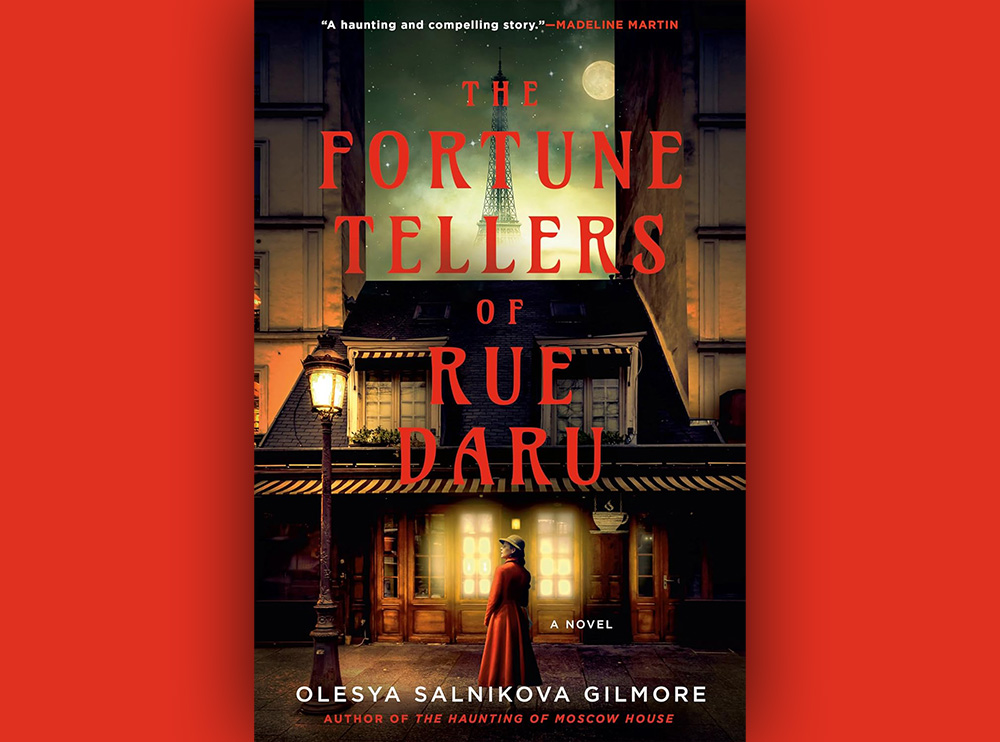
A fearless fortune teller in 1920s Paris must use her powers to divine who she can trust when an exiled Romanov princess and her brother come to her seeking answers about a decades-old mystery…
Intrigued? Read on to discover the synopsis and an excerpt from The Fortune Tellers of Rue Daru by Olesya Salnikova Gilmore, which releases on March 24th 2026.
Spirited Zina and her secretive grandmother, Baba Valya, own a tearoom on rue Daru in Paris, where they have lived quietly since Zina’s mother’s untimely death. By day, the women serve tea, mostly to members of the bustling Russian émigré community, but when dusk falls, they divine fortunes and perform séances for their loyal clientele.
Then the charming Princess Olga and her brother arrive, searching for knowledge about the disappearance of their father, the exiled Grand Duke, cousin of the last Tsar of Russia. Zina, eager to learn more about the spirit world and her powers, performs the séance. She is able to summon the Grand Duke, but to her horror, he starts to haunt the shop, and he seems to know something sinister about her mother’s death.
As Zina delves into her family’s hidden past, dark secrets are unearthed, threatening the home and tearoom Zina and her grandmother have worked so hard to build, not to mention their very lives.
Tonight, the street air felt particularly fresh after the herbal, waxy consulting room—and those dead eyes.
Hearing bursts of Russian from La Rotonde, a favorite hangout of the expat Bolsheviks, we kept walking, in silent agreement that we wanted Paris tonight, not Russia. Besides, these Russians had exiled our rue Daru Russians, including Katya, and imprisoned or killed their loved ones. They were no friends of ours.
We crossed boulevard du Montparnasse to the sprawling Le Dôme, the block-like letters on the café’s awning announcing its presence as though screaming. The terrace was crowded despite the cool night. Seemingly every table was taken over by chatting, laughing, smoking men and women. We were soon surrounded by a few painters, a model or two, and a writer, who pushed a couple of whiskeys toward us. I met Katya’s gaze, whiskey not being our drink of choice. But I shrugged, thankful it was free, feeling thirsty and craving a lift out of the darkness that had settled in the pit of my stomach like a stone. I tried to lose myself in the endless stream of chatter and laughter, the cigarette someone handed me at some point, its smoke dispelling some of the darkness. But not all.
“Tell me”—the writer leaned toward me, too closely, too intimately—“what was the most interesting thing to happen to you today?”
I could tell by his poor French that he was American, apparently from some middle-of-nowhere town in Illinois, sniffing around Paris for his latest inspiration. There were many such personages at Le Dôme. I hated intellectuals, but not worse than the Bolsheviks, who spoke only about Marx and Lenin and their damn revolution. I sipped at my whiskey. By now, it had burned its way down my throat, set my belly on fire and my head swimming pleasantly. I was feeling cheeky, not to mention truthful, for once.
“I thought I saw a pair of dead men watching me from their photographs.”
The American peered at me curiously, then laughed, clearly un- comfortable. “You are an odd bird, aren’t you?”
“You don’t know the half of it.” “So what happened then?”
“What usually happens when you encounter horror?” “You—scream.”
“No.” I leaned closer to the American so that we were centime- ters apart, the air between us soaked with whiskey. “I turned on the light.”
The American broke into a smile, showing me his very straight, very white teeth. He was handsome enough, with dark slicked-back hair that revealed a wide, intense forehead, a small mustache, and eyes that were merciless in their judgment, though set a little too far apart. I closed the space between us anyway, kissing him on the mouth.

The painters and their models whooped and jeered. Katya smiled teasingly.
I didn’t even feel the American’s lips against my own. I was won- dering what would have happened if I hadn’t turned on the light.
We stumbled back to La Rotonde with our new friends, no longer caring about the Bolshevik revolutionaries there, not after several whiskey glasses each, but about the café’s newly opened dance hall. We were eager to lose ourselves in the ceaseless motion, the care- free music, the pure pace and rhythm and life of those halls.
I slid one hand onto the American’s shoulder, the other into his rather slick hand, and I let my feet move in time to the music as he pressed me to him tightly. The tune was fast and jaunty, and I laughed, even saying something utterly drunken and stupid to him, maybe stealing another kiss or two through my whiskey haze.
I could usually forget Baba Valya’s séances at the cafés with Katya, but tonight, it was proving impossible. I kept imagining those dead eyes staring at me from their place of darkness, their place of death, drawn to them like a doomed moth to a flame.