

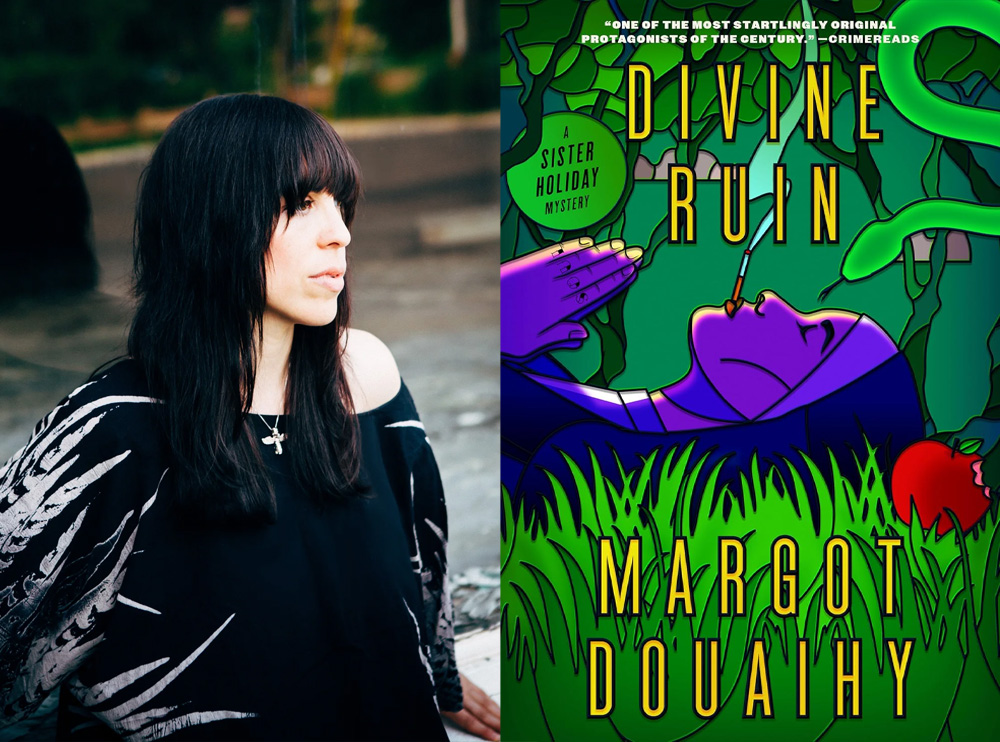
We chat with author Margot Douaihy about Divine Ruin, which is the latest installment in the USA Today bestselling, award-winning, critically acclaimed series that follows New Orleans punk rock nun-detective Sister Holiday.
Hi, Margot! Can you tell our readers a bit about yourself?
Myself…well, I like forests and lakes and friendship and reading books. I require black coffee. I am obsessed with dive-bar neon. Cults are very intriguing to me. I’m an Aries, a professor, and a creative writer working across genres. My crime novels are published by Gillian Flynn Books/Zando, and I also create flash and micro fiction, true-crime poems, and multimodal projects like VR narratives. I earned a PhD in Creative Writing focused on the craft, theoretical frameworks, and applications for lesbian crime fiction and queer noir. (Genre is a generative dare.) The promise of queer futurity and the gritty beauty of the Rust Belt aesthetic inform everything I do.
When did you first discover your love for writing and stories?
Late but then instinctively. Stories were/are how I made/make sense of the world. I’ve always been drawn to poetry and mysteries… to the epistemological thrill of knowing and not knowing. Detective fiction asks urgent questions like What’s true? Who’s lying? Who’s instantly believed and why? So I started attending to these questions by writing my own hardboiled mysteries.
Quick lightning round! Tell us:
- The first book you ever remember reading: The Bible? (I think. It’d have to be.) I didn’t understand a lot of it as a kid, but I got a sense of violence and luminous grace together on the same page.
- The one that made you want to become an author: In the crime fiction realm it was Agatha Christie’s And Then There Were None. Such clockwork plotting. My style is remarkably different from our Golden Age high priestess, but I think that’s part of the joy. Art that makes you want to make art…what a gift. Also I was gripped and galvanized by Raymond Chander’s PI Marlowe stories. That swagger, and the PI’s taste for vice.
- The one that you can’t stop thinking about: Giovanni’s Room by James Baldwin – pure ache. Lyrical, raw, searching, wise. Everything I aspire to.
Divine Ruin is the third installment in your Sister Holiday series and it’s out January 13th! If you could only describe it in five words, what would they be?
A rosary doubles as brassknuckles.
For those who haven’t picked up the first two books, what can readers expect?
Scorched Grace introduces Sister Holiday, a chain-smoking, heavily tattooed nun who has a gold tooth from a barfight but she’s a true believer. When her school and convent become the targets in an arson spree, she launches her own investigation in the sticky New Orleans heat. I tried to write it so it feels propulsive and punchy, and Sister Holiday’s narratorial biases texturize the mystery.
Blessed Water brings Sister Holiday back for a darker case. When her priest’s body is found floating in the Mississippi during a torrential Easter weekend storm, she and her partner-in-PI, Magnolia Riveaux, dive into the case. The mystery is fast…it takes place over three days: Good Friday, Holy Saturday, and Easter Sunday. The chapters are like flash fiction—just 2 or 3 pages each. I love (and loathe) a ticking clock. I tried to leverage temporal anxiety as fuel in Blessed Water.
Both books weave lyrical patterning inside traditional structures (like the three-act) to queer narrative design. Each book is about faith, doubt, fetishizing details, and the imbricated contradictions that make us human.
And for those who have, what’s to come in Divine Ruin?
Garden of Eden noir! When one of her favorite students dies of a fentanyl overdose at school, she and Riveaux investigate who’s behind the drug influx. Our punk nun goes undercover as her old self. (Yes, a reverse Sister Act.) It’s all happening at the same time as her permanent vow ceremony. Sister Holiday becomes desperate and reckless as more students fall prey. The case tests the limits of her faith and her sanity, with ruthless implications for herself and the people she loves. (The title, like the title of a poem, should point to the emotional heart of the piece.)
Were there any moments or characters you really enjoyed writing or exploring further?
Sister Holiday’s descent into the abyss (literal and psychological) was exhilarating to write. The “abyss” is a noir signature, so it was thrilling (and terrifying) to write into it in my eccentric way. I loved exploring Sister Holiday’s relationship with addiction as a slant system of devotion, asking What happens when our stories change? Who actually owns faith? Why? I also loved deepening Magnolia Riveaux’s arc too, and her crucial role in the series. Riveaux is Sister Holiday’s private-eye boss and an avatar for the reader, but she’s flawed and duty-bound in her own right. Their partnership gave me space to explore growth. Foil is too reductionist of a term, but they are definitely driven by divergent needs. Writing Riveaux lets me think about found family and how/why we need other people when the ground shifts.
And the setting. Divine Ruin is set in New Orleans at the end of the school year, so it’s overgrown and intoxicating in its lushness. The city, always a reflection of Sister Holiday’s internal state, feels on the verge of collapse, but still sacred.
Did you face any challenges whilst writing? How did you overcome them?
The subject matter – addiction – was brutal. And personal. It required sensitivity but I wanted to take big swings and hurl a sledgehammer at the patriarchy. I try to balance the visceral reality of a crisis with Sister Holiday’s personal history without letting either decelerate or overshadow the mystery. The core mystery is the engine.

And structurally I wanted to push the noir form a bit further, to make the narrative feel like it was crumbling as Sister Holiday crumbled. The story ran away from me a lot, and perhaps it feels asymmetrical in some ways. But perfection is exceptionally boring to me. I’m much more interested in weirdness and in the gorgeous shape of hairline cracks than a flawless surface. I let cracks show via the character(s).
What’s next for you?
Book 4, Ravaged Light. It’s the last installment in the Sister Holiday quartet. Without spoiling anything just know that these four books can be read as one meganarrative. Everything from Scorched Grace has been building toward book 4. (Scorched Grace itself is the inciting incident of the larger story, and Ravaged Light answers in turn.)
In concert with the next book, I’m continuing my critical work on queerness in crime fiction and an Element with Cambridge University Press on inclusive crime-fiction pedagogy. I’m always experimenting with multimodal tools—VR, AR, Twine, choreography—exploring what creative writing can become if we resist the flatness of the page.
Lastly, what books are you looking forward to picking up this year?
2026 is going to be a big, big year for books. I’m really excited for The Keeper, Tana French’s third book in her Cal series. So good. Tana is one of my favorite authors. Full stop. I adore her strong narrative voice and punchy plots, but her deeply empathetic and contoured characters are what transcend. I’m also excited for new mysteries by Robyn Gigl and Rob Osler. Check them all out and thank me later.



I’m three-fourths through Divine Ruin right now, expect to finish it this evening. It’s every bit as rich, thought provoking and deviously wonderful as the first two Sister Holiday books were. I understand but am still saddened to hear that the next book in the series will likely be the last. Unrelated, but want to note that I loved (and really related to) Margot’s recent Crime Reads essay!