


Guest post written by author Xio Axelrod
Xio Axelrod is a USA Today bestselling author of award-winning contemporary romance, romantic fiction, and what she likes to call strange, twisted tales. Xio grew up in the music industry and began recording at a young age. When she isn’t writing stories, she can be found in the studio, writing songs, or performing on international stages (under a different, not-so-secret name). She lives in Philadelphia with one full-time husband and several part-time cats. She occasionally writes erotica under the name Xio Nin. Find her at www.xioaxelrod.com.
Ten years ago this week, Norway’s public broadcasting entity, Norsk rikskringkasting (NRK), debuted SKAM—a television series about a young teen struggling to find her place at a new school. Adolescent angst isn’t groundbreaking subject matter for TV. Certainly not when shows like Skins exist. So, why are YouTube reactors still so keen to watch a Norwegian teen drama years after it went off the air? The title of the first episode, “De ser ut som en slut” (You Look Like a Slut), might be a hint.
It opens on a montage of teenagers doing what teens do: playing basketball, hanging out with friends, frolicking in a field while watching bees pollinate a flower. (It’s Scandinavia, after all.) Underneath all of the home-movie-style imagery, a gravelly voice speaks about the state of the world as it was meant to be perceived in 2015 – marching towards progress and full of opportunity.
“It sounds fantastic,” he says. “And it is fantastic.”
There’s more than a note of sarcasm, and, as the audience for his monologue, you can feel the but coming. Sure enough, as the clips continue to roll towards you at a rapid pace, the tone of the narrative changes. The kids are partying a bit too hard. Shots of alcohol-infused dancing, hookups, and conspicuous consumption play out over a scathing rant about consumerism and apathy.
“For the vast, poor majority, the capitalist system only means one thing: death and suffering.”
It’s a dark perspective, and the footage is at once chaotic, nostalgic, and intriguing. It’s also unsettling.
This is SKAM, which also happens to be the Norwegian word for shame.
If you’ve never heard of the series, you aren’t alone. It appeared without fanfare on NRK P3 on September 24th, 2015. Unless you spent most of your waking hours scrolling through the Norwegian side of Tumblr, you probably missed it. It was the brainchild of writer-creator Julie Andem, who managed to do what few in the genre had done to date: create a teen drama to which anyone, of any age, could relate.
A friend turned me on to the show not long after the premiere, and I became a casual viewer. SKAM looked and sounded nothing like the polished, cookie-cutter series coming out of Hollywood. The show had a way of tackling issues head-on without turning each storyline into an after-school special. But it was the way the episodes were crafted and delivered that really drew me in as a creator.
Set and filmed at Hartvig Nissen Skole, a secondary school in an affluent suburb of Oslo, the show capitalized on the rising popularity of social media among teens, creating a true transmedia experience for the viewer. Each season was presented in a series of clips, published to the network’s website in real-time, that often took place during school hours. Anywhere from two to ten minutes long, they would drop at random times throughout the week. If a conversation between two characters happened at 8:32 on a Tuesday morning, that’s when the clip was released on the show’s website.
Text messages between the characters, most of whom maintained their own social media accounts, and Instagram posts would fill in the moments between drops. It added a note of voyeurism to the experience. You never knew when an update would occur, keeping us viewers on a very tight leash. (One clever fan developed an app that would notify you when there was new content.)
All of the clips from the week, and one new one, were then compiled into a single episode that aired on Friday. Episodes could run anywhere from fifteen to forty-five minutes, and there was no pre-ordained timeslot. SKAM didn’t break the fourth wall as much as put up sheer curtains in every window and invite you to peek inside.
The cast, some of whom were actually enrolled at Hartvig Nissen at the time, was age-appropriate and full of raw talent. The dialogue was clever and grounded, and the characters reacted to difficult situations in real, very human, often frustrating ways. No one on SKAM was perfect – especially the protagonists. And there was rarely a clear antagonist, except for season two.
Andem painted tough topics [everything from sexual assault to Islamophobia] with a gray brush, something that worked well on a show that was unabashedly full of color; from the H&M-inspired wardrobe, to the contemporary music, to the language the kids used. SKAM felt like a slice of real life, whether you were living through your teen years or reminiscing about them.
In a unique approach at the time, each season focused on a single character and their relationships —familial, romantic, and platonic, all told from their point of view. It was fascinating to see a beloved character’s personality shift each season through the lens of the new lead character.
It was season three that brought many of the show’s international fans into the fold and solidified it as a cultural touchstone and a personal favorite. Isak (Tarjei Sandvik Moe) —a recurring character from the first two seasons who had been struggling with his sexuality since it was revealed (spoiler alert) that he had a crush on his best friend, Jonas (Marlon Langeland), in season one—takes center stage.
For two seasons, Isak had lived in terror behind a carefully constructed persona of gangster rap, snapbacks, and a series of disastrous relationships with girls. In season three, his mask began to slip as he fell hard for a mysterious new student, Even, and embarked upon a painful yet beautiful journey of self-acceptance. SKAM explored Isak’s internalized homophobia, which was at times cringeworthy, while also exposing the hypocrisy of homophobia and the idea of using religion to justify hate. Mental illness also featured prominently in this season and was handled with the kind of care we rarely see even now.
The final clip of Episode Nine, O Helga Natt (O, Holy Night), is six minutes and fifteen seconds of pure show and no tell. There is only a single line of dialogue at the end, and yet it is my favorite segment in any TV show. Ever.
It is SKAM’s willingness to push the envelope, along with its deft handling of complex topics, that sets it apart from its peers. The series has become somewhat of a blueprint, proving that the issues teens face can be addressed with the same care and respect as those of adults. More than that, the problems we encounter as we get older aren’t as different from high school as we like to think.
The series was a big hit in its homeland. Averaging 1.2 million streams per episode in a country with a population of roughly 5 million people is pretty impressive. It was the show’s global reach that came as a surprise. Fans from around the world translated episodes into over a dozen languages and shared them across the Internet. This led to adaptations in eight other countries, including France, Germany, and Spain. It was enough to convince American television producer Simon Fuller (American Idol) to buy the rights from NRK and make an ill-fated American version, SKAM Austin. It ran for two seasons on the short-lived Facebook Live platform.
As someone who consumes a lot of media, I began to notice bits of SKAM popping up in places beyond the adaptations.

In season three, episode three of the original series, Isak sits alone in his room searching the Internet for “how to be attracted to girls when you’re gay,” and inevitably stumbles upon the Gay Test. If you’ve read the Heartstopper webcomic or seen the fantastic Netflix series, that will sound a little familiar. Author Alice Oseman’s novels, Solitaire and Nick and Charlie, both predate SKAM. So, the influence is probably a two-way street. Young Royals (Netflix) is sometimes referred to as SKAM’s successor, and you can certainly see the influence. “SKAM walked so Young Royals could run” is a common phrase amongst fans of both shows.
There is no doubt that SKAM’s greatest legacy is its refusal to talk down to its intended audience. The show’s ability to capture the voice of youth culture with authentic, sometimes painfully relatable characters has had an undeniable impact on shows like Euphoria (HBO). However, no one could have guessed what a phenomenon SKAM would become. In the 2017 E! Online poll of TV’s top couples, Isak and Even beat out Hollywood-produced juggernauts like The Walking Dead, Teen Wolf, and Shadowhunters.
Sadly, it was the show’s popularity that prompted its premature cancellation. As the fandom grew larger and more passionate, so, too, came the pressure on the production team to deliver amidst the chaos. Some misguided admirers even made pilgrimages to Oslo to catch a glimpse of the young actors at the school. Despite the show’s high ratings, Andem and NRK decided to pull the plug.
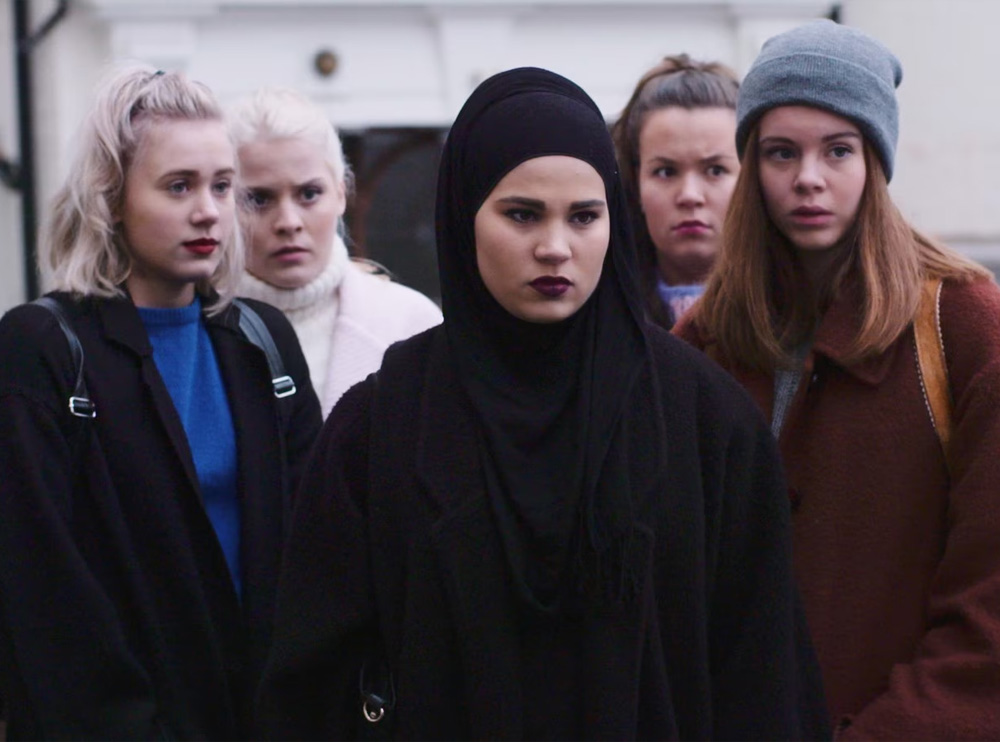
Only four of the planned nine seasons for the series, shot over two years, were produced. Indeed, many of the international adaptations outlived the run of the original show. Most recently, a Croatian team premiered their version, SRAM, in 2024. They’re currently filming the pivotal third season, which has received the most attention from fans and critics alike. The series broke new ground in its portrayal of Isak and Even’s relationship, prompting a groundswell of support from the LGBTQIA+ community. Season four focused on fan-favorite Sana (Iman Meskini), a snarky, hijab-wearing teen. Fans and critics praised the nuanced portrayal of her struggle growing up as a practicing Muslim in a secular country.
Whether you were experiencing your teen years for the first time or waxing nostalgic about what could or should have been, SKAM managed to tap into the zeitgeist and strike a chord with viewers of all ages and backgrounds.
The actors, many of whom are now in their mid-to-late twenties, have moved on from talking about the show. But in a 2017 issue of Interview Magazine, Henrik Holm, who portrayed Even in season three, was asked how it felt to be part of something that made viewers want to emulate the characters.
“SKAM has actually changed people’s lives for the better,” Holm replied. “…Julie [Andem] made a series that was possible for everyone to understand, even if you were 14 or 90 years old. That’s what I think was so special about SKAM.”
I couldn’t agree more. Happy 10th, SKAM!
Takk for alt.

About Xio’s latest book, Girls with Bad Reputations
All her life, Kayla heard the same refrain: Don’t be so loud. Don’t act so wild. Don’t take up so much space. Now she’s the beating heart of an up-and-coming rock band…and the whole world is going to know her name.